Field notes from the maple, April.
The short version: Northern Flickers ignore tube feeders and seed mixes. They want suet on a vertical log, an untreated lawn full of ants, and a large-cavity nest box on a tall trunk. Get those three right and you’ll have flickers working your yard - a striking 12-inch woodpecker that drums on metal flashing every spring and laughs across the garden like a lunatic.
What makes flickers different
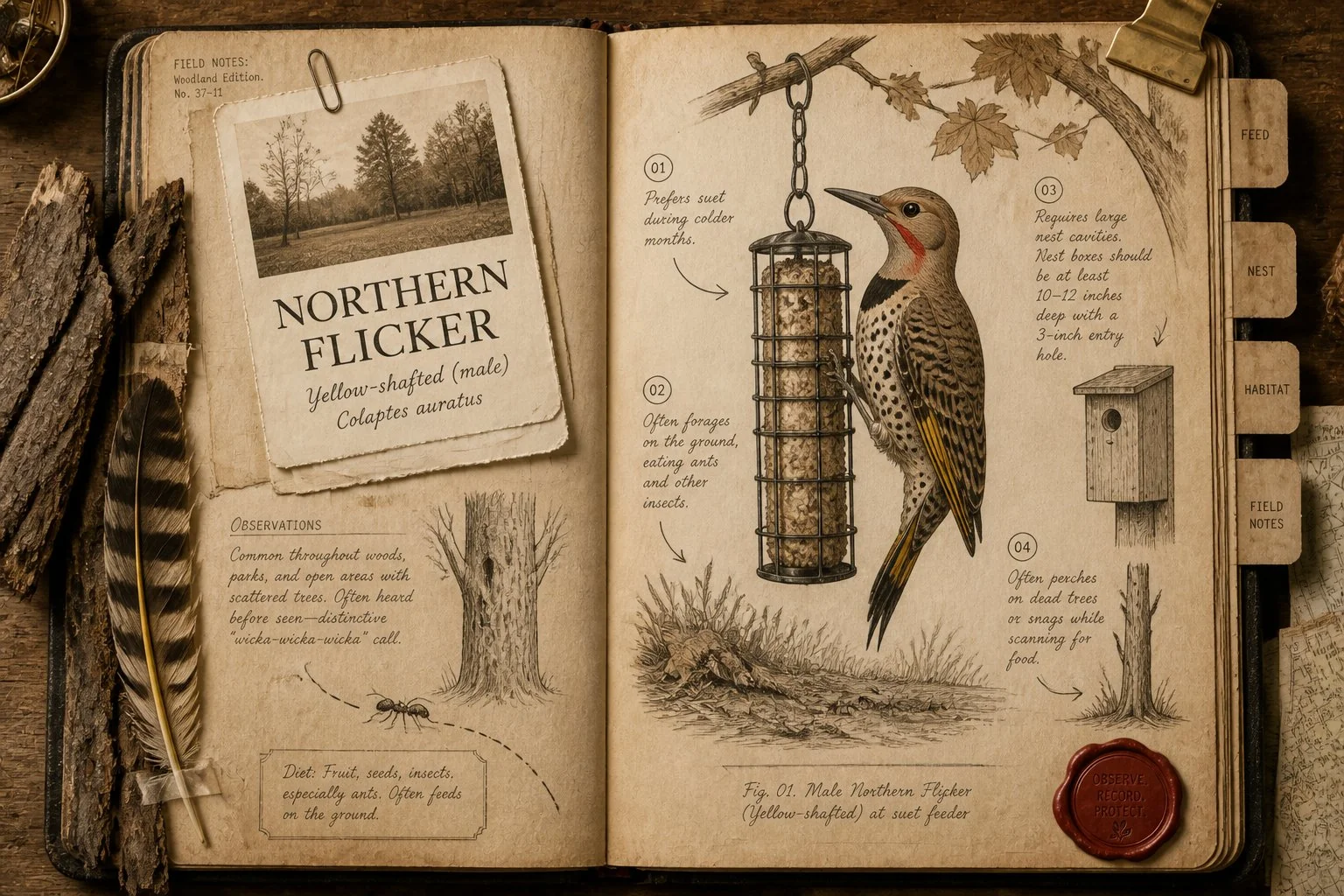
Most North American woodpeckers feed on tree trunks. Flickers don’t - or rather, they do, but only some of the time. The Northern Flicker is a ground-foraging woodpecker, and roughly half of its diet by volume is ants. A flicker will hop across a lawn the way a robin does, drilling its bill into the turf to extract carpenter ants and pavement ants by the dozen.
That changes everything about how you attract them:
- A flicker barely visits a seed feeder.
- A flicker takes suet readily - it’s the calorie supplement they want, especially in winter.
- A flicker needs a lawn or open ground area to forage ants.
- A flicker nests in a large tree cavity - they will use a nest box if it’s big enough and sited high.
Two subspecies meet in North America: the yellow-shafted (east) and red-shafted (west). Both behave the same; only the underwing colour differs. Hybrids are common through the Great Plains.

The suet log that works
The single most useful feeder for flickers is a vertical hardwood log with drilled cups for suet. Flickers cling vertically - exactly as they would on a tree trunk - and they prefer suet packed into a wood cavity over a wire suet cage. The wood gives them something to grip; the wire cage forces them onto perches they don’t naturally use.
We’ve tried both. The wood-log feeder is taken almost twice as often.
Songbird Essentials Suet Log Feeder
A hardwood log with drilled suet cups - flickers, woodpeckers and nuthatches cling and chip.
A solid hardwood log drilled with cups for suet or peanut butter. No perches - which keeps starlings and house sparrows off it. Flickers, Downy, Hairy and Pileated Woodpeckers all cling vertically the way they would on a real tree. Hangs from a chain (included).
- Solid hardwood, drilled cups, no plastic
- No perches - blocks larger non-clinging birds and most invasives
- Hangs from a chain (included)
- Takes any standard suet cake or peanut butter mix
 Songbird Essentials

As an Amazon Associate we earn from qualifying purchases. Linked products are ones we actually use.
What to pack the log with
Two options work equally well:
- Commercial high-fat suet cake, broken up and pressed into the drilled holes.
- Homemade peanut butter / suet / oat mix. Warmer in cold weather; doesn’t shatter in deep frost. The recipe is in feeding birds peanut butter - the same mix that works for chickadees works for flickers.
Skip “no-melt” suet in summer; melt-resistant cakes are usually stretched with cornmeal and grain filler. In summer most of us take suet down anyway and let the birds forage natural insect prey.
The lawn matters more than the feeder
A flicker spends most of its foraging time on the ground after ants. If your lawn is sprayed regularly with broad-spectrum insecticide, you have no ants and you’ll have no flickers. The single biggest thing you can do to attract them is stop spraying the lawn.
Tolerate the ant hills. Tolerate a slightly less perfect turf. The flickers eat enough ants in a summer to be measurable - a 1979 study counted over 5,000 ants in a single flicker’s stomach.
If you live somewhere where untreated grass is a fire-ant problem, the trade-off is different and we sympathise; in that case the suet log alone will still pull in some flickers, you’ll just see less ground-foraging.
The nest box, if you have a tall trunk
Flickers are cavity nesters. They will excavate their own hole in soft dead wood, but they readily use a nest box that meets their specs:
- Entry hole diameter: 2.5 inches. Smaller and they won’t fit; larger and Starlings out-compete them.
- Floor: 7×7 inches. They need room - they’re bigger than a Hairy Woodpecker.
- Interior depth: 16-18 inches from hole to floor. The chicks climb up to fledge; too shallow and they pop out too early.
- Mounted: 10-20 feet high, on a tall trunk or pole. Higher is safer from raccoons and squirrels.
- Filled with wood shavings to a depth of 3-4 inches. Flickers don’t bring nesting material; the chips become the nest.
A standard Stovall or Audubon flicker box meets these specs. Site it on the trunk of a tall tree or a dedicated 4×4 post with a predator baffle. For our breakdown of the squirrel-defence problem on nest boxes, see how to keep squirrels out of an owl nest box - the same baffle principle applies.
The drumming question
Spring males drum to advertise territory. Flickers, unfortunately, have learned that metal flashing, gutters, and even the side of a satellite dish make excellent drumming surfaces - much louder and more impressive than a tree. If a flicker is drumming on your house at 5:30 AM in April:
- It’s a male, advertising. He’ll do it for two to three weeks then stop.
- He’s not damaging the metal - he’s not excavating, just drumming.
- Hanging a mylar streamer near the favoured spot usually moves him.
- It’s a sign you’ve got a healthy local population. Annoying, but a good sign.
Range and timing
Yellow-shafted flickers occupy most of eastern and central North America; red-shafted hold the West. Northern populations migrate; southern populations are mostly resident. Peak activity at feeders is October through April; in summer they’re working the lawn and the suet log gets quiet.
For the broader feeder-and-cover setup that brings flickers alongside chickadees and other backyard species, see how to attract common backyard birds. For the specific seed-side of the backyard system, see what to put in a bird feeder.
The bottom line
A flicker garden is a suet log on a tree, an untreated lawn, and a tall nest box. Get those three right and you’ll see one of North America’s most under-appreciated birds working your yard - the woodpecker that doesn’t read the woodpecker rulebook.