Field notes from a season counting raptors at a Pennsylvania hawkwatch.
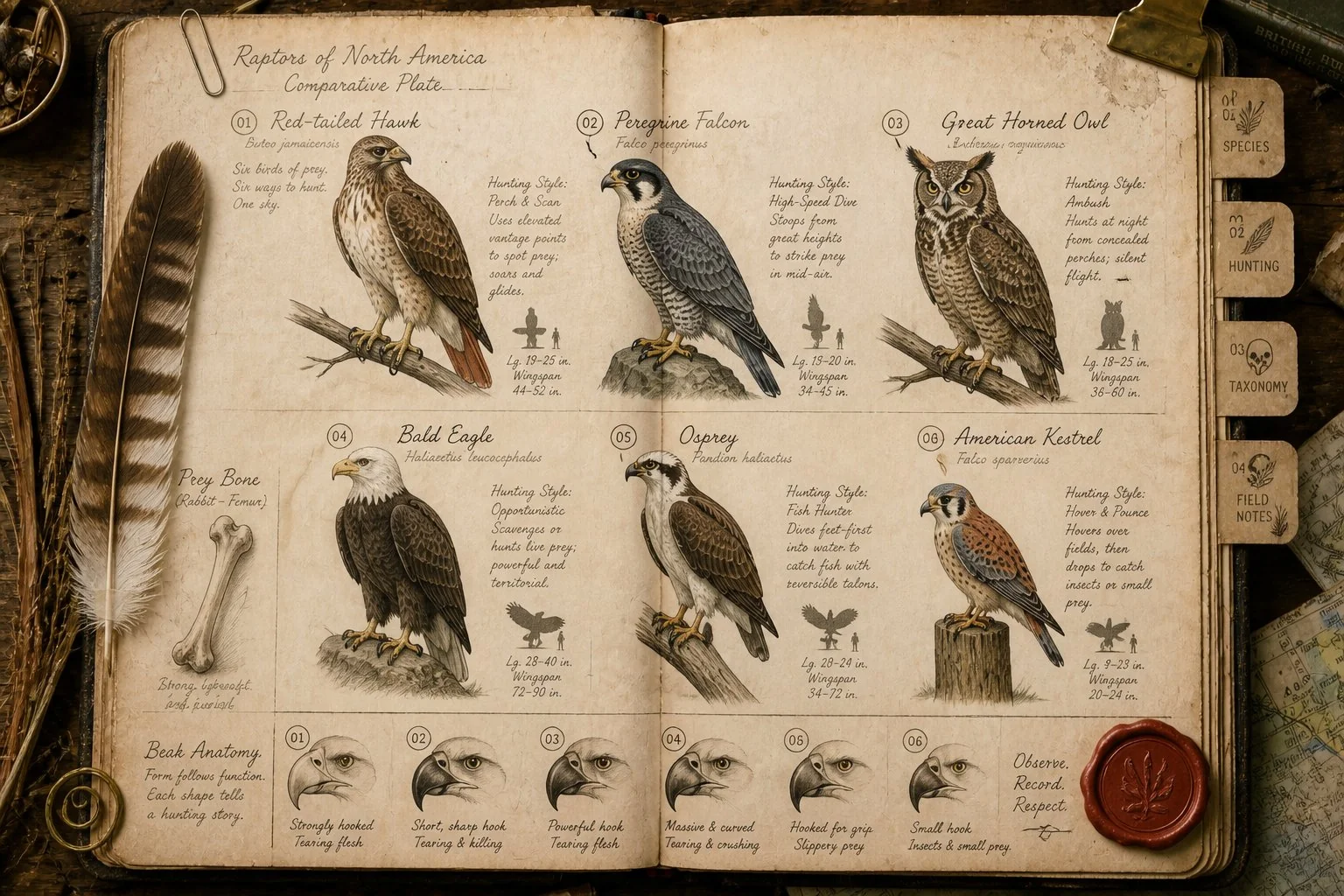
The short version: “birds of prey” is a working category covering ~50 North American species across five groups - hawks (buteos, accipiters, harriers), falcons, eagles, kites, and owls. They share three traits: hooked beaks, talons, and an obligate-carnivorous diet. The most-seen eight in North America are Red-tailed Hawk, Cooper’s Hawk, Bald Eagle, Osprey, American Kestrel, Turkey Vulture, Great Horned Owl, and Barred Owl. Learn those cold and the rest become much easier.
What counts as a bird of prey
The technical definition varies, but the working one used by most birders:
- Diurnal raptors (Order Accipitriformes + Falconiformes): hawks, eagles, kites, ospreys, falcons. ~34 species in North America.
- Owls (Order Strigiformes): nocturnal raptors. 19 species in North America.
- Vultures: technically separate (Cathartidae) but functionally grouped with raptors. 3 species in North America (Turkey, Black, California Condor).
A few books exclude vultures (they’re scavengers, not predators); most birders include them by convention. Pelicans, herons, and shrikes all eat live prey but aren’t called raptors because the anatomy doesn’t fit - they lack the curved talons.

The five working groups
Buteos (broad-winged hawks)
Large, broad-winged, soaring hawks. Hunt from a perch or by circling. The “classic” hawk shape.
- Red-tailed Hawk - most common large raptor in North America.
- Red-shouldered Hawk - wooded wetlands.
- Broad-winged Hawk - migrates in spectacular numbers in autumn.
- Swainson’s Hawk - western prairies.
- Rough-legged Hawk - arctic-breeding winter visitor.
- Ferruginous Hawk - western open country.
Accipiters (forest hawks)
Long-tailed, short-winged, fast-pursuit hunters. Specialise in songbird prey through forest.
- Cooper’s Hawk - common backyard hunter.
- Sharp-shinned Hawk - smaller cousin, mostly winter visitor in the south.
- Northern Goshawk - large, scarce, northern forests.
Falcons
Pointed wings, fast level flight, hunt by stooping or pursuing at speed. Genetically more closely related to parrots than to hawks (a recent surprise).
- American Kestrel - the smallest, hovers over fields.
- Merlin - small, fast, urban resident in many cities now.
- Peregrine Falcon - the fastest. Stoops at 240+ mph.
- Prairie Falcon - western prairie specialist.
- Gyrfalcon - largest, arctic.
Eagles
Large, heavy, often fish or carrion specialists.
- Bald Eagle - the recovery success story. Now widespread.
- Golden Eagle - mostly western mountains, scarce in east.
Kites and Osprey
Specialised diet or hunting style.
- Osprey - fish specialist; nests on poles, channel markers.
- Mississippi Kite - aerial insectivore, southeast.
- Snail Kite - Florida specialist, eats apple snails.
- Swallow-tailed Kite - graceful long-tailed insectivore.
- White-tailed Kite - hovers over grassland, west coast.
Vultures
Soaring scavengers.
- Turkey Vulture - common, all-dark, holds wings in dihedral, smells out carrion.
- Black Vulture - black with white wingtips, soars on flat wings, sight-hunts.
- California Condor - critically endangered, captive-breeding recovery.
Owls
Nocturnal raptors. See owl eyes for the night-vision biology that defines this group, and are owls dangerous for the human-interaction question.
- Great Horned Owl - most widespread, common.
- Barred Owl - eastern forest.
- Barn Owl - worldwide, mostly grassland and agricultural.
- Eastern and Western Screech-Owls - small, cavity nesters.
- Northern Saw-whet Owl - small, scarce, dense conifer.
- Snowy Owl - arctic, irruptive winter visitor.
- Burrowing Owl - ground-nesting western owl.
- … and a dozen others including pygmy, elf, long-eared, short-eared, spotted, great grey.
For nest-box specifics on owls, see barn owl nesting and when to put up an owl box.
How to tell them apart in flight
Most field ID happens at distance with the bird in flight. The reliable cues:
Shape silhouette:
- Long broad wings, short tail = buteo.
- Long narrow wings, long tail = accipiter.
- Pointed swept wings = falcon.
- Massive heavy bird = eagle.
- M-shape silhouette = osprey.
- Wing dihedral (held in shallow V) = Turkey Vulture or harrier.
- Flat wings, rocking flight = Black Vulture.
Flight behaviour:
- Soaring in circles = buteos, eagles, vultures.
- Fast level pursuit through trees = accipiters.
- Hovering over open ground = American Kestrel, White-tailed Kite, Rough-legged Hawk.
- Stooping from height = Peregrine, Golden Eagle.
- Flushing prey by flying low = harrier.
Tail bands:
- Equal-width banded tail = accipiter.
- Single broad terminal band = many buteos.
- Plain rust-red tail = Red-tailed Hawk adult.
The classic beginner’s mistake: calling every soaring bird a Red-tailed Hawk. The classic intermediate mistake: missing Turkey Vultures because their silhouette looks “like a hawk” at distance. The dihedral and rocking tells you it’s a vulture.
The eight you'll see most
If you live anywhere in North America, these eight species account for ~80% of all raptor sightings:
- Red-tailed Hawk - everywhere.
- Cooper’s Hawk - backyards, suburbs.
- Bald Eagle - water bodies (now widespread).
- Osprey - water bodies, March-October.
- American Kestrel - farmland, declining.
- Turkey Vulture - everywhere.
- Great Horned Owl - heard more than seen, suburb to wilderness.
- Barred Owl - eastern forest.
For your specific state, see the state-by-state breakdowns - we have Virginia done in detail.
The field guide for serious birders
The single most useful book for raptor ID is the National Audubon Society guide, which covers both diurnal raptors and owls in one volume with multiple plumages per species.
National Audubon Society Birds of North America
The single best reference for raptor ID across both diurnal and nocturnal species.
800 species in one hardcover, photographed, with range maps and natural history. Raptor coverage is detailed - flight silhouettes, multiple plumages, voice descriptions, prey species. Covers both diurnal raptors (hawks, eagles, falcons, kites, vultures) and owls in one book - few guides do.
- All 800 North American species, photographed
- Multiple plumages per raptor (adult, immature, light morph, dark morph)
- Range maps current to the 2020 ABA classification
- Voice descriptions essential for owl ID
 Audubon · 800 species

As an Amazon Associate we earn from qualifying purchases. Linked products are ones we actually use.
The crow-mobbing observation
If you’re trying to find a raptor in your area, watch the crows. Crows mob hawks, eagles, owls and vultures more visibly than any other behaviour - if you see a tight knot of crows scolding from a tree, there’s a raptor in or near that tree. The full case is at why crows attack hawks.
The bottom line
Birds of prey are the easiest large-bird category to learn well because there aren’t that many of them and the shape cues are reliable. Start with the eight common species, learn their silhouettes in flight, and you’ll find that the rest of the local raptor fauna falls into place over a season. A good field guide and a pair of 8x42 binoculars is the whole kit.