Field notes from a winter visit to Strangford Lough where a Light-bellied Brant flock had just touched down from arctic Canada.
Updated: 2026-05-20.
The short version: when someone says “I saw an all-black goose,” they almost always mean a Brant (Branta bernicla) - a small dark coastal goose of arctic origin. Brant are smaller than Canada Geese, have stubby black bills, white neck collars, and saltwater habits. Other candidates: a melanistic Canada Goose (rare), a domestic Chinese variant (white knob on bill), a Cackling Goose (smaller cousin of Canada), or - in some Western US contexts - a “Black Brant” subspecies. Bill shape and habitat decide which one.
The most likely answer: Brant
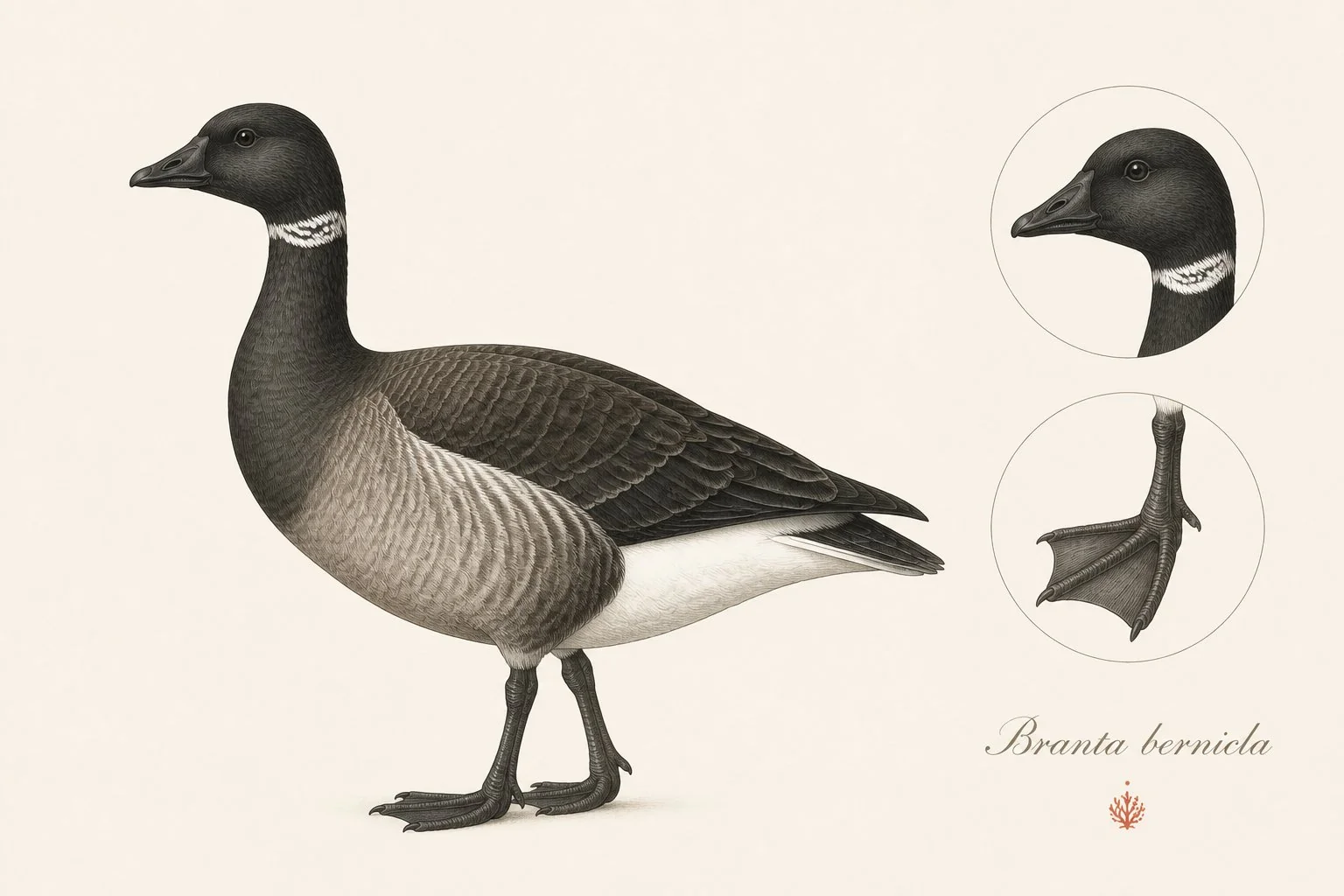
The Brant (Branta bernicla) is North America’s small dark saltwater goose. According to Cornell Lab All About Birds, Brant are 55-66 cm long with a wingspan of 106-121 cm - much smaller than the Canada Geese most people are familiar with.
Identification features:
- All-black head, neck, and breast with a small white patch on each side of the neck (sometimes called a “necklace”).
- Stubby black bill - much shorter than a Canada Goose’s.
- Brown back and wings.
- White undertail that’s strikingly visible when the bird tips up to feed.
- Saltwater habits - estuaries, bays, salt marshes, eelgrass beds. Almost never on inland fields the way Canada Geese are.
The US Fish & Wildlife Service Brant species page notes that Brant are obligate eelgrass and seagrass feeders - so the saltwater context isn’t just preference, it’s diet-driven.
The Brant subspecies
Three subspecies, each appearing in different parts of North America and Europe:
- Pale-bellied Brant / Light-bellied Brent (Branta bernicla hrota) - eastern North America and arctic Canada/Greenland breeding, winters along the US East Coast and Ireland. Light-coloured flanks.
- Black Brant (Branta bernicla nigricans) - Pacific North America. Much darker, with extensive white neck collar. Breeds in coastal arctic Alaska/Russia, winters along Pacific coast from Alaska to Mexico.
- Dark-bellied Brent (Branta bernicla bernicla) - eastern Atlantic. Breeds in arctic Russia, winters in NW Europe. Uniformly dark.
The “Black Brant” subspecies is the one that most matches the search for “black goose” - it’s noticeably darker than the others.
How to tell Brant from confusing alternatives
Brant vs. Canada Goose
- Size: Brant is smaller. Canada Goose is 76-110 cm; Brant is 55-66 cm.
- Bill: Brant has a short stubby black bill. Canada has a longer, slightly hooked black bill.
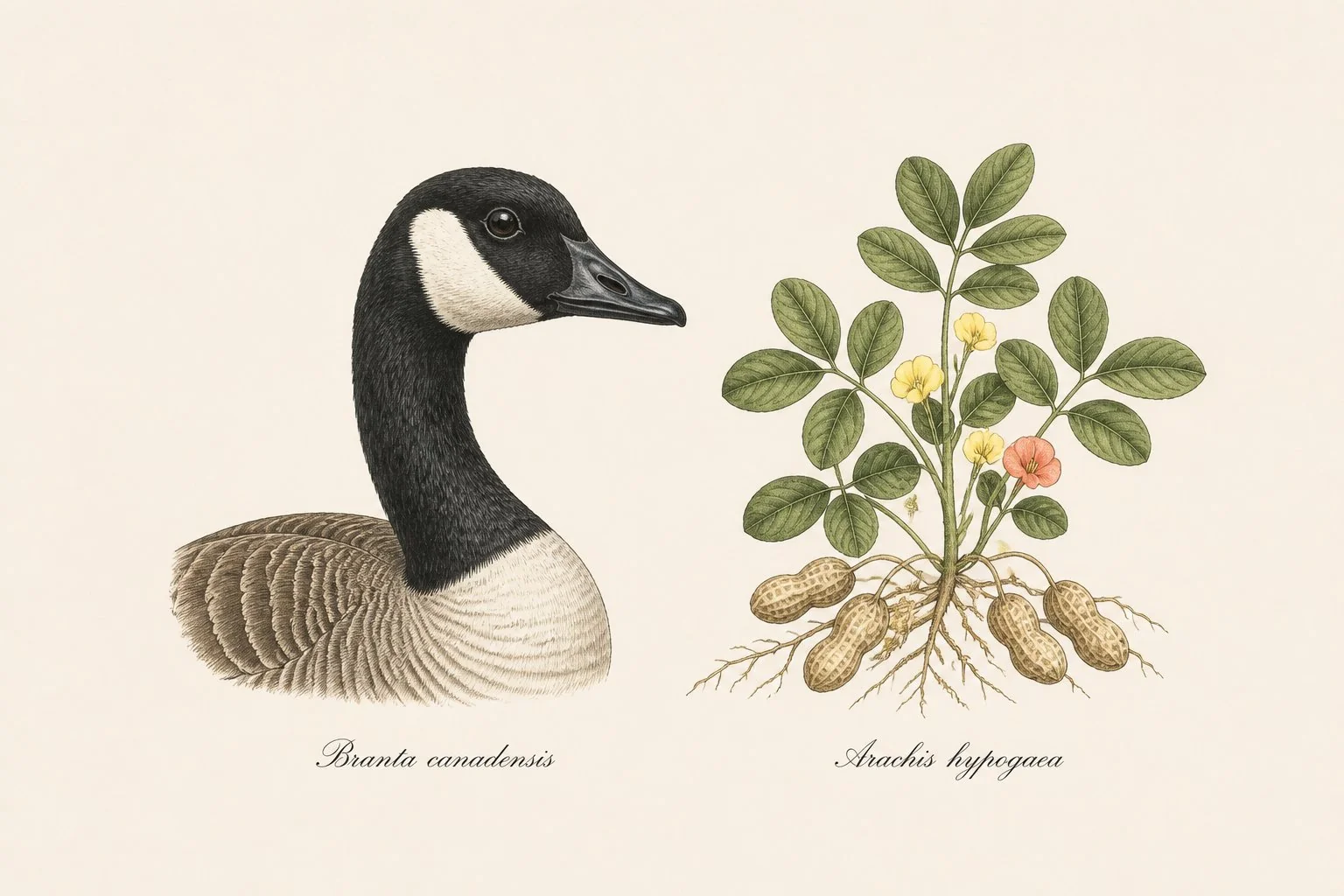
- Neck pattern: Brant has a small white “necklace” on the dark neck. Canada has a sharply-defined white chinstrap that wraps under the throat.
- Habitat: Brant on salt water; Canada on inland fields and freshwater.
Brant vs. Cackling Goose
- Cackling Goose (Branta hutchinsii) is a small cousin of the Canada Goose - looks like a Canada but smaller, with a stubbier bill.
- The Cackling has the white chinstrap (like Canada), Brant has the white neck necklace.
Brant vs. melanistic Canada Goose
- Melanistic (all-dark) Canada Geese exist but are very rare.
- Still has Canada-shaped bill and overall size.
Brant vs. domestic Chinese Goose
- The Chinese Goose (Anser cygnoides domesticus) can be brown or grey but has a prominent black knob on the upper bill - the obvious tell.
- Almost always seen at urban park ponds and farms, never on salt water.
Brant vs. Greater White-fronted Goose
- White-fronted (Anser albifrons) has an orange-pink bill, white forehead patch, and barred belly. Not all-black.
Brant vs. Snow Goose (blue morph)
- Blue-morph Snow Geese have a white head and dark body. Not the right pattern.
Where to find Brant
Atlantic Coast (Light-bellied):
- Chesapeake Bay, especially in winter.
- Long Island and New Jersey coastal lagoons.
- Strangford Lough, Northern Ireland - a key European wintering site.
Pacific Coast (Black Brant):
- Padilla Bay and Willapa Bay, Washington.
- Humboldt Bay, California.
- Izembek Lagoon, Alaska - the staging site where most Pacific Black Brant gather before migration.
European populations:
- Foulness, Essex (UK) - major Dark-bellied wintering site.
- The Wadden Sea (Netherlands/Germany/Denmark).
Inland Brant are rare. If your “black goose” is on a farm pond or city park, it almost certainly isn’t a Brant.
The other Branta species
For the wider “black-feathered goose” cluster, see north american geese and north america swans for the broader Branta and Cygnus genera. Other dark members:
- Hawaiian Goose / Nene (Branta sandvicensis) - mostly buff with dark face and neck.
- Barnacle Goose (Branta leucopsis) - black neck, white face. Distinctive.
- Cackling Goose (Branta hutchinsii) - same pattern as Canada but smaller.
Conservation
Brant populations are stable to slightly increasing in most flyways. BirdLife DataZone’s species factsheet classifies the global Brant as Least Concern.
The species is dependent on eelgrass beds - and eelgrass has declined catastrophically in many estuaries since the 20th century. Brant numbers crashed in the 1930s when eelgrass “wasting disease” devastated Atlantic eelgrass beds. The population recovered as eelgrass did. The species remains a useful indicator of estuarine health.
The book worth owning
For identification of Brant alongside the other dark and unfamiliar geese, the Sibley East and Sibley West guides cover both subspecies regions.
National Audubon Society Birds of North America
The reference covering all Branta species side by side.
800 species in one hardcover. Includes Brant (both Light-bellied and Black Brant subspecies), Canada, Cackling, Barnacle and the rest of the Branta genus side by side with bill detail close-ups - exactly what you need when trying to ID an unfamiliar dark goose. Voice descriptions, range maps, conservation status.
- All 800 North American species photographed
- All Branta species with bill and head detail
- Range maps current to ABA 2020 classification
- Hardcover, sized for a reference shelf
 Audubon · 800 species

As an Amazon Associate we earn from qualifying purchases. Linked products are ones we actually use.
The bottom line
An “all-black goose” in North America is, almost certainly, a Brant. Small, coastal, eelgrass-eating, with a stubby black bill and a small white neck necklace. The Black Brant subspecies is the darkest version, the Atlantic Light-bellied the palest. If the bird is inland on a freshwater pond, look again - it’s probably a Canada Goose, Cackling Goose, or a domestic variant rather than a true Brant.
Sources
- Cornell Lab All About Birds: Brant Identification
- US Fish & Wildlife Service: Brant Goose
- BirdLife DataZone: Brent Goose Branta bernicla species factsheet
- Audubon Field Guide: Brant
- Wikipedia: Brant (goose)