Field notes from the strange case of the hen Mallard who came into eclipse plumage and never went back.
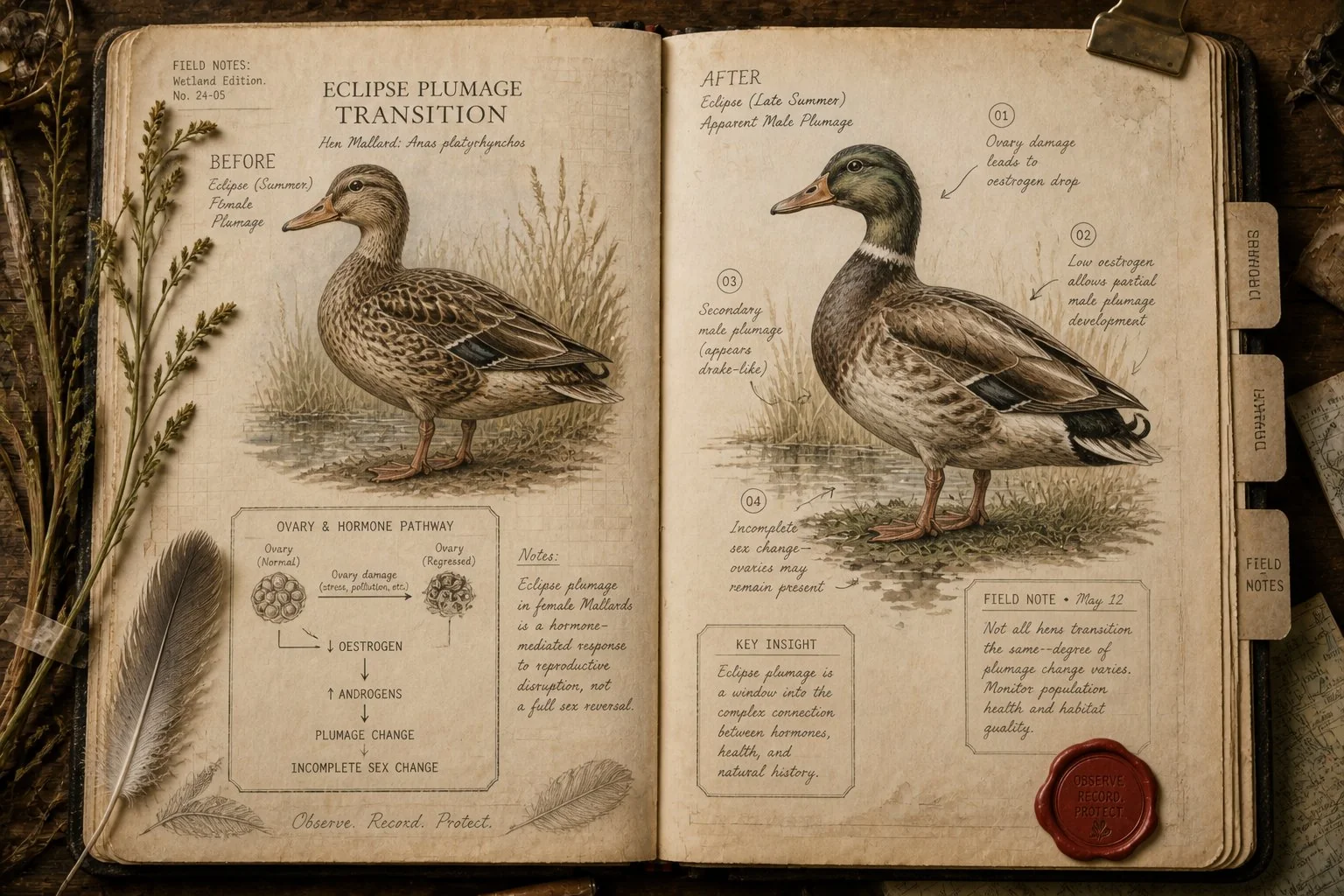
The short version: yes, female ducks can develop male plumage and behaviour. The mechanism is real - female ducks have only one functional ovary (the left one), and when it’s damaged by injury, disease or old age, oestrogen production drops sharply. Without oestrogen suppressing it, the dormant right “ovotestis” can become active and produce androgens, which trigger male plumage on the next moult. The bird is still genetically female. She often becomes infertile and stops laying. Males changing to female is far rarer and not well-documented.
The anatomy that makes it possible
Female ducks have an unusual reproductive setup. During embryonic development, both ovaries form, but only the left one matures into a functional reproductive organ. The right side remains as a small undifferentiated mass called an “ovotestis” - capable in theory of producing either male or female hormones, but suppressed by the left ovary’s oestrogen output throughout the bird’s life.
The implication: if the left ovary fails, the oestrogen suppression disappears, and the ovotestis can switch on. When it switches on, it tends to produce androgens (testosterone-like hormones), not oestrogen. Those androgens drive male plumage development at the next moult.
The bird is genetically female - her DNA hasn’t changed. She’s visually and hormonally male.

What causes the ovary to fail
Three main causes:
1. Disease. Ovarian cysts, tumours, infections (egg yolk peritonitis is common in heavy-laying hens). The ovary stops producing eggs and oestrogen.
2. Age. Older hens (typically 5+ years) experience natural ovarian decline. The transition is gradual rather than sudden.
3. Injury or surgical removal. Trauma to the abdomen, or veterinary intervention. Some captive female ducks who’ve had ovarian surgery for tumours come through with classic male plumage.
A short-term hormonal blip (a season of poor laying, for example) usually doesn’t trigger the change. The ovary has to be fundamentally non-functional for long enough that the ovotestis can take over.
What the transition looks like
For a hen Mallard, the typical pattern:
- Stops laying. The first sign. Usually months before any plumage change.
- Becomes assertive. Behavioural change toward dominance over other hens.
- Next moult shows partial change. Some male plumage - the green head feathers of a drake Mallard - appears alongside hen plumage.
- Subsequent moults complete the change. Within 1-2 moult cycles, the bird looks like a drake.
The transition is usually permanent if the underlying ovary problem is permanent.
Many birds don’t complete the change - they stop midway, presenting as “mixed plumage” hens with patches of male colour. These are sometimes mistaken for hybrids or genetic anomalies but are usually old hens with declining ovaries.
The Mallard case people most often see
The bird the question is most often asked about is a Mallard. Hen Mallards are brown speckled; drakes have a green head, white collar, brown breast, grey body. A hen transitioning to male plumage is striking - the head greens up first, then the white collar, then the body grey.
This is the classic backyard “I think my duck changed sex” observation. The owner had a brown speckled hen for three years; she stopped laying last spring; she came back from autumn moult with a green head. She’s genetically the same bird; her ovary has failed.
For the broader duck identification and the visible cues, see what are baby ducks called for sex differentiation in juveniles. A good field guide is also useful for sorting genuine drakes from changed-plumage hens.
Sibley Field Guide to Birds of Eastern North America
The field guide with the plumage plates that show eclipse, breeding and juvenile side by side.
David Sibley's Eastern guide includes side-by-side plates for male breeding, male eclipse, female and juvenile plumages for every duck species. Indispensable when trying to distinguish a normal eclipse drake from a hen with failed-ovary plumage or a genuine first-year drake.
- All Eastern North American species, including waterfowl
- Multiple plumages per species - breeding, eclipse, juvenile, female
- Range maps and behaviour notes
- Pocket-sized softcover - genuinely portable
 Sibley · Eastern

As an Amazon Associate we earn from qualifying purchases. Linked products are ones we actually use.
Does she still lay or fertilise?
A hen who has converted to male plumage is functionally infertile in both directions:
- She doesn’t lay - the ovary has failed.
- She can’t fertilise - she has no testes, only the small ovotestis producing androgens. No sperm.
She may attempt male mating behaviour (mounting other hens) but it’s purely behavioural. The clutch sired by a converted hen doesn’t exist; she’s not actually a reproductive male.
A converted hen also tends to be less aggressive than a true breeding drake - the androgen levels are partial, not full male.
Other waterfowl species
Documented in Mallards, Pekin ducks, Khaki Campbells, Muscovies, and some wild Mallard hybrids. Also in chickens (where it’s well-studied - “spontaneous sex reversal” in old hens is a recognised veterinary phenomenon), pheasants, and some songbirds.
Less documented in swans and geese, but probably happens at similar rates - the same ovotestis anatomy applies across all birds.
The reverse - drakes becoming hens
Far rarer and less documented. Drake ducks have two functional testes, no equivalent ovotestis structure on either side. For a drake to develop hen plumage, testosterone production would need to crash AND oestrogen production would need to start from a tissue that doesn’t normally make it.
There are scattered reports of drakes with patchy hen-like plumage after castration or testicular damage, but full feminisation is uncommon.
If your hen is changing
For backyard duck-keepers who notice a hen converting, the welfare implications:
- The bird is usually nearing the end of her life. Ovarian failure is rarely an isolated condition; cancer, peritonitis or age-related decline drive most cases.
- A veterinary check is worth doing if you can find an avian vet. Sometimes the underlying cause is treatable.
- She’ll often live another 1-3 years in the converted state, depending on the cause.
- Other birds may treat her differently. Drakes may try to mate with her early in the transition; hens may submit to her later. The flock dynamic can shift.
For the broader case on keeping ducks and the welfare of older flocks, see are ducks a good pet.
The bottom line
Yes, hen ducks can change to male plumage, and the mechanism is documented and well-understood. The ovary fails, the dormant ovotestis switches on, androgens trigger male feathers. She’s still genetically female, she’s infertile, and the change is usually permanent. It’s a quiet, fascinating bit of duck biology that mostly shows up in older backyard hens whose owners notice their familiar brown bird turning green at the head.