Pintails overhead at 60 mph in November. Couldn't follow with the binoculars.
Almost all wild duck species fly, and they fly well. Typical cruising speeds run 40-60 mph; migration flights can cover several hundred miles in a single day. The exceptions are mostly domestic: Pekin, Khaki Campbell, Welsh Harlequin, Indian Runner, and Muscovy Duck (the heavy farmyard breeds) have been selectively bred for body weight and can’t fly more than short awkward hops. Their wild ancestors fly fine. Three flightless duck species exist in nature (all on remote islands) but you’re unlikely to see them.
What "can fly" actually looks like in ducks
Most wild dabbling and diving ducks:
- Take off - from water with a running splash in 2-5 metres; from land with a hopping push.
- Cruise speed - 40-50 mph for dabblers, 50-65 mph for divers (heavier bodies, faster wing beats).
- Top speed - peak migration speeds of 65-70 mph have been recorded for Mallards and Pintails using tailwinds.
- Altitude - typically 200-2,000 feet for short flights; 3,000-5,000 feet for migration; rare records above 20,000 feet for Mallards crossing mountain ranges.
- Daily distance - 200-500 miles per migration day is typical; 700+ miles possible with following winds.
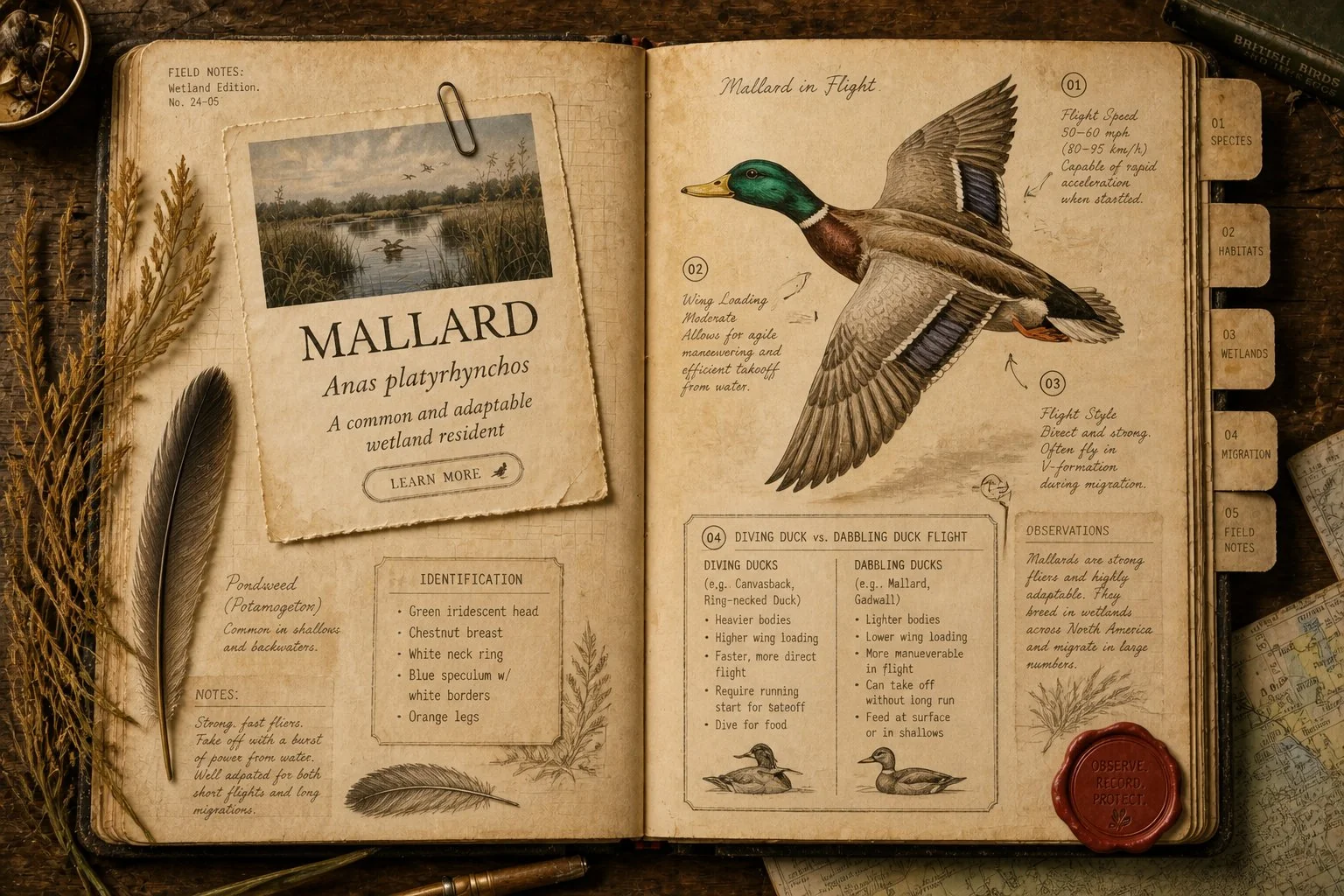
Mallards and Pintails have been clocked at sustained 50 mph cruising. Canvasbacks, with their long pointed wings, are the fastest American ducks at around 70 mph in level flight.
Ducks that genuinely can't fly
Three categories:
- Domestic breeds bred for weight - Pekin, Aylesbury, Rouen, and large Muscovy crosses. Selected over centuries for body mass, they can hop and flutter but not sustained flight.
- Light-domestic breeds that can fly but rarely do - Khaki Campbell, Welsh Harlequin, Indian Runner. Physically capable, behaviourally rare.
- Wild flightless species - three species on isolated islands: the Auckland Teal (NZ subantarctic), Campbell Teal (NZ subantarctic), and Brown Teal (NZ mainland). Evolved flightlessness due to absence of mammalian predators.
The Steamer Ducks of southern South America (genus Tachyeres) include both flying and flightless species in the same genus - a textbook example of evolved flightlessness in waterfowl.
Why ducks fly so well
Three adaptations:
- Wing loading - ducks have relatively small wings for their body weight, requiring fast wing beats (8-12 per second). They trade efficiency for speed and power.
- Powerful breast muscles - the pectoralis muscle is huge in ducks, providing the fast contractions needed for sustained flight.
- Flight feathers - moulted and replaced annually in a single concentrated event. During the moult (typically late summer), most species are temporarily flightless for 3-4 weeks.
The annual moult is when even the wild fliers can’t fly. Birds gather in dense reedy cover during this period for safety.
The simultaneous wing moult
Unlike most birds (which replace flight feathers a few at a time over months), waterfowl replace all primary feathers at once. Pros: a clean new wing set, faster replacement. Cons: the bird is genuinely flightless for 3-4 weeks. Drakes typically moult in late June through August; hens later, after the brood is independent.
This is why you see strange-looking “eclipse plumage” ducks in late summer - drakes in brown camouflage feathers, flightless, hiding in marshes.
Migration distances
Some impressive duck migration records:
- Northern Pintail - Arctic Alaska to South America. 6,000+ miles round trip.
- Blue-winged Teal - prairie Canada to South America. 7,000 miles round trip.
- Long-tailed Duck - Arctic to mid-latitude coasts, but routinely crosses 1,000+ miles of open ocean.
- Common Eider - mostly short coastal hops but can do 1,500 miles between summer and winter ranges.
- Mallard - more variable; some populations migrate 1,500+ miles, others are essentially resident.
What about take-off from land vs water?
Dabbling ducks can take off from both land and water with similar ease - their lighter bodies and longer wings allow vertical-ish lift-off. Diving ducks (Canvasback, scaup, goldeneye) need a long running take-off across water and can barely lift off from dry land. That’s why you see diving ducks loafing on water rather than walking around on shore.
Sibley Field Guide East
Flight ID by wing shape and speed.
Identifying ducks in flight is its own skill - they pass at speed, often at distance, and the field marks are wing shape, body proportions, and underbelly colour. Sibley shows duck species in-flight from below, which is what you actually see when a flock passes overhead.
- Covers 650+ species of eastern North America
- In-flight illustrations for every duck species
- Pocket-friendly format for field use
 Sibley · 2nd Ed.

As an Amazon Associate we earn from qualifying purchases.
The bottom line
Wild ducks fly fast (40-65 mph cruise) and far (200-500 miles per migration day). Domestic Pekin, Rouen, and Muscovy crosses can’t fly because they were bred for body weight. Three island species are naturally flightless. The annual simultaneous wing moult makes even good fliers temporarily grounded for 3-4 weeks each summer.
For more, see how far can geese fly and cold-hardy duck breeds.