Bill, not beak. By convention, not anatomy.
Ducks have bills. The words “beak” and “bill” describe the same anatomical structure - the keratin-sheathed jaws that all birds have instead of teeth. Ornithologists use “bill” for ducks because of the flat, broad, lamellated shape, while “beak” tends to describe the pointed, hooked, or chisel shape of raptors, songbirds, and woodpeckers. There is no scientific difference. Both words are correct. The duck mouthpart itself is one of the most specialised feeding tools in the bird world.
Why ornithologists say "bill" for ducks
By convention, “bill” is the preferred term for any bird with a flat, broad mouthpart adapted for filtering, dabbling, or grasping wet food. That includes:
- All ducks, geese, and swans
- Spoonbills
- Pelicans
- Flamingos
“Beak” is preferred for birds with a more pointed or hooked mouthpart adapted for tearing, cracking, or chiselling:
- Hawks, falcons, eagles, owls
- Songbirds
- Woodpeckers
- Parrots
Field guides use both interchangeably. Birders use “bill” almost exclusively for waterfowl.
What the duck bill is built to do
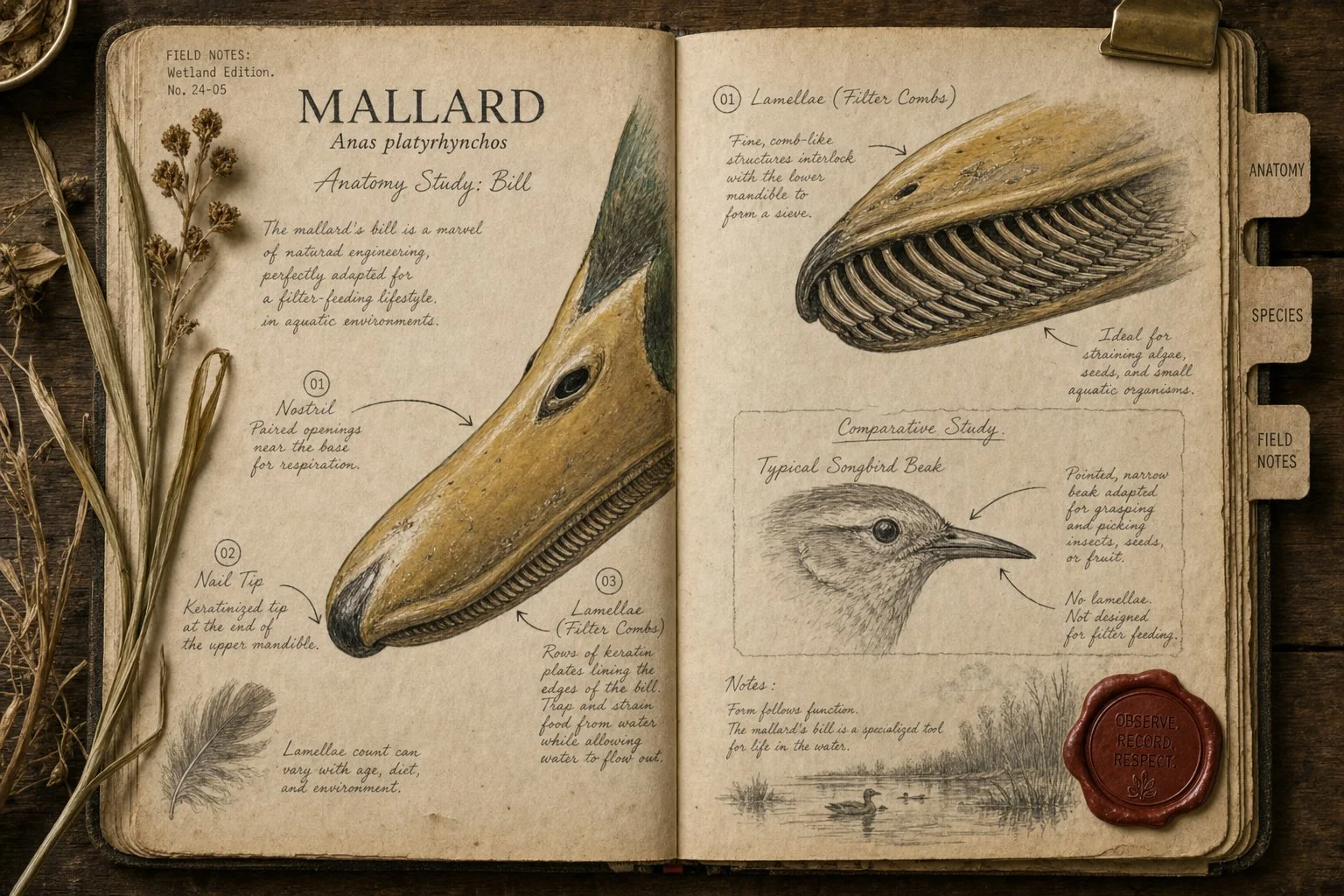
A mallard’s bill has four functional features that a songbird beak doesn’t:
- Lamellae - comb-like ridges along the inside edges of the upper and lower mandibles. Used to filter food particles out of mud and water.
- Nail (dertrum) - a hardened tip at the end of the upper mandible for nipping plants, prying open shells, and grabbing slippery prey.
- Wide, flat shape - maximises the area for sifting water on each scoop.
- Highly sensitive nerves - the bill is densely innervated. Ducks can “feel” prey in muddy water without seeing it.
Diving ducks (like Canvasbacks) have stronger bills with smaller lamellae. Filter-feeders (like Northern Shovelers) have huge, oversized bills with dense lamellae for skimming the surface.
How a duck eats with its bill
A typical dabbling sequence:
- Submerge the bill while paddling.
- Open and close the mandibles rapidly, drawing water and mud in through the front.
- Pump the tongue, expelling water out the sides.
- The lamellae trap seeds, larvae, and small invertebrates.
- Swallow the retained food.
This whole sequence takes about a second. A feeding mallard can do it 100+ times a minute when the food is good.
Bill colour by species and season
Bill colour is one of the easiest species and sex markers in waterfowl:
- Mallard drake - bright yellow-olive in breeding plumage; greenish-grey in eclipse.
- Mallard hen - orange with dark blotches year-round.
- Northern Shoveler - oversized, dark, with no clear seasonal change.
- Wood Duck drake - white, red, and yellow stripes.
- Pintail - blue-grey with black ridge.
If you can see the bill clearly, you usually have a confident ID before the rest of the body is visible.
Sibley Field Guide East
Bill detail in every plate.
Sibley's bill paintings are accurate enough that you can identify most species by bill colour and shape alone. The 2nd edition adds eclipse plumage colours, which is what trips most people up in late summer when drakes go drab.
- Covers 650+ species of eastern North America
- Multiple plumage states per species
- Pocket-friendly format for field use
 Sibley · 2nd Ed.

As an Amazon Associate we earn from qualifying purchases.
The bottom line
Bill and beak are the same structure. Ducks have bills by convention because the mouthpart is flat, broad, and lamellated. It’s one of the most specialised feeding tools in any bird group, and bill colour and shape are the fastest way to identify a duck species.
For more, see duck anatomy and mallard diet.