Field notes from a banded Mute Swan pair at a country reservoir that have been together for nine breeding seasons.
Updated: 2026-05-20.
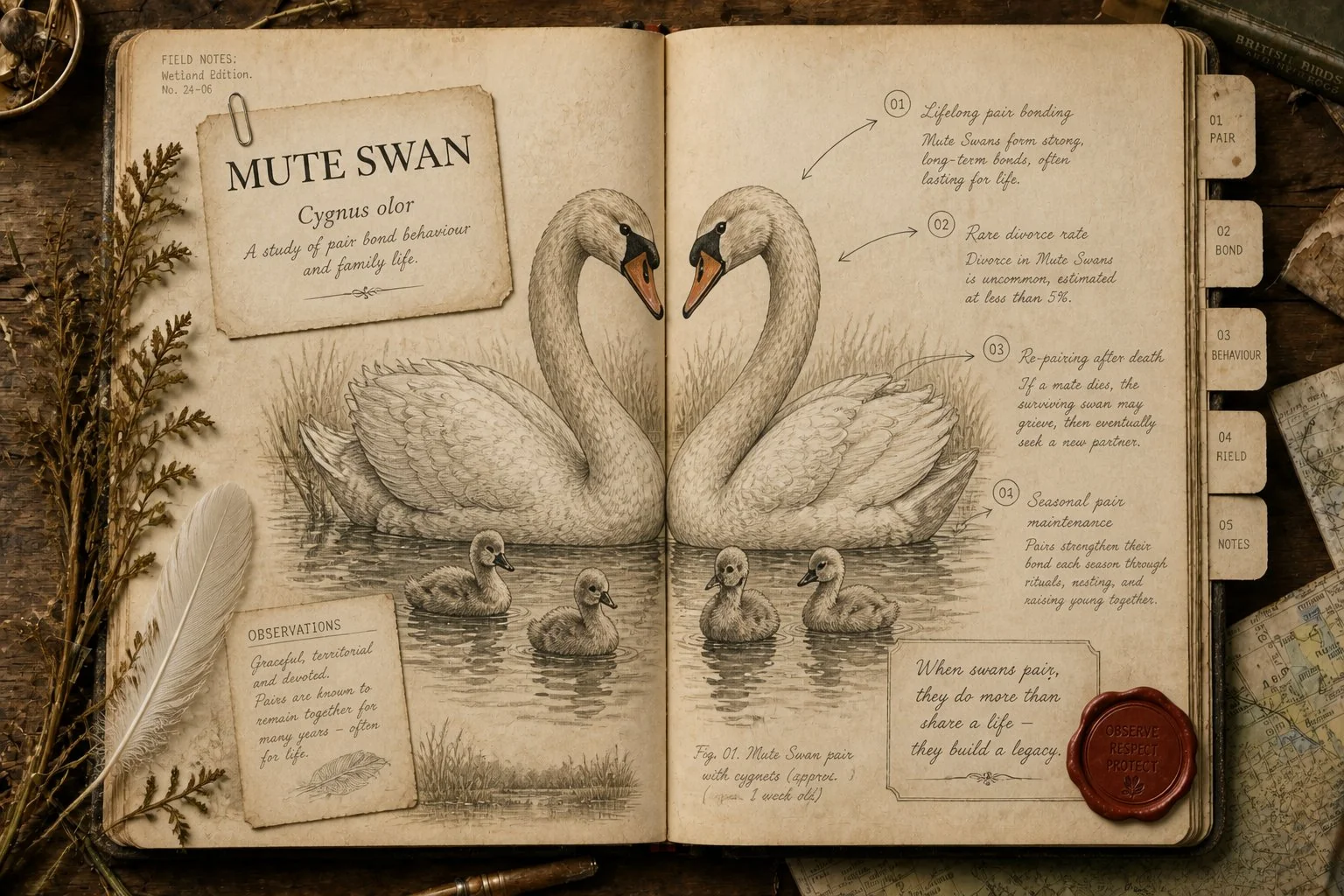
The short version: yes, swans pair for life - mostly. The famous “swans mate forever” folklore is roughly right. Pairs typically stay together for many breeding seasons, often a decade or more. But about 6-9% of Mute Swan pairs ‘divorce’ each year (the documented rate from banded population studies), and bereaved swans often re-pair within 1-2 years rather than remaining solitary. The romance is real; the absolute “one mate forever” version is a slight exaggeration.
The biology of swan pair-bonding
Mute Swans (and the other Cygnus species) are among the most consistently monogamous waterfowl. According to Cornell Lab All About Birds, Mute Swan pairs typically form during the bird’s second to fourth year, and most remain bonded for life.
The pair-bond serves practical functions:
- Joint territory defence. A pair holds breeding territory better than a solo bird.
- Shared incubation. The female (pen) does most of the sitting, but the male (cob) takes over occasionally and guards the nest.
- Cygnet protection. Both parents defend cygnets aggressively for the first 4-5 months.
- Year-round support. The pair stays together through winter, providing mutual vigilance and warmth.
The bond is reinforced by frequent “triumph ceremonies” - synchronised neck-raising, calling, and head-bobbing displays that pairs perform together after threats or during reunions.
The divorce rate
Long-term banding studies have documented that “lifelong” isn’t quite absolute. The BTO’s BirdFacts page on Mute Swans covers the pair-bond stability research.
The general pattern from studies of banded Mute Swan populations:
- Divorce rate: approximately 6-9% per year of established pairs.
- Reasons for divorce: typically failed breeding seasons. After multiple unsuccessful nesting attempts, one or both birds may abandon the partnership.
- Re-pairing after divorce: typical within one breeding season.
Black Swans (Cygnus atratus) show similar patterns but with higher rates of extra-pair copulation - they’re “socially monogamous” but genetic studies show that about 1 in 6 cygnets has a father other than the pen’s social partner. Other species (Trumpeter, Tundra) appear to have lower divorce rates than Mute Swans in studied populations.
So “lifelong” is broadly true at the population level but with measurable exceptions at the individual level.
What happens when a mate dies
Death of a mate triggers a documented grief response - covered in detail at do swans kill themselves. The key points:
- Most bereaved swans show clear mourning behaviour for weeks to months.
- Older or weakened birds may decline and die from grief-related stress.
- Most healthy bereaved swans eventually re-pair, typically within 1-2 years.
- The new pair bond usually functions well and can last many seasons.
This is a key correction to the absolute “one mate forever” story. A bereaved swan who lives to find a new partner usually does pair again. The original mate is replaced - they don’t remain solitary as romantic legend suggests.
When pair-bonds form
The pair-formation timeline:
- Cygnet to 1 year: stays with parents.
- Year 1-2: disperses to non-breeding flocks of immature birds.
- Year 2-4: pair formation typically begins. Males display, females choose.
- Year 3-5: first breeding attempt.
- Year 5+: if successful, the pair is established and stays together for many seasons.
Pair formation often happens in non-breeding winter flocks - young birds court while gathered together, then split off as pairs in spring to claim territory.
For the species variation across North America, see north america swans.
The behaviour that maintains the bond
Once pair-bonded, swans maintain the bond through specific repeated behaviours:
- Mutual preening - especially around the head and neck.
- Synchronised feeding - upending and grazing together.
- Triumph ceremonies - the synchronised head-bobbing and calling after a threat or reunion.
- Joint nest-building - both birds collect material and arrange the nest.
- Vocal contact calls that maintain proximity awareness.
These behaviours strengthen across years. A long-paired swan recognises its mate’s voice from across a lake.
The famous "heart" display
The classic image of two swans facing each other with necks curved into a heart shape is real and is part of the courtship and bond-maintenance repertoire. It’s not just a Valentine’s Day cliche - swans actually do this. The neck-arching display is called a “triumph ceremony” or “greeting display” and serves both bond maintenance and territorial advertisement.
If you’ve watched a swan pair perform this, you’ve seen one of the most well-documented bonding behaviours in any bird.
The geese comparison
Geese also pair for life, with similar but slightly less rigid patterns. Canada Geese, Brent Geese, and most other geese form long-term pair bonds with similar divorce rates. See north american geese for the geese parallel.
Ducks are different - most duck species form new pair bonds each year, typically on the wintering grounds before spring migration. They’re not “lifelong” pair-bonders.
For backyard swans
If you keep swans on a private lake or pond, the pair-bond matters for husbandry:
- Always keep pairs, not singles. A solo swan suffers without a partner.
- Don’t separate established pairs. Even temporary separation stresses them.
- If one of a pair dies, give the survivor time but consider sourcing a new mate after several months if no recovery is visible.
For the broader swan-keeping context, see can swans be pets and north america swans.
The bottom line
Yes, swans pair for life - mostly. They form genuine long-term bonds, maintain them through years of joint behaviour, and most survive together until one dies. About 6-9% of pairs divorce each year in well-studied populations, and bereaved birds usually re-pair within a year or two. The folklore is mostly accurate; the absolute “one mate forever” version is romance, not biology.
Related swan questions
- do swans kill themselves - the grief response.
- swan symbolism - the cultural arc.
- do swans have predators - what eats them.
- north america swans - species ID.
Sources
- Cornell Lab All About Birds: Mute Swan Life History
- BTO BirdFacts: Mute Swan
- RSPB: Mute Swan species page
- Birdfact: Do Swans Mate for Life