Field notes from a winter weekend at Skagit Wildlife Area and the Lake Washington margin.
The short version: Washington State hosts about 30 regularly-occurring duck species. Twelve cover most field sightings: Mallard, Wood Duck, Northern Pintail, American Wigeon, Green-winged Teal, Cinnamon Teal, Blue-winged Teal, Bufflehead, Common Goldeneye, Harlequin Duck, Greater Scaup, and Hooded Merganser. Saltwater on Puget Sound brings the sea ducks (eiders, scoters, Long-tailed); freshwater Cascade lakes hold dabblers and divers; the eastern shrub-steppe wetlands host the teals.
The 12 reliable Washington ducks
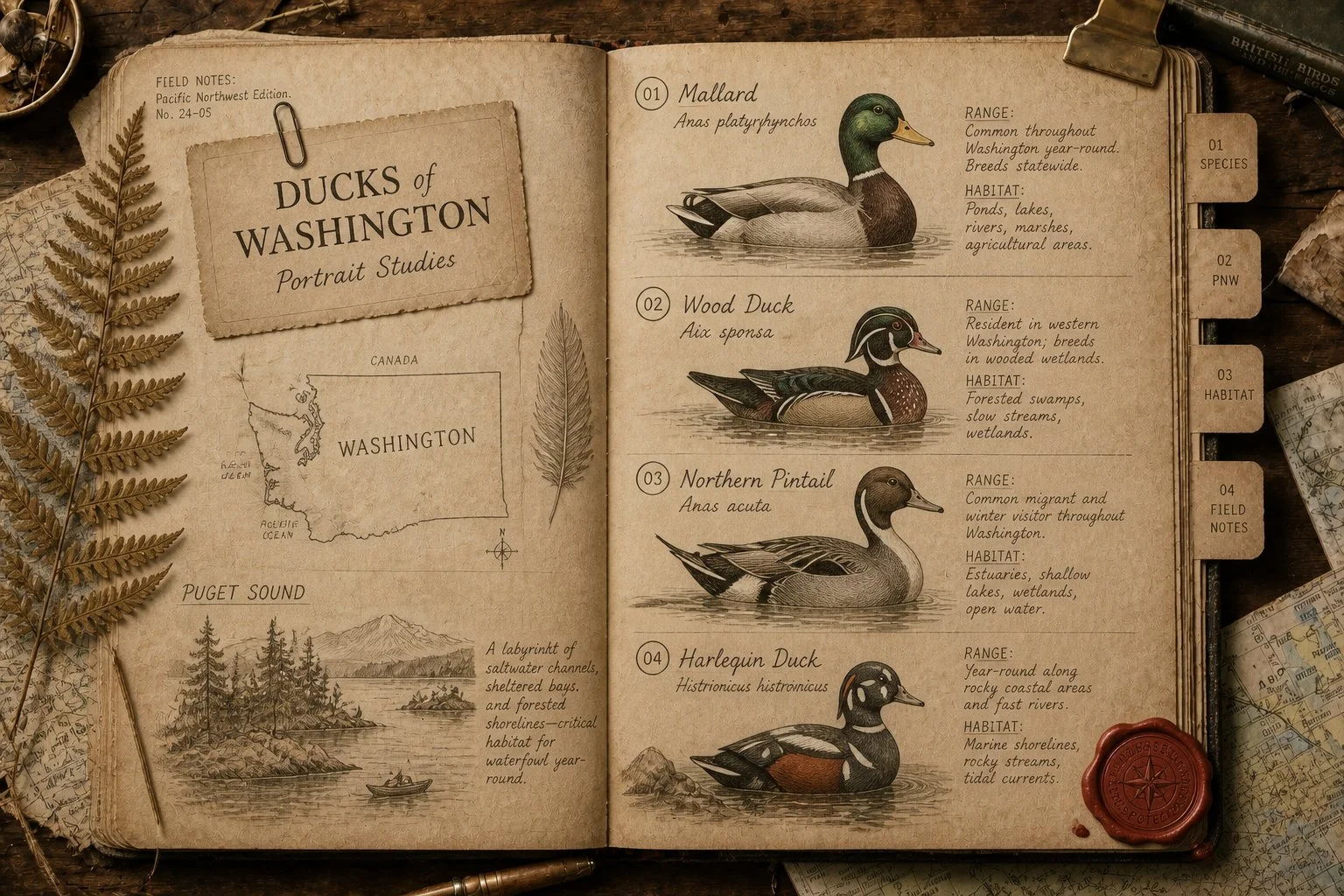
1. Mallard (Anas platyrhynchos)
The default duck. Year-round across the state, everywhere there’s water. Drake green head, hen brown speckled. Hybridises freely with domestic ducks in urban parks. Eats everything from waste grain to aquatic invertebrates.
For Mallard-specific diet, see what to feed wild ducks.
2. Wood Duck (Aix sponsa)
The most striking duck in WA. Bright green-crested head on the male, white facial markings. Forested ponds, slow rivers, oxbow lakes. Cavity nester - takes well to nest boxes mounted on poles in water.
Year-round in western WA; mostly summer in the east. See are ducks a good pet for the kept-in-captivity question.
3. Northern Pintail (Anas acuta)
The greyhound of dabbling ducks - long-necked, slim, with a pointed tail. Drake with chocolate-brown head and white neck stripe. Common in winter on Skagit, Samish, and Columbia Basin wetlands.
4. American Wigeon (Mareca americana)
Drake has a buff forehead and white crown stripe. Common winter visitor; grazes on lawns, golf courses and pasture edges in coastal western WA. Often forms mixed flocks with Mallards.
5. Green-winged Teal (Anas crecca)
North America’s smallest duck. Drake has a chestnut head with a green eye-patch. Winter flocks on shallow freshwater wetlands; eastern WA in particular.
6. Cinnamon Teal (Spatula cyanoptera)
Western specialty. Bright cinnamon-red drake, mostly in eastern WA wetlands April-September. The teal you specifically come for if you’re an east-of-the-Cascades birder.
7. Blue-winged Teal (Spatula discors)
Less common than the other two teals. Spring/summer breeder in eastern WA, scarcer elsewhere. Drake has a white facial crescent.
8. Bufflehead (Bucephala albeola)
Small black-and-white diving duck. Common winter on Puget Sound and freshwater lakes. Drake with a large white patch on the head. Dives for aquatic invertebrates.
9. Common Goldeneye (Bucephala clangula)
Larger diving duck. Drake with a round white spot below a yellow eye. Winter common in Puget Sound and large freshwater lakes.
10. Harlequin Duck (Histrionicus histrionicus)
A signature WA duck. Striking patchwork-coloured drake, lives along rocky coastal shoreline and fast-moving Cascade streams. Year-round in northwest WA; breeds in mountain streams (Olympics, Cascades), winters along the outer coast.
11. Greater Scaup (Aythya marila)
Large diving duck on saltwater. Common winter on Puget Sound. Distinguishing from Lesser Scaup at distance is a classic WA birder challenge.
12. Hooded Merganser (Lophodytes cucullatus)
Stunning drake with a fan-shaped white-and-black hood that he can erect at will. Forested ponds, slow rivers, beaver swamps. Year-round in western WA.

The Puget Sound sea ducks (winter only)
The salt water of Puget Sound hosts a separate suite of ducks in winter:
- Surf Scoter - common, all-dark drake with colourful bill markings.
- White-winged Scoter - large dark scoter, white wing patch in flight.
- Black Scoter - the all-black scoter.
- Long-tailed Duck - elegant, with the namesake long central tail feathers on drakes.
- Common Merganser - large fish-eating diver.
- Red-breasted Merganser - similar but with a shaggy crest, common on salt water.
- Barrow’s Goldeneye - cousin of Common, more localised. Crescent-shaped white face patch.
- Common and King Eider - rare; King Eider is a sought-after rarity for WA birders.
The Puget Sound winter waterfowl experience - watching mixed flocks of scoters, mergansers and goldeneye from a coastal kayak - is one of the best in North America.
The eastern shrub-steppe ducks
Eastern Washington’s irrigation reservoirs, alkali lakes and Potholes Reservoir host:
- All three teals (Green-winged, Blue-winged, Cinnamon).
- Mallard and Pintail in big winter flocks.
- Redhead and Canvasback in the deeper lakes.
- Ruddy Duck on alkali lakes.
The Columbia Basin wildlife refuges (McNary, Umatilla, Toppenish) are excellent for these species during waterfowl season.
Where to look, by region
Puget Sound (Seattle, Tacoma, Olympia):
- Mallards, Wood Ducks, Hooded Mergansers in freshwater.
- Scoters, scaup, goldeneye, Long-tailed Duck on salt water in winter.
- Harlequins on the outer coast.
Skagit, Samish, Padilla:
- The winter waterfowl spectacle of the WA coast. Massive flocks of Pintails, Wigeon, Mallards, Northern Shovelers.
Olympic Peninsula:
- Harlequin Ducks on mountain streams (breeding) and outer coast (winter).
- Mergansers in salmon rivers.
Cascade lakes:
- Hooded and Common Mergansers in summer.
- Buffleheads in winter.
Eastern Washington (Yakima, Walla Walla, Spokane):
- Cinnamon Teal in summer.
- Massive winter dabbler flocks on Potholes Reservoir.
The field guide for the west
For Washington birders, the Sibley Western Field Guide is the right pocket reference - it covers every duck you’ll see across the state, including the sea ducks.
Sibley Field Guide to Birds of Western North America
The pocket reference for Washington ducks, sea ducks and Cascade specialties.
David Sibley's Western guide covers every WA duck with adult, eclipse and immature plumages, flight silhouettes, and range maps. Especially strong on the western specialties (Harlequin Duck, Barrow's Goldeneye) and the sea-duck guild that defines Puget Sound winters.
- All Western North American species, including all WA ducks
- Multiple plumages per species
- Flight silhouettes - essential for distant sea-duck ID
- Pocket-sized softcover
 Sibley · Western

As an Amazon Associate we earn from qualifying purchases. Linked products are ones we actually use.
For the duck-as-pet question
Backyard duck-keeping is popular in WA. For the husbandry side, see are ducks a good pet and baby ducks. For pond planting, best plants for ducks.
For the wider waterfowl-feeding question (at parks, not at home), see best food to feed ducks and geese.
The bottom line
Twelve duck species cover most of what you’ll see across Washington in a year. The state’s diversity comes from having both salt water (Puget Sound sea ducks) and freshwater (Cascade and eastern lakes) plus an east-west moisture gradient. A weekend split between Skagit in winter and Potholes Reservoir in spring will rack up 25+ species without much effort.