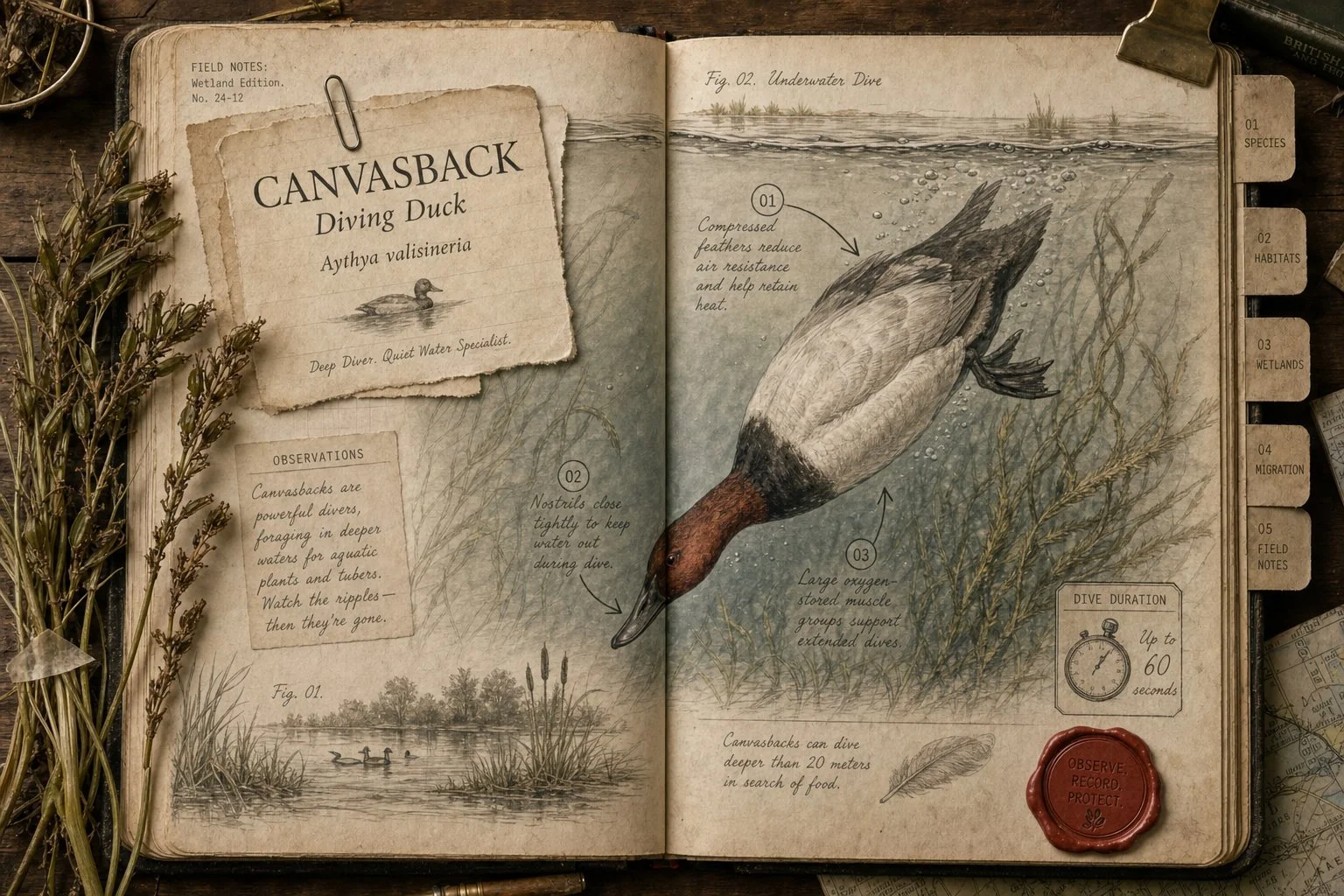
Stopwatch said 41 seconds for a Canvasback. Surfaced 12 metres from where she dove.
Most diving ducks stay underwater for 10-30 seconds at a time, surfacing briefly to breathe before diving again. The deepest and longest divers are sea ducks: Long-tailed Ducks have been recorded at over 60 seconds and depths past 60 metres, far exceeding any freshwater diver. Dabbling ducks (mallard, teal, wigeon) only “tip up” briefly with their head submerged for 3-5 seconds and don’t truly dive. Diving capacity depends on lung volume, oxygen storage in blood and muscle, and how cold the water is.
Typical dive durations by species
| Species | Type | Typical dive | Max recorded |
|---|---|---|---|
| Mallard | Dabbler (tipping only) | 3-5 sec | rarely fully submerges |
| Northern Shoveler | Dabbler | 3-5 sec | rarely fully submerges |
| Canvasback | Diver | 15-25 sec | 60+ sec |
| Redhead | Diver | 15-25 sec | 45 sec |
| Lesser Scaup | Diver | 20-25 sec | 60 sec |
| Common Goldeneye | Diver | 25-35 sec | 60+ sec |
| Bufflehead | Diver | 15-25 sec | 40 sec |
| Common Eider | Sea duck | 30-45 sec | 80 sec |
| Long-tailed Duck | Sea duck | 30-60 sec | 90+ sec, to 60m deep |
| Common Loon (not a duck but relevant) | Diver | 45-60 sec | 90+ sec, to 70m deep |
The Long-tailed Duck is the diving champion. It feeds on benthic invertebrates in deep cold water and has the physiology to match.
How the diving works physiologically
Three adaptations make extended diving possible:
- Compressed air-sac system - ducks don’t fill their lungs with air before diving the way mammals do. They use their air sacs less and rely more on oxygen stored in blood and muscle tissue.
- High myoglobin - the protein that stores oxygen in muscle is far more abundant in diving ducks than in dabblers. Long-tailed ducks have some of the highest myoglobin concentrations of any waterfowl.
- Lowered heart rate - dive bradycardia. The heart slows from ~200 bpm to under 50 bpm during a dive to conserve oxygen.
Cold water actually helps. Lower temperatures slow metabolic demand for oxygen, extending dive time. This is partly why sea ducks in Arctic waters can dive longer than tropical diving ducks.
Dabblers vs divers
Dabbling ducks (mallard, teal, pintail, shoveler, wigeon, gadwall) feed at or near the surface. They tip up - head and chest down, tail vertical in the air - to reach food a few inches below. They almost never fully submerge.
Diving ducks (canvasback, redhead, scaup, ring-necked, goldeneye, bufflehead, ruddy) feed below the surface, often metres down. They have legs set further back on the body for diving propulsion, which is why they look clumsy on land.
Sea ducks (eiders, scoters, long-tailed, harlequin) take diving to the extreme, hunting benthic invertebrates in salt water at significant depth.
Why ducks don't stay underwater longer
Three limits:
- Oxygen - depleted myoglobin reserves force a surface for fresh air.
- Buoyancy - even diving ducks are positively buoyant once their lungs reset, so staying under requires constant swimming effort.
- Body heat - prolonged time in cold water depletes energy reserves quickly. Sea ducks have heavier fat layers and denser plumage to compensate.
A duck pushed beyond its dive limit (e.g., trapped under ice) will drown.
Nikon Prostaff P3 8x42
Track the surface for the right horizon.
Watching divers means scanning the water for re-emergence, often 10-15 metres from the dive point. A wide field of view at 8x and bright low-light optics turn an hours-long guess into a real observation session. The Prostaff P3 holds enough water in frame to follow several divers at once.
- 8x magnification, 42mm objective
- Wide field of view for scanning open water
- Waterproof and fog-proof for coastal scoping
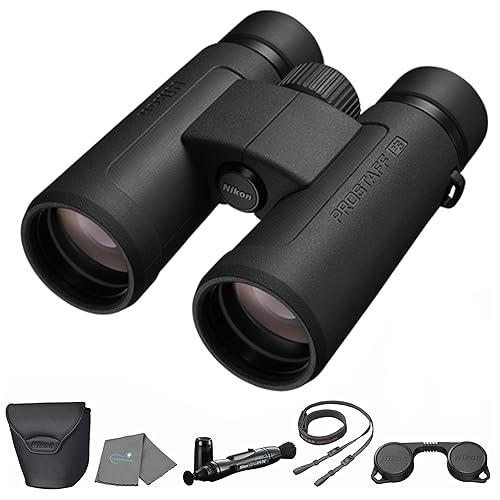 Nikon · Prostaff P3

As an Amazon Associate we earn from qualifying purchases.
The bottom line
Most diving ducks stay under for 10-30 seconds. Sea ducks routinely hit 30-60 seconds, with Long-tailed Ducks the species record-holder. Dabbling ducks barely dive at all; they tip-up. Cold water and high muscle myoglobin extend dive time, while buoyancy and oxygen depletion impose the limits.
For more, see mallard diet and duck feet.