Banding-recovery notes.
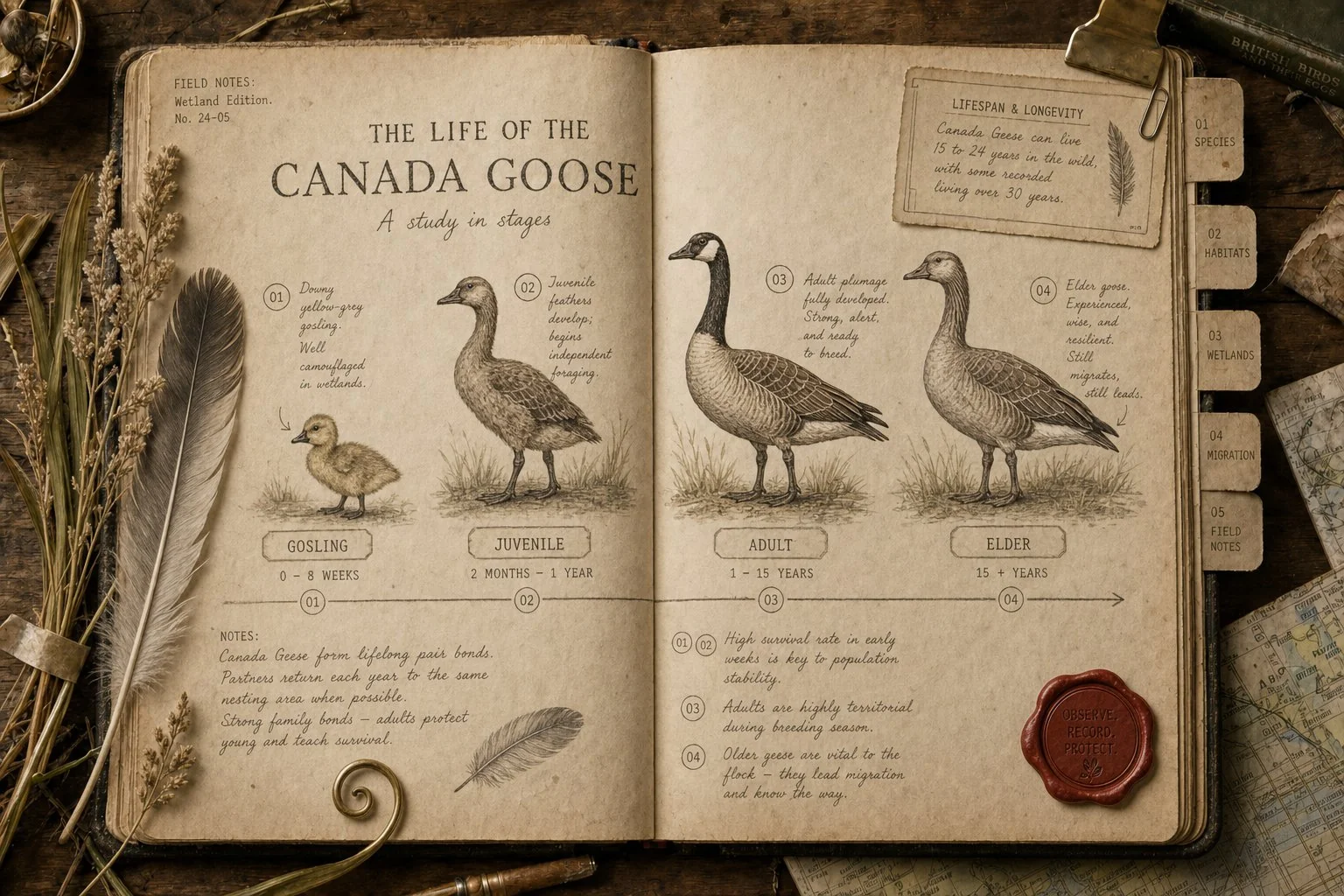
A wild Canada goose averages 10-12 years if it survives its first winter. The oldest banded wild Canada goose on record was 33 years old (banded in Ohio, recovered alive in 2001). Domestic geese typically live 15-25 years because they avoid the main wild mortality sources: predation, hunting, and harsh winter starvation. The first year is by far the most lethal; survive that and life expectancy doubles.
Wild Canada goose lifespan, by stage
The honest numbers from banding studies:
- Hatchling to fledging (0-10 weeks): about 50-60% survive to fledge. Predation by foxes, raccoons, snapping turtles, and large fish kills most losses.
- First winter (fledging to one year): about 60-70% survive. First migration, learning stopovers, evading hunters.
- Surviving adult (after first year): annual survival around 85-90%. The bird now knows the route, the safe roosts, the food.
- Average lifespan of birds that reach adulthood: 10-12 years.
- Oldest documented wild bird: 33 years (banded 1968 in Ohio, recovered 2001).
The average from-hatch lifespan is much lower (~5-7 years) because of the heavy early mortality. The “10-12” number applies to birds that have already survived the dangerous first year.
Domestic goose lifespan
Pet and farm geese typically live considerably longer:
- Pekin, Embden, Toulouse (heavy breeds): 15-25 years.
- Chinese, African (medium breeds): 15-25 years.
- Sebastopol, ornamental breeds: 20+ years.
- Documented record: a domestic goose named “George” lived to 49 in Lancashire, UK.
The difference is environmental. A pet goose has no predators, no hunting season, no migration, reliable food year-round, and veterinary care. The biological maximum hasn’t changed; the survival rate has.
What kills wild geese
In rough order of mortality:
- Hunting (in regulated seasons) - the single largest cause in heavily-hunted populations.
- Predation of goslings - fox, raccoon, snapping turtle, mink.
- Vehicle strike - especially on roads near rural ponds.
- Power line collision - significant in heavily-electrified migration corridors.
- Avian disease - botulism in shallow lakes; avian flu episodically.
- Starvation during harsh winters when feeding areas freeze.
- Lead poisoning (historic, from spent shot in feeding areas) - declining but not eliminated.
Old age is rarely the cause; most geese die before reaching their biological potential.
How geese show age in the field
A few visible markers of an older Canada goose:
- Slightly paler cheek patches in very old birds.
- More worn feathers, especially primaries.
- Beak condition - older birds sometimes show keratin overgrowth.
- Behaviour - older birds tend to lead V-formations and are often the most vocal.
These aren’t reliable enough for precise ageing. Banding studies are how the lifespan numbers were actually measured.
Pair-bonding and longevity
Canada geese pair for life and the pair-bond can last 20+ years. When one member dies, the survivor often:
- Mourns visibly for weeks (refuses to leave the dead bird, won’t feed properly).
- May not re-pair at all if elderly.
- Sometimes joins a non-breeding flock for the rest of life.
This is why hunting Canada geese during breeding season disproportionately damages populations - losing one adult often means losing a clutch and a working bonded knowledge of the route.
Sibley Field Guide Birds of Eastern North America
The reference that ages and IDs them.
Hand-painted plates showing adult, juvenile, and seasonal plumage variation for every Canada Goose population. Age clues in the field (faint chest barring, juvenile cheek pattern) are illustrated. The standard reference for North American birding.
- Plates show adult and juvenile plumage for each species
- Range maps with seasonal breakdown
- Behaviour notes for each species
 Sibley · 2nd Ed.

As an Amazon Associate we earn from qualifying purchases.
The bottom line
A wild Canada goose that makes it past its first winter has roughly a decade ahead of it; a domestic goose can double that. Hunting is the largest single mortality source in most populations. The oldest documented wild goose was 33; the oldest documented domestic was 49.
For more goose biology, see behaviour and flight range.