Field notes from too many emails that said "I put a feeder up and nothing came."
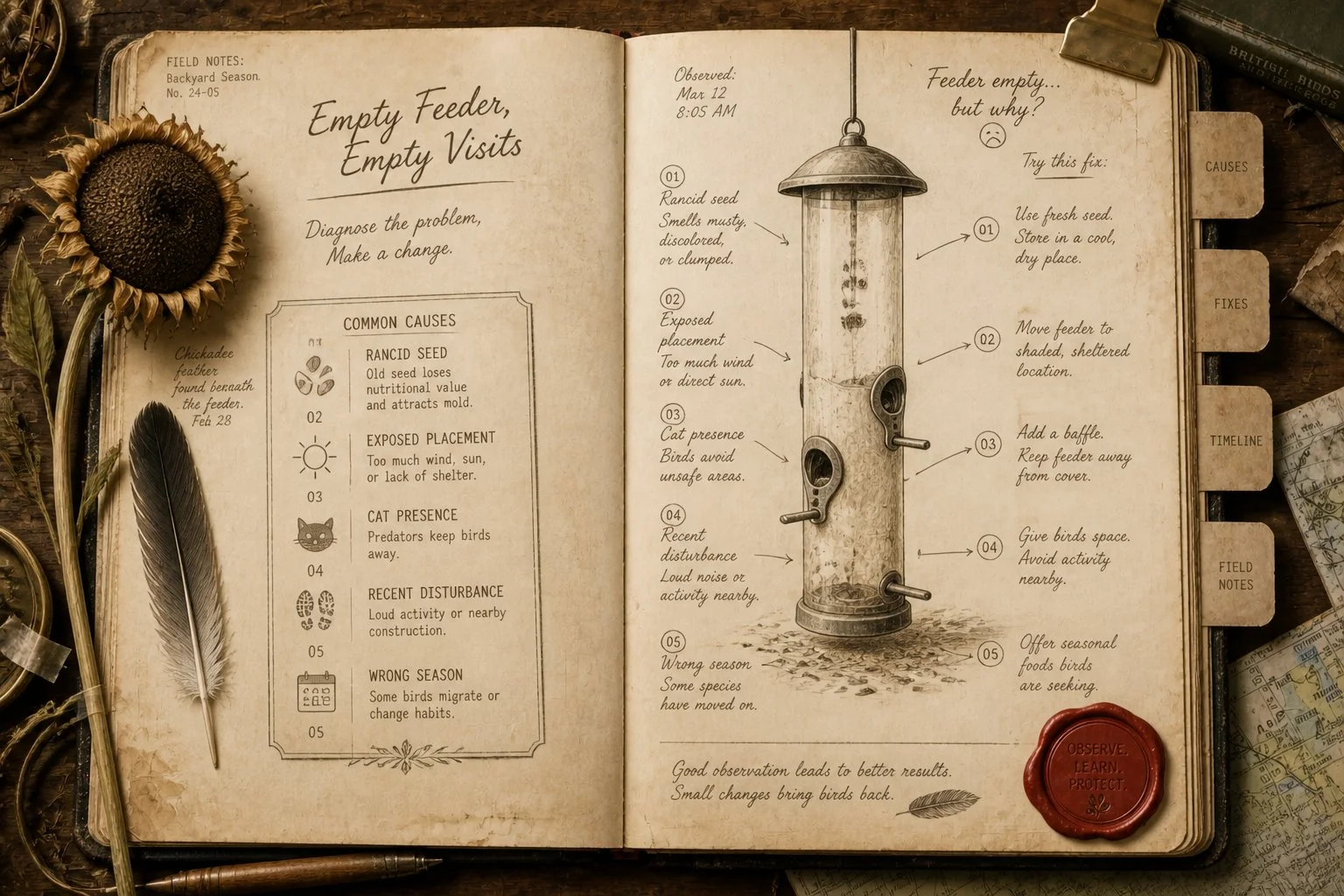
The short version: a new feeder needs 1-6 weeks before regular birds use it. If you’ve waited that long and nothing is happening, work through eight checks: rancid seed, wrong placement, no cover nearby, cat pressure, predator pressure (hawk/owl), recent disturbance, wrong season, wrong food for the local species. Most “empty feeder” cases come down to one of three: rancid seed, placement in the open, or a cat working the patio.
How long it actually takes
The thing nobody tells new feeder-buyers: it can take six weeks for birds to find and trust a brand-new feeder.
The pattern in a typical back garden:
- Days 1-7. No birds. Don’t move it, don’t refill the whole thing - just let it sit. Birds need to notice the feeder and the seed.
- Days 7-21. First scouts. Usually a House Sparrow or a chickadee. They’ll land, take one seed, leave. Repeat over a week.
- Days 21-42. Word spreads. The first regulars settle into a daily pattern. You’ll see 3-5 species using the feeder by week 6.
- Months 2-12. Full community builds. Rarer species drop in over the following months.
If you’ve put up the feeder this week and nothing has come yet, the problem is patience, not the feeder.
The eight checks, in order of likelihood
1. Rancid seed
The most common cause of an “empty” feeder. Seed that’s been in the bag or the feeder for too long, or stored damp, goes rancid. Birds can detect rancidity and avoid it.
Check: smell the seed. Fresh seed smells mildly oily and nutty. Rancid seed smells sharp, paint-like, or musty.
Fix: dump the seed (into the compost), scrub the feeder in hot water, refill from a fresh bag stored properly. See bird seed shelf life for the full storage rules.
2. Wrong placement
A feeder in the middle of a lawn with no cover nearby is a feeder birds visit briefly and abandon. A feeder hung too close to a window kills birds. A feeder near a fence or roof edge is squirrel territory.
Check: is the feeder within 4-5 metres of a shrub or tree? Is it less than 3 ft or more than 10 ft from any window?
Fix: move it. Full breakdown in best place for a bird feeder.
3. No cover within reach
Related but distinct from placement. Birds approach feeders in short hops from cover. A bare flagpole in an open garden gets visitors but never residents.
Check: can a bird step from cover to the feeder in one hop of less than 5 metres?
Fix: plant a hawthorn whip, install a brush pile, or move the feeder closer to existing cover (4-5 metres away, not touching).
4. Cat pressure
A cat sitting under or near the feeder is a kill zone. Birds learn within days and stop coming. Even an indoor cat visible through a window suppresses traffic.
Check: is there a cat using the area? Look for paw prints, scat, or actual sightings.
Fix: move the feeder to a part of the garden the cat doesn’t patrol. Raise it higher (5-7 ft minimum). Don’t put it on a low fence. Indoor cats - keep them away from the window the birds approach from.
5. Hawk or owl pressure
A Cooper’s Hawk or Sharp-shinned Hawk hunting your garden is exactly what should happen in a healthy feeding station, but it suppresses songbird traffic for a few days each time. The same effect comes from a Great Horned Owl roosting nearby.
Check: have you seen a hawk or larger bird in the area? Any plucking sites (concentrated feather piles)?
Fix: wait. The raptor pressure passes within a fortnight in most cases. Take feeders down for 48 hours if it’s intense - that often pushes the hawk on. See are owls dangerous for the owl side and why crows attack hawks for the wider context.
6. Recent disturbance
A garden renovation, a new dog, builders working on the house, even a Christmas tree being dragged out - all temporarily disrupt the feeder’s regulars. Birds remember disturbance for 1-2 weeks.
Check: has anything changed in the garden in the last fortnight?
Fix: wait. The pattern re-establishes within 2-3 weeks of the disturbance ending.
7. Wrong season
In spring and early summer, garden birds eat insects to feed protein-hungry chicks. Feeder traffic drops sharply from May through July in most regions. This isn’t a problem - it’s biology.
Check: what month is it? Is your garden showing breeding birds (insects being carried to nests)?
Fix: none. Resume normal traffic returns in August and peaks November through March.
8. Wrong food for local species
Cheap mixed seed with milo and cracked corn fillers is rejected by most species. Sunflower seed in a feeder with ports too small for cardinals attracts only the smallest birds. Nyjer in a regular tube doesn’t work.
Check: which species are you trying to attract? Is the food matched to them?
Fix: see best bird seeds for the species-to-seed mapping and what to put in a bird feeder for the working shortlist.

The 90% diagnosis
Across hundreds of empty-feeder emails over the years, three causes account for 90% of cases:
- Rancid seed - 35% of cases.
- Placement in the open with no cover - 30% of cases.
- Cat pressure - 25% of cases.
The remaining 10% is the seasonal, raptor, disturbance, wrong-food cases.
If you’ve checked those three and birds still aren’t coming, the next steps are:
- Add a moving-water source. A simple solar fountain in a shallow dish pulls birds in faster than any feeder change. See birdbaths with fountains.
- Switch to black-oil sunflower seed in a clean tube feeder. It’s the single most universally accepted seed.
- Wait six weeks. Really.
The seed bag we'd start with
If you’re rebuilding the feeder station from scratch, one bag covers 90% of species:
Wagner's Black-Oil Sunflower 20 lb
The single seed that gets a slow feeder working again.
Black-oil sunflower outperforms mixed seed because almost every species takes it - chickadees, finches, sparrows, cardinals, nuthatches, woodpeckers, doves. Higher oil content than striped sunflower means more calories per gram. Fresh from a current-season harvest, in a sealed 20 lb bag. Decant into a metal bin to keep it fresh.
- Single ingredient - no filler that birds reject
- Thin shell that small finches can crack
- 20 lb resealable bag - winter supply for one feeder
- Replaces the "premium mixed seed" that isn't working
 Wagner's · 20 lb

As an Amazon Associate we earn from qualifying purchases. Linked products are ones we actually use.
When the feeder is working but you want more
If you have some birds but want greater variety, the next levers to pull (in order):
- Add suet or peanut butter in winter. See best winter bird seed and feeding birds peanut butter.
- Add a moving-water source. See birdbaths with fountains.
- Add a ground-feeder tray for sparrows and juncos.
- Plant native hedge and seed-producing flowers. See are birds good for your garden.
The bigger picture
A new feeder taking 6 weeks to attract birds is normal. A feeder that’s been up for six months with no birds has a problem - usually the seed, the placement, or a predator. Work through the eight checks above before changing the feeder itself.
For the broader case on whether feeders are worth setting up at all (yes, with maintenance), see are bird feeders bad.
The bottom line
Patience first - six weeks before you conclude anything. Then check rancid seed, placement, cover, cats. Those four account for almost every “nothing is coming” case. Switch to single-ingredient black-oil sunflower seed in a clean feeder, give it a fortnight, and the regulars will arrive.