Field notes from a season working the New Hampshire backyard count.
The short version: New Hampshire’s “blue” birds split into five reliable species - Eastern Bluebird (year-round across the state), Blue Jay (year-round resident), Indigo Bunting (summer breeder May-September), Tree Swallow (April-September aerial insectivore), and Belted Kingfisher (year-round on any clean stream). All five are findable without specialist effort. The state’s other “blue” birds (Blue Grosbeak, Cerulean Warbler, Black-throated Blue Warbler) are scarce, accidental, or warbler-tier seasonal specialists.
The five reliable blues
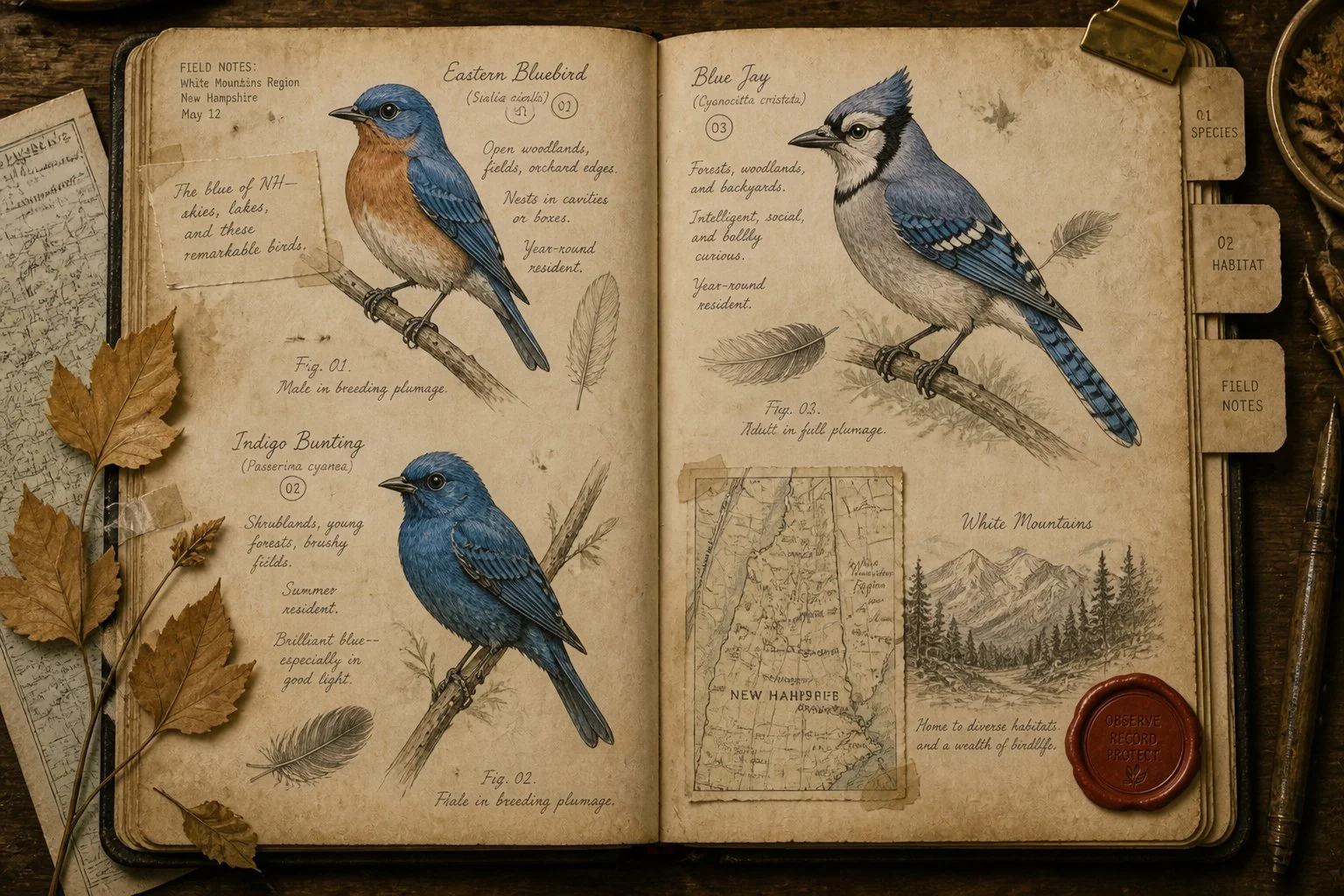
1. Eastern Bluebird (Sialia sialis)
The state bird of three US states and a frequent NH garden visitor. Bright cobalt-blue back, rust-orange breast, white belly. Female duller but same pattern. Open habitats - meadows, orchard edges, golf courses, suburban gardens with nest boxes.
Year-round resident across NH. Northern populations migrate, southern populations stay through winter. They take to nest boxes readily; the New Hampshire Bluebird Conservation Initiative monitors hundreds of boxes statewide.
For the broader case on attracting them, the same principles apply as for chickadees - see how to attract Black-capped Chickadees for the feeder routine, and add a properly-sized bluebird box for cavity nesting.
2. Blue Jay (Cyanocitta cristata)
The loud, blue-and-white-crested corvid. Year-round resident, very common. Eats almost everything - acorns, insects, eggs, sunflower seed, peanuts. Will dominate a feeder if you let it.
Behavioural notes:
- Caches acorns and other nuts. A single Blue Jay can hide 4,500 acorns in a season.
- Mobs hawks aggressively. See why crows attack hawks for the mobbing behaviour (Jays do it for the same reasons as crows).
- Often mimics Red-tailed Hawk calls.
3. Indigo Bunting (Passerina cyanea)
Summer breeder, May-September. Deep iridescent blue (which is structural colour, not pigment - the bird looks brown in shadow). Found in shrubby roadsides, second-growth woodland edges, hedgerows. Male’s song is a high paired-note phrase.
Best seen May-July when males are singing from prominent perches. By September they’ve moulted into duller plumage and slip south.
4. Tree Swallow (Tachycineta bicolor)
Iridescent blue-green above, pure white below. The aerial insectivore that arrives in early April and stays through September. Nests in tree cavities and competes hard for nest boxes - they’ll take a bluebird box if the bluebird isn’t already in it.
Common around any open water - ponds, lakes, rivers. Often nests in dead snags over water.
5. Belted Kingfisher (Megaceryle alcyon)
Slate-blue back, white belly, crested head, dagger bill. Female has a rust-coloured belt across the chest (unusual in birds - the female is the more colourful sex).
Year-round resident on any clean stream or lake where small fish are present. Hovers and dives. Loud rattling call carries far.

The scarce or accidental ones
Worth knowing about but you’ll need luck or specialist effort:
- Black-throated Blue Warbler - common breeder in NH hardwood forests but warbler-sized and easy to miss in canopy. Listen for the distinctive “zee-zee-zee-ZWEE” song.
- Cerulean Warbler - rare and declining; mature deciduous canopy.
- Blue-headed Vireo - common breeder in mixed forest, but blue-grey not bright blue.
- Blue Grosbeak - accidental in NH; resident range stops in southern New England.
- Mountain Bluebird - western species, accidental in east.
- Common Grackle - looks blue-black in good light; technically iridescent.
- European Starling - winter plumage shows blue-green iridescence. Not a great “blue bird” but common.
Why birds look blue (briefly)
Almost all bird blues are structural colour, not pigment. The feather structure scatters blue wavelengths preferentially - the same mechanism that makes the sky blue. Grind up a blue feather and it goes brown. This matters because:
- A bluebird looks black in shadow.
- Faded blue feathers look duller, not browner.
- Photo flash washes out the blue rapidly.
Pigment-based blue exists in some parrots and pittas; it’s vanishingly rare in North American birds.
Setting up for bluebirds specifically
If you want to attract Eastern Bluebirds to your NH garden:
- Bluebird-spec nest box. 1.5-inch entry hole (critical - keeps starlings out), 5x5 floor, 8-12 inches deep, mounted 4-6 feet up on a smooth pole with a baffle.
- Open habitat nearby. Bluebirds want short grass for ground-foraging. A lawn or mown field beside the box is ideal.
- Mealworms. Bluebirds take mealworms enthusiastically, especially in spring when they’re feeding chicks. See best bird seeds for the mealworm recommendation.
- No pesticides on the lawn. Insecticide-treated lawns have no ground insects, and ground insects are bluebird food.
Woodlink Audubon Bluebird House
The right-spec box for Eastern Bluebirds across New Hampshire.
A North American Bluebird Society-approved nest box with 1.5-inch entry, 5x5 floor, and hinged side for monitoring. Built to the dimensions bluebirds actually take. Mount on a smooth pole (with a predator baffle) facing east or southeast at 4-6 feet.
- NABS-approved dimensions - 1.5 inch entry, 5x5 floor, 8 inch depth
- Cedar construction, no paint or finish on the interior
- Hinged side panel for monitoring
- Drilled ventilation and drainage
 Woodlink · Audubon NABB

As an Amazon Associate we earn from qualifying purchases. Linked products are ones we actually use.
Where to look, by region
Seacoast and southern tier (Portsmouth, Manchester):
- Eastern Bluebirds on every golf course and orchard edge.
- Tree Swallows on every pond.
- Belted Kingfishers on rivers.
Lakes Region (Lake Winnipesaukee area):
- Eastern Bluebird and Tree Swallow in nest boxes around the lake.
- Belted Kingfisher on every clean stream.
- Indigo Bunting in early-successional habitat.
White Mountains:
- Black-throated Blue Warbler in mature hardwood (specialty bird).
- Blue Jay year-round.
- Mountain ponds host Tree Swallows in summer.
Connecticut River Valley:
- All five common blues reliable.
- Best general birding zone in the state.
Conservation status
The five common blues split into:
- Increasing/stable: Eastern Bluebird (recovered from mid-century lows thanks to nest-box networks), Blue Jay, Tree Swallow.
- Stable but worth watching: Belted Kingfisher (dependent on clean water).
- Declining: Indigo Bunting (loss of shrubby early-successional habitat).
For the broader case on garden bird support, see are birds good for your garden and how to attract common backyard birds.
The bottom line
New Hampshire’s five reliable blue birds are findable in a single weekend of casual birding across two or three habitats. Hang a bluebird box on a pole and a Tree Swallow or Eastern Bluebird will likely move in within a season. The kingfisher requires no effort beyond being near water. The warbler-tier blues need a specific hunt during May-July.