Field notes from a January afternoon, the whole flock fighting joyfully with a hung Savoy cabbage.
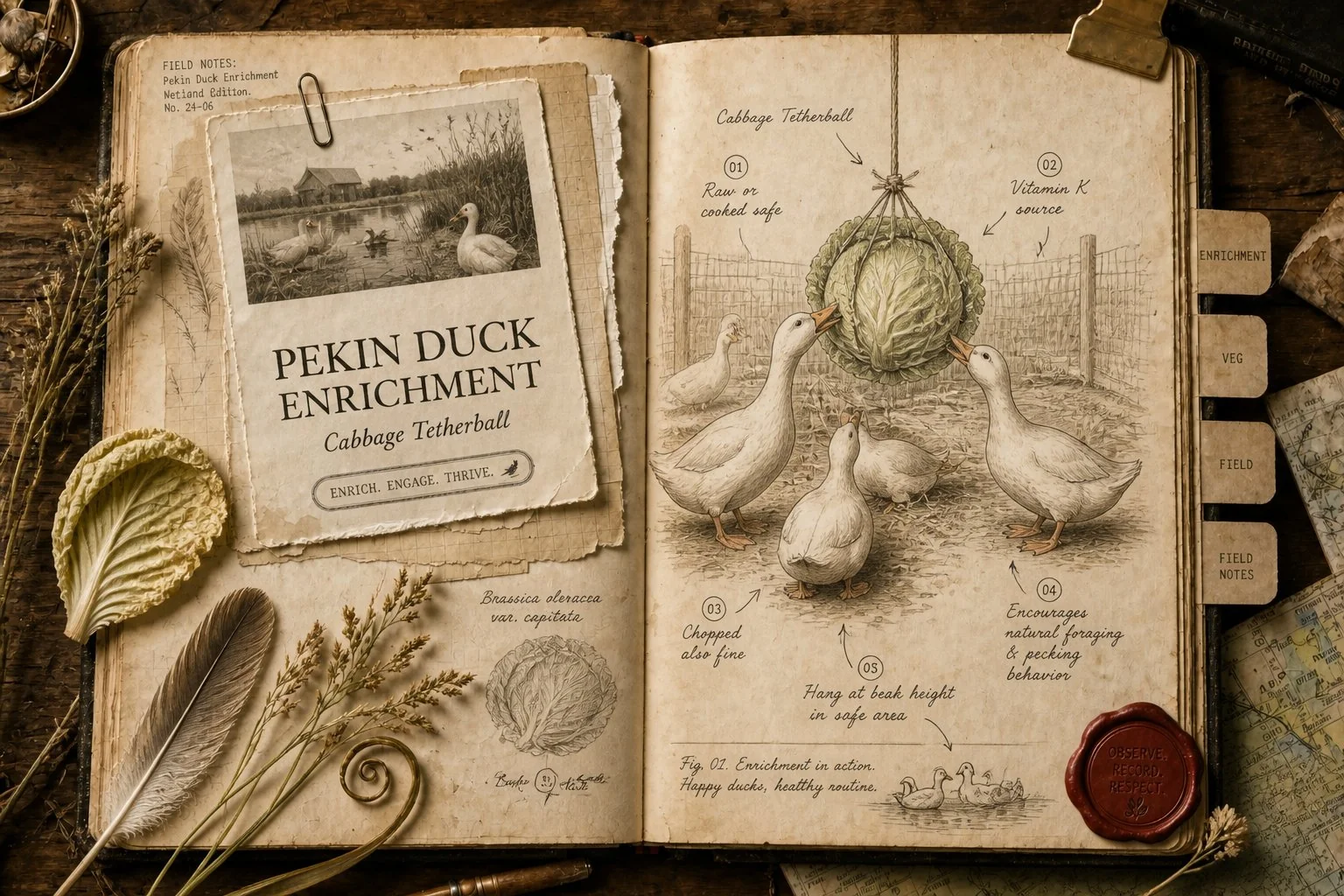
The short version: yes, ducks can eat cabbage - all varieties (green, red, Savoy, Napa), raw or cooked, chopped or whole. The single most useful preparation is also the most fun: drill a hole through a whole cabbage, thread a string through it, hang it at duck-head height in the pen. The result is a tetherball game that occupies a flock for hours and delivers steady leafy greens. Far and away the best winter enrichment you can give a confined backyard duck.
Why cabbage is great for ducks
Cabbage offers a useful nutritional profile alongside genuinely high enrichment value:
- Vitamin K, vitamin C, folate - useful in laying hens especially.
- Sulfur compounds (glucosinolates) - antioxidant in moderation.
- Fibre - gut health.
- Hydration - cabbage is 92% water.
- Very low calorie - hard to overfeed cabbage.
The bigger contribution though is enrichment. Cabbage holds together, takes time to dismantle, and works at the duck’s preferred peck-and-tug pace. Most other vegetables get eaten in seconds; a hung cabbage occupies a flock for hours.

The hung-cabbage game
The single best preparation for a confined backyard flock:
- Buy a whole cabbage - green is cheapest, Savoy is the most popular with ducks for the textured leaves.
- Drill a hole through the centre with a long thin screwdriver or a corkscrew. Push from the stem end through to the crown.
- Thread a length of jute or strong string through the hole. Knot a thick wooden bead or a small stick at the bottom to stop it pulling through.
- Hang the cabbage at duck-head height (about 30-40 cm off the ground) from a rafter, branch, or hook in the pen.
- Walk away.
The ducks discover it within minutes. They peck, the cabbage swings, they peck again, they grab leaves and tug, the whole flock joins in. Two ducks can dismantle a medium Savoy across an afternoon; four ducks finish it in two hours.
The reasons it works:
- It moves. Ducks are stimulated by motion.
- It resists. They have to work for each mouthful.
- It’s social. Multiple ducks can engage at once without crowding a single dish.
- It’s leafy and fibrous. Closer to natural foraging than a flat dish.
In a confined flock - especially in winter when outdoor browsing is reduced - a cabbage a week prevents the boredom-related behaviour problems (feather pulling, aggression, overeating pellets) that develop in under-stimulated ducks.
Other preparations
If hanging isn’t practical (no rafter, no hook), there are simpler options:
Quartered and offered in a dish. Cut a whole cabbage into quarters, leaving the core in. The ducks peck the loose outer leaves and gradually break it down. Less engaging than hanging but still works.
Chopped. Shredded or chopped into 2-3 cm pieces, scattered on a feeding tray. Eaten fastest, lowest enrichment value, easiest for ducklings.
Cooked plain. Briefly boiled or steamed cabbage is safe and easier to eat for older ducks. Cool before offering, no salt or butter.
Coleslaw, sauerkraut, kimchi: all off-limits. Salt and/or fermentation issues.
Red, green, Savoy, Napa
All cabbage varieties are safe:
- Green cabbage - cheap, sturdy, ideal for the hung-tetherball setup.
- Savoy cabbage - texture ducks particularly like.
- Red cabbage - safe; the betalain-style pigments may colour droppings slightly.
- Napa / Chinese cabbage - safe, eaten readily, but doesn’t hang as well (looser leaves).
- Pointed / sweetheart cabbage - safe but pricier.
Buy whichever is cheapest at the supermarket; the ducks don’t have preferences strong enough to justify spending more.
How often, how much
Cabbage is one of the few treats where you can be generous:
- A whole cabbage per 4-5 ducks, once a week is a reasonable enrichment routine.
- Daily small amounts as part of the chopped-greens portion of the diet is also fine.
- Avoid making it >25% of the diet - even cabbage in extreme quantity causes loose droppings.
The brassica loose-droppings warning from can ducks eat Brussels sprouts applies here too - just spread the brassica intake across the week.
The pet rabbit comparison
Common question: “Rabbits aren’t supposed to have much cabbage. Is it the same for ducks?”
No. Rabbits have a specific gut microbiome sensitivity to brassicas that doesn’t transfer to ducks. Ducks process moderate cabbage without issue. The same applies for kale, broccoli, and chard - all of which are common rabbit-caution foods that are fine for ducks in normal quantities.
Outdoor flocks vs indoor flocks
The enrichment value of cabbage scales with how confined the ducks are:
- Free-range duck flocks browse naturally and don’t need a hung cabbage as much - they’re already engaged with the garden.
- Penned ducks in winter benefit hugely. A hung cabbage transforms an otherwise boring January pen.
- Indoor ducks (rare, but real) - cabbage is one of the few enrichment activities that fits indoor space.
The wider veg list
For the broader picture:
- Brussels sprouts - safe, cooked easier. See can ducks eat Brussels sprouts.
- Cauliflower - safe. See can ducks eat cauliflower.
- Beets - safe, pink poo is normal. See can ducks eat beets.
- Carrots - grated or cooked. See can ducks eat carrots.
- Lettuce, kale, spinach - safe (skip iceberg).
- Peas, cucumber, courgette, sweet potato (cooked) - all fine.
The everyday base
Cabbage is the enrichment. Cracked corn is the calorie base.
CountryMax Cracked Corn 50 lb
The everyday calorie treat that pairs with the cabbage tetherball.
A 50 lb sack of cracked corn - the everyday duck treat. Use as the calorie base; the hung cabbage and other seasonal veg sit on top. Stores months in a sealed bin; decant into smaller bags for daily feeding.
- 50 lb sack - a season's supply for a small flock
- Cracked to the right size for ducks and geese
- Pairs with weekly cabbage enrichment
- Stores stably in a sealed metal bin
 CountryMax · 50 lb

As an Amazon Associate we earn from qualifying purchases. Linked products are ones we actually use.
The bottom line
Cabbage is the single most useful enrichment vegetable for backyard ducks. Safe in all varieties, low-calorie, nutritionally useful, and the hung-on-a-string version is the closest thing to a duck toy that actually works. A whole cabbage a week per 4-5 ducks gives you a flock that’s happier, less prone to feather pulling, and easier to live with. Cheaper than any commercial enrichment product and works first time.