A footnote on waterfowl genetics.
Geese and ducks are different subfamilies of waterfowl (Anserinae vs Anatinae) and don’t interbreed in nature. A small number of captive cases exist - mostly Mallard x Domestic Goose pairings - but resulting eggs are almost always infertile or non-viable. Real-world hybridisation is essentially zero. The two birds are genetically too distant for compatible offspring.
Why the question keeps coming up
A goose and a mallard on the same pond look related: both swim, both honk-or-quack, both pair up, both feed on similar things. People assume that proximity equals compatibility. Geese and ducks share enough biology to socialise, but not enough to interbreed.
The genetic distance
Geese (subfamily Anserinae) and ducks (subfamily Anatinae) diverged roughly 20-30 million years ago. In comparison, within the duck subfamily, mallards and pintails diverged only 4-6 million years ago.
That difference shows up at every level:
- Chromosome counts and arrangements differ.
- Egg shell chemistry and yolk structure differ.
- Courtship displays are completely different.
- Mating mechanics including sperm storage in the female are configured differently.
Even if a goose and a duck physically attempted to mate, the gametes would be unlikely to produce a viable embryo.
Documented captive cases
A small handful of cases exist in zoo and farm records:
- Domestic Goose x Mallard - eggs laid, almost always infertile. One or two cases of chick hatching, none surviving long.
- Muscovy x Mallard - this is actually duck x duck (Muscovy is in a separate genus Cairina but still Anatinae), and produces sterile hybrid “mules” used in foie gras production.
- Canada Goose x Mallard reports - claims exist; none verified with genetic testing.
The Mallard x Muscovy hybrid is sometimes confused for “goose x duck” because Muscovies are large; but Muscovies are ducks, just unusual ones.
What about within the same subfamily?
Within ducks specifically, hybrids occur regularly:
- Mallard x American Black Duck - common in the east, problematic for Black Duck conservation.
- Mallard x Gadwall, Mallard x Pintail, Mallard x Wigeon - all documented.
- Wild duck hybrids in general are estimated at 1-3% of wild mallard populations in some regions.
Within geese:
- Canada Goose x Cackling Goose - same genus.
- Snow Goose x Ross’s Goose - same genus.
Cross-subfamily (goose x duck) is the line that almost never crosses.
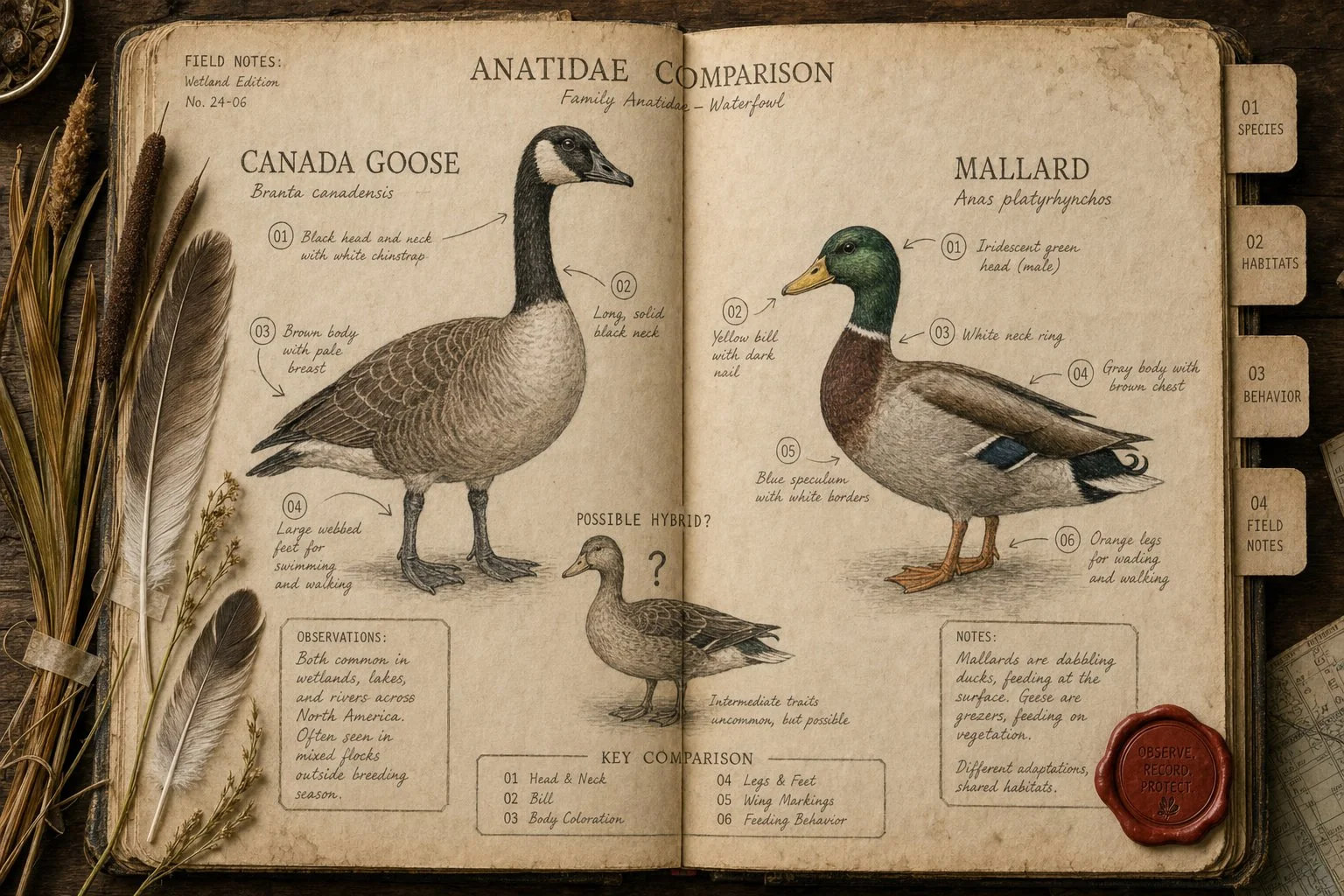
How to tell goose from duck
If you’re unsure whether a bird at your pond is a goose or a duck:
- Size: geese are much larger.
- Neck: geese have proportionally longer necks.
- Bill: geese have shorter triangular bills; ducks have wider, longer bills.
- Behaviour: geese spend a lot more time grazing on land; ducks are more water-bound.
Sibley Field Guide Birds of Eastern North America
For sorting geese, ducks, and the rare hybrid.
The standard reference includes Mallard hybrid plates (Black Duck, Gadwall hybrids) plus all duck and goose species at scale. The best resource for "is that bird an oddity or a known hybrid?"
- All North American ducks, geese, swans
- Mallard hybrid plates included
- Range maps and behaviour notes
 Sibley · 2nd Ed.

As an Amazon Associate we earn from qualifying purchases.
The bottom line
Geese and ducks don’t mate in nature. Captive cases are rare and almost never produce viable offspring. Within-genus hybrids are common in both groups; cross-subfamily is the barrier.
For more, see can geese and swans mate and North American geese.