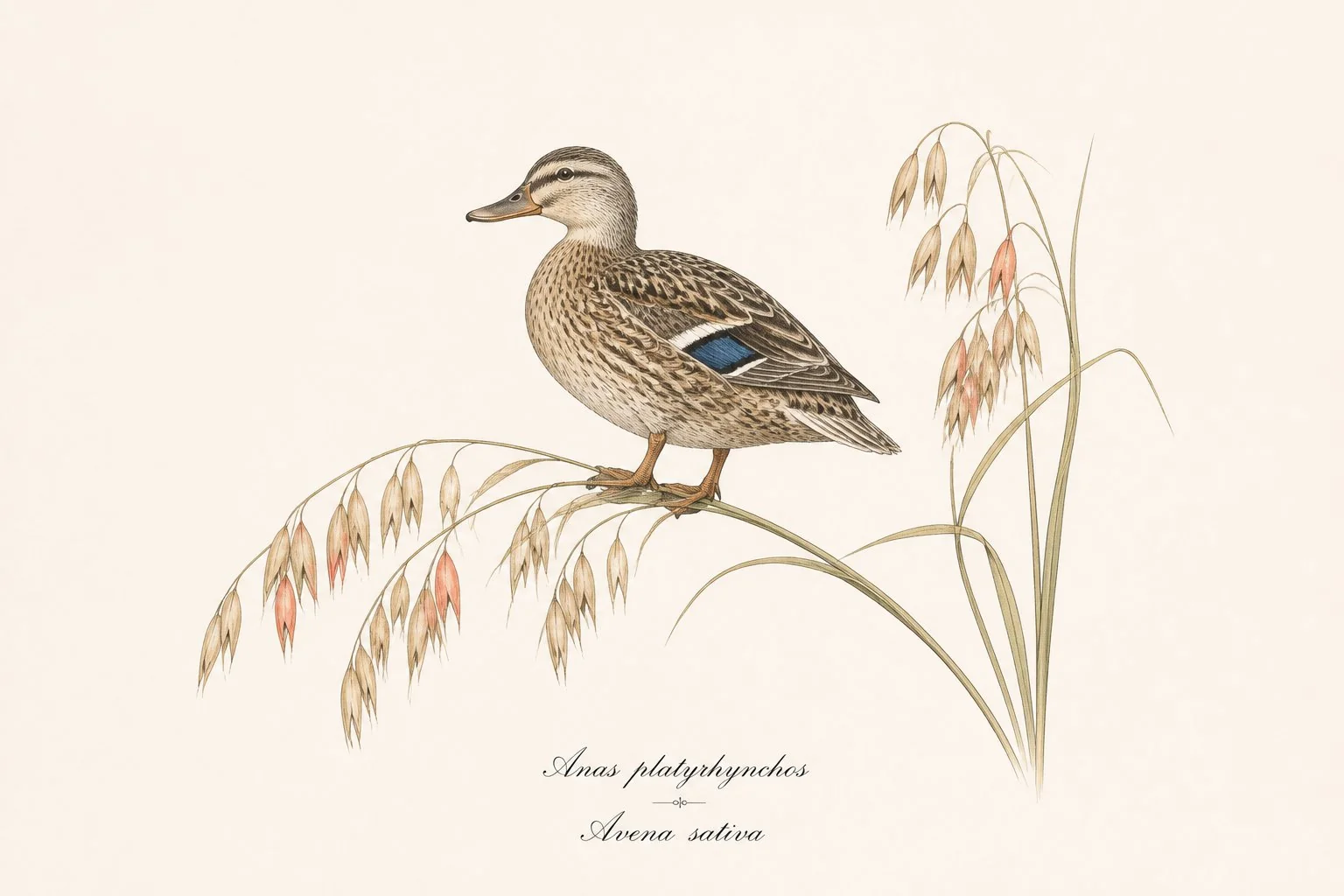
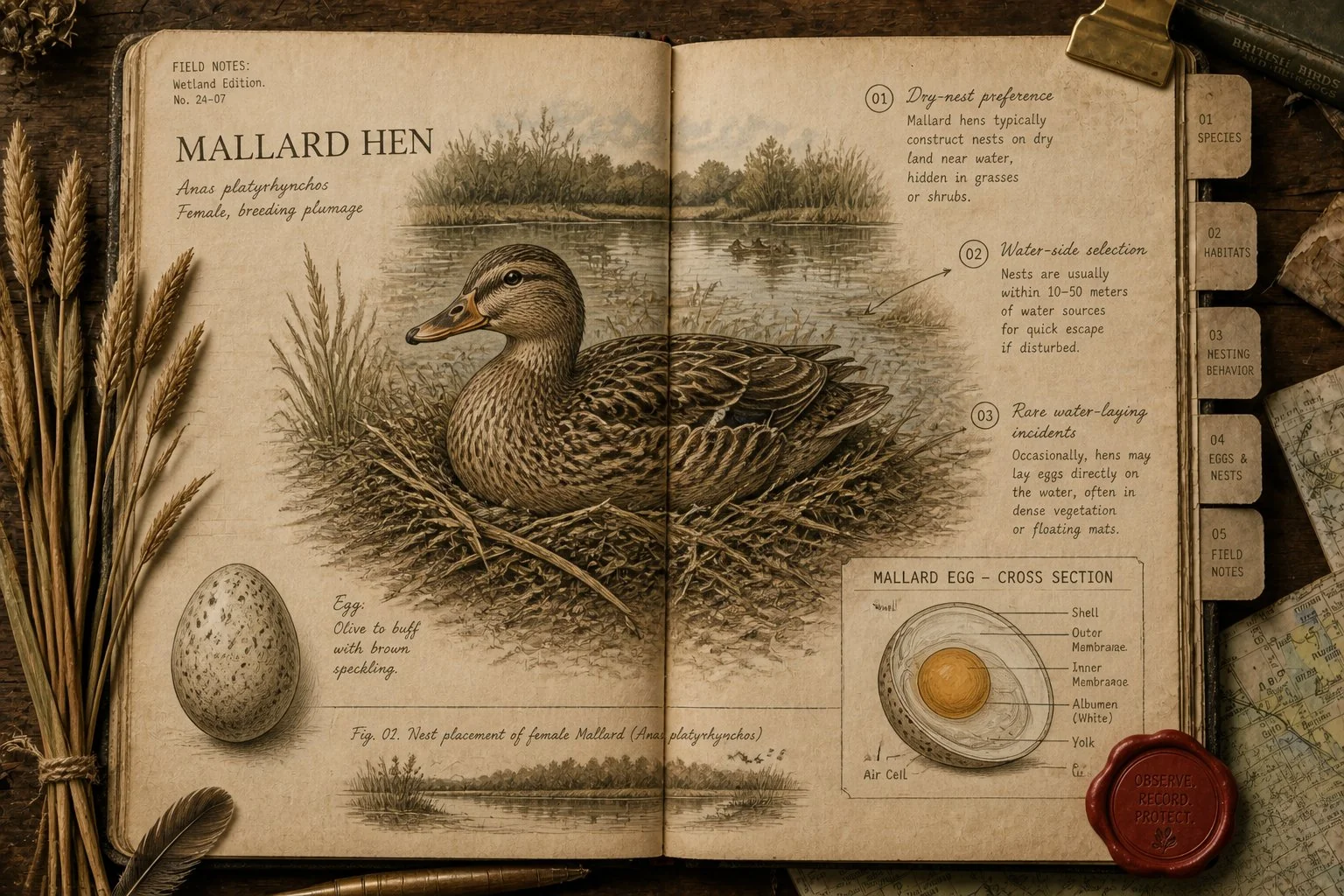
Hen on dry nest 2m from pond edge. 11 eggs. Standard mallard setup.
Ducks almost never lay eggs in water. Their nests are built on dry land - in grass tussocks, under shrubs, in tree cavities (Wood Duck and Hooded Merganser), or occasionally on muskrat platforms. The eggs need stable temperature, a dry surface for the brood patch contact, and protection from waves and currents. When you do see an egg in the water, it’s almost always one of three things: an accidental drop during nesting commute, a “dump nest” abandoned by a stressed hen, or an unhatched egg pushed out of the nest by a parent.
Why ducks lay on land, not water
Three physiological and behavioural reasons:
- Incubation temperature - eggs need to stay at 37-38°C. Water continuously absorbs heat from an egg, making incubation impossible. A nest sits on dry insulating material (down, grass, shredded vegetation) that holds the brood patch’s warmth against the egg.
- Brood patch contact - the hen has a featherless skin patch on her belly that presses against the eggs. This direct skin-to-egg contact is impossible when the eggs are in water.
- Survival of the chick at hatch - even if water-laid eggs somehow developed, the hatching chick would drown the moment it cracked the shell.
The few duck species that nest on water-side platforms (some tropical species build raised floating nests) still lay eggs on dry vegetation above the waterline.
Where ducks actually nest
By species type:
- Dabbling ducks (Mallard, Pintail, Teal, Shoveler) - on the ground in dense grass, sedge, or shrub cover within 100 metres of water.
- Cavity-nesting ducks (Wood Duck, Hooded Merganser, Common Goldeneye, Bufflehead) - in natural tree cavities or nest boxes, sometimes 30+ feet above ground.
- Diving ducks (Canvasback, Redhead, Lesser Scaup) - in dense emergent vegetation over shallow water, on platforms of bent reeds. The nest sits above the waterline.
- Sea ducks (Eider, Scoter) - on the ground on coastal islands, often colonially.
In every case, the eggs themselves sit on a dry, insulated platform.
When eggs do end up in water
Three scenarios:
- Accidental drop - a hen carrying or commuting from the nest may drop an egg into the water near the nest. Rare but happens.
- Dump nests / abandoned nests - a hen pushed off her nest by predation or human disturbance may drop her remaining clutch in the open. Some end up in water.
- Nest flooding - a heavy rainstorm raises water levels, the nest floods, and eggs are washed out. Common in ground-nesting species nesting too close to the waterline.
When you find a duck egg in shallow water, it’s almost always one of these. The egg is non-viable - either developmentally too far gone or, more often, never incubated at all.
What about ducks that nest "on water"?
Some species (Pied-billed Grebe, Common Loon, Coot) build floating nests on water and lay eggs on those nests - but the nest itself is a constructed dry platform of vegetation that sits a few centimetres above water level. The eggs never actually touch water.
Ruddy Ducks build platform nests in dense reeds over shallow water, similar to grebes. The platform itself stays dry.
So even the “water-nesting” species don’t literally lay in water. They lay on dry platforms built over water.
What to do if you find a duck egg in water
Leave it. The egg is non-viable - either because:
- It was never fertilised (a “dump” from a stressed hen)
- It was fertilised but never incubated (water exposure stops development quickly)
- It’s late-stage but drowning conditions killed the embryo
Removing eggs is technically illegal under the Migratory Bird Treaty Act in the US without a permit, though no one will prosecute you for picking up a clearly dead egg. If you find an active nest that’s been flooded, contact local wildlife rescue - they may move the eggs to artificial incubation in some cases.
Stovall 5H Cedar Duck Box
A proper nest stops water-laying mistakes.
If you keep domestic ducks or want to attract wild Wood Ducks to your pond, providing the right nest box ends the problem of eggs in unsuitable places. The Stovall 5H is sized for Wood Ducks and small domestic breeds; cedar resists rot in damp conditions; side-opening lid makes inspection and cleanout simple.
- Western Red Cedar construction
- Side-opening inspection lid
- Right dimensions for Wood Ducks and small domestics
 Stovall · 5H Cedar

As an Amazon Associate we earn from qualifying purchases.
The bottom line
Ducks don’t lay eggs in water by design. Nests are on dry land or in tree cavities. Water-laid eggs are almost always accidents, dump nests, or flood casualties - and they’re not viable. Even species with “water nests” actually use dry platforms built above the waterline.
For more, see do ducks lay unfertilised eggs and when ducks start laying.