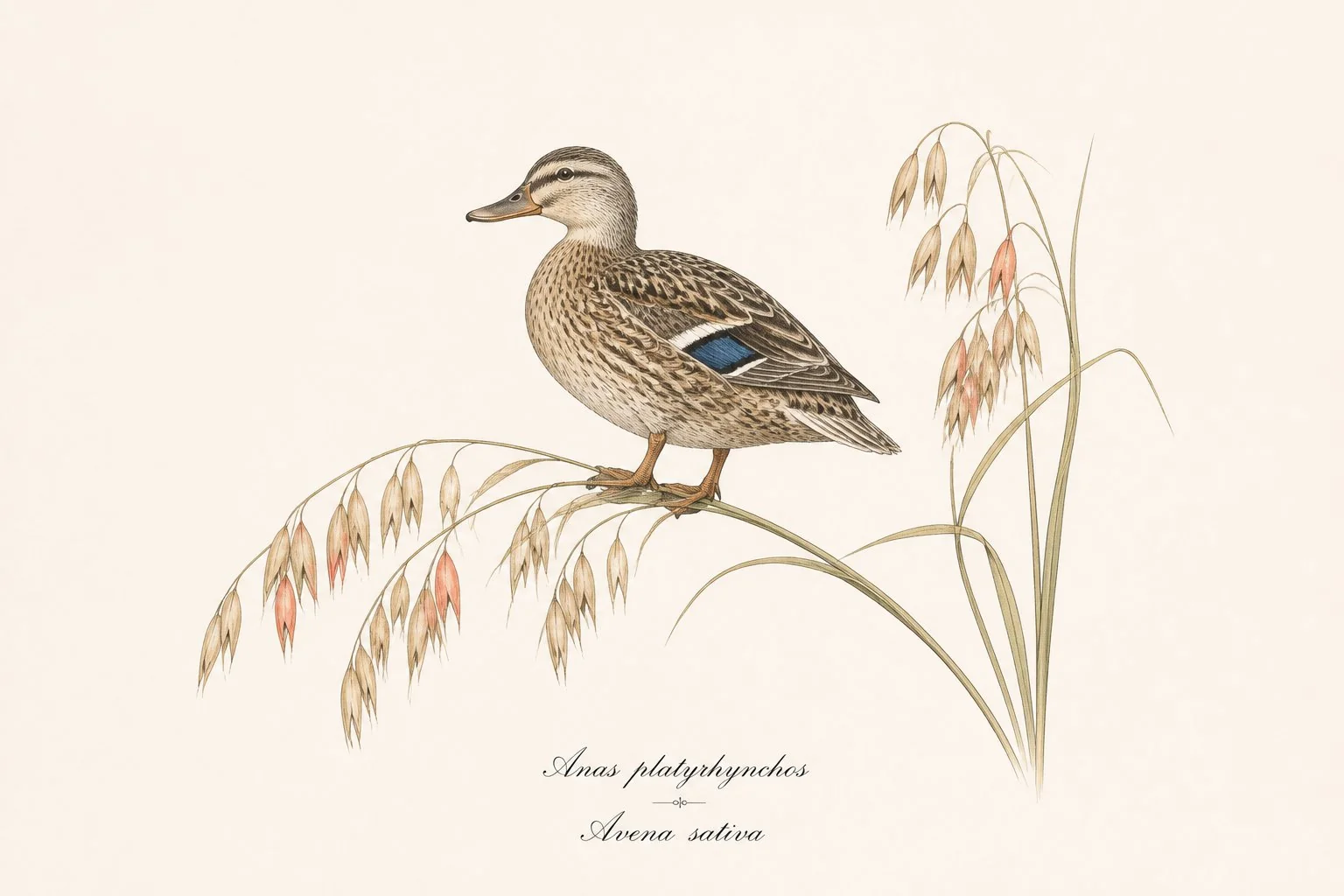
Mallard hen, orange bill with dark blotches. Pure breeding-plumage marker.
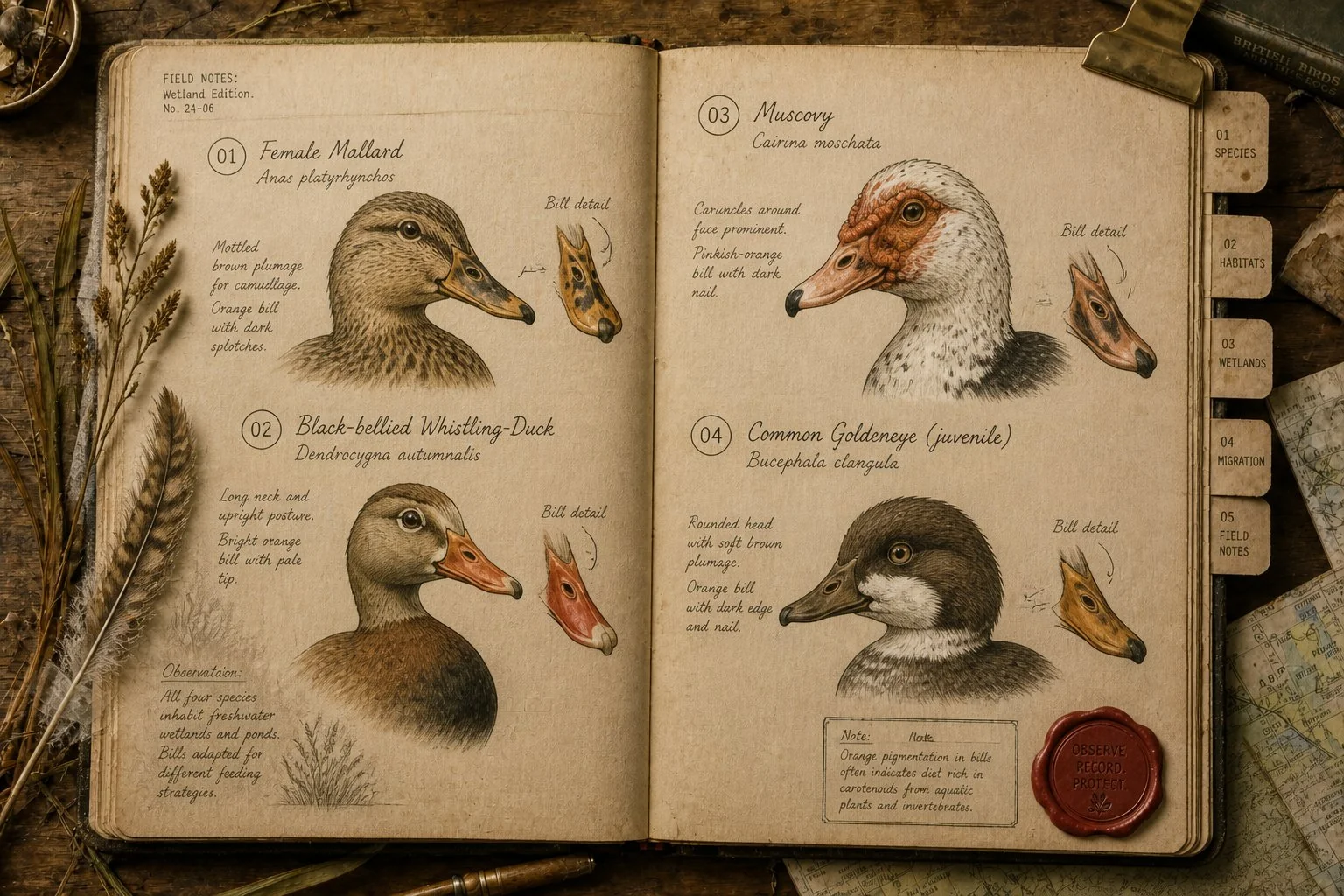
Several common duck species have orange bills, and in most cases it’s a sex or species marker that helps you identify the bird before you see the rest of it. The five you’re most likely to encounter: the female Mallard (orange with dark blotches), the male Black-bellied Whistling-Duck (bright coral-orange), the Muscovy (orange to pink, often blotched), the juvenile Common Goldeneye (dull orange), and several domestic breeds derived from the Mallard. Once you learn each one’s bill pattern, you can ID them at distance.
The five most common orange-billed ducks
- Female Mallard - orange bill with dark central blotches or a saddle of black on the upper ridge. The most common orange-billed duck in North America.
- Black-bellied Whistling-Duck - bright coral-orange to coral-pink bill, no black markings. Both sexes have the same bill colour. Common in the southern US and expanding north.
- Muscovy Duck - bill colour ranges from orange to pink to mottled red. Often visible warty facial caruncles distinguish them too.
- Common Goldeneye juvenile - dull orange bill (adult drake bill is dark grey-black). Helps separate first-winter birds.
- Domestic breeds derived from Mallard - Khaki Campbell, Welsh Harlequin, Pekin, Rouen, and others mostly retain the orange bill from their Mallard ancestor.
A note: many sources also list the female Wood Duck as orange-billed, but the Wood Duck female’s bill is dark with only a slight orange wash at the base.
Why orange specifically
Orange bill colour in ducks comes from carotenoid pigments deposited in the bill keratin. The pigments come from diet - aquatic plants, algae, and small invertebrates. Bill colour intensity tracks diet quality: a well-fed female Mallard has a brighter orange bill than a starved or stressed one. Researchers use bill colour as a quick body-condition index in some studies.
In drakes of dimorphic species, the female keeps the simple orange bill year-round while the male evolved fancier colours for breeding display.
How to separate female Mallard from female American Black Duck
This is the orange-bill identification challenge that catches most people:
- Female Mallard - orange bill with dark central saddle of blotches. Body warm tan-brown with strong patterning.
- Female American Black Duck - olive-yellow bill (often dull and dirty-looking). Body dark chocolate-brown with little patterning. Speculum violet-blue without white edges.
The bill colour difference is the most reliable single feature. The mallard’s bill is genuinely orange; the black duck’s is dull olive.
How to recognise a Black-bellied Whistling-Duck
If you see a duck with:
- A bright coral-orange (almost pink) bill
- Pink-orange legs
- Chestnut-brown body
- Black belly
- White wing-stripe in flight
… it’s a Black-bellied Whistling-Duck. They’re noisy (the whistling call carries), often perched in trees, and increasingly common across the southern half of the US.
The Muscovy question
Muscovy Ducks are native to Central and South America but feral populations are now established across the southern US, especially Florida and Texas. Their bills can be:
- Solid orange (most common)
- Pink-orange with black mottling
- Reddish in older drakes
The give-away is the facial skin: bare, often warty, sometimes red. No other common North American duck has that face.
Domestic and farmyard ducks
Most domestic duck breeds (except Muscovy and its derivatives) descend from the Mallard and inherit the orange bill. The bill colour can be slightly more vivid or duller depending on the breed:
- Khaki Campbell, Welsh Harlequin - typical orange.
- Pekin - vivid yellow-orange (the “rubber duck” colour).
- Rouen - close to wild Mallard pattern.
- Indian Runner - greenish-yellow to orange depending on bloodline.
These birds are obvious by their oversized bodies, unusual colours, and lack of fear of humans.
Sibley Field Guide East
Bill colour shown clearly in every plate.
Sibley's bill paintings are accurate to the species, sex, and seasonal plumage. The female Mallard vs female Black Duck comparison is one of the trickier IDs and Sibley shows them on facing pages with bill colour highlighted.
- Covers 650+ species of eastern North America
- Bill colour shown for both sexes, all seasons
- Pocket-friendly format for field use
 Sibley · 2nd Ed.

As an Amazon Associate we earn from qualifying purchases.
The bottom line
The most common orange-billed ducks are female Mallards, Black-bellied Whistling-Ducks, Muscovies, juvenile Common Goldeneyes, and Mallard-derived domestic breeds. Bill colour intensity reflects diet and condition. The female Mallard vs Black Duck pair is the most useful ID to learn since they overlap in range and look similar otherwise.
For more, see ducks with red eyes and do ducks have beaks or bills.