Field notes from three pond-builds over five years, the ones that worked and the ones that didn't.
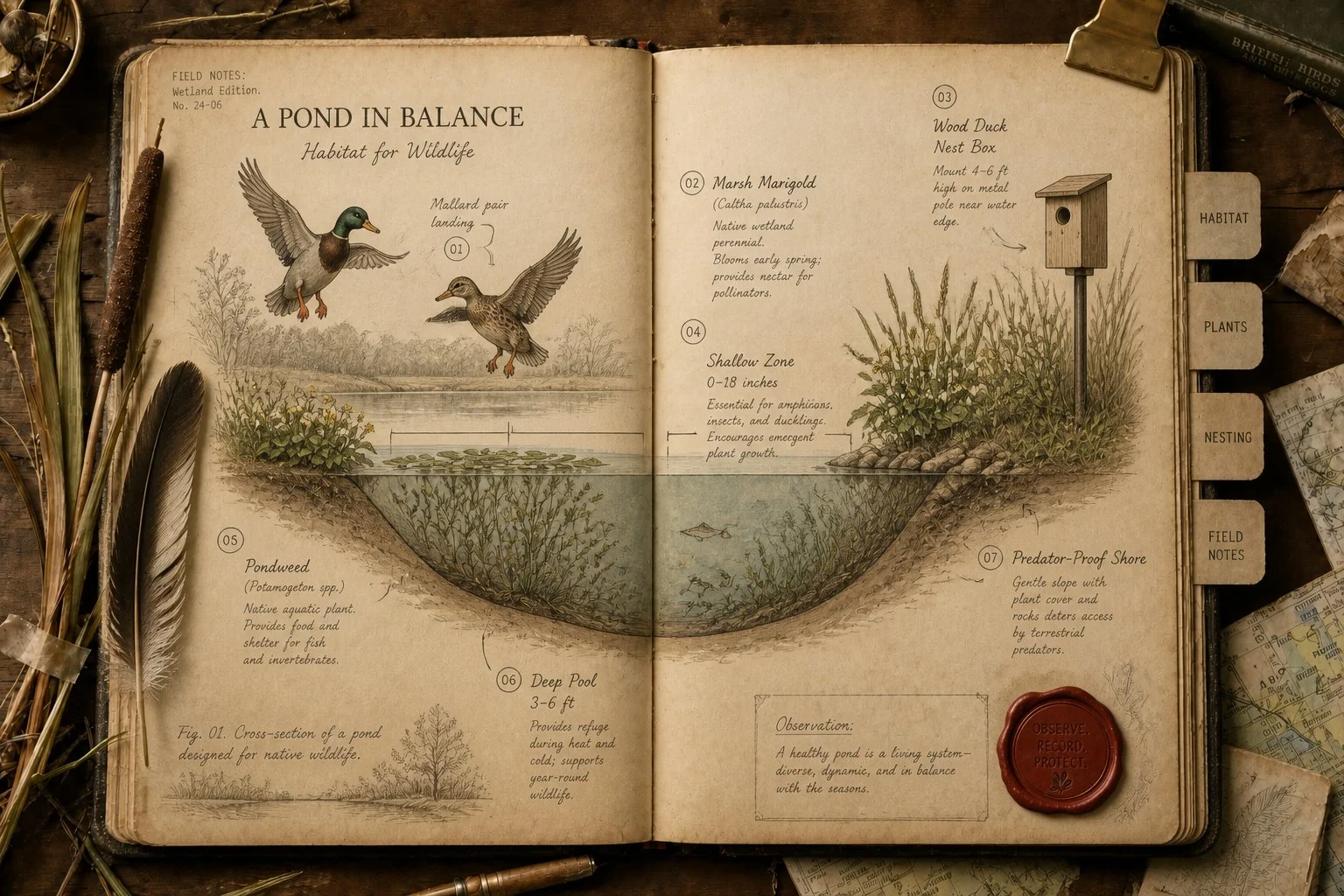
The short version: wild ducks need four habitat elements, all on the same pond. (1) Shallow margins under 18 inches deep for dabbling. (2) Submerged food plants (sago pondweed, wild celery, smartweed, duck potato). (3) Predator-proof cover (dense bank vegetation, an island, deep water in the centre). (4) Nest cavities (a Wood Duck box on a pole over the water). Build all four into a one-acre pond and the ducks find it within a single season. Skip any one and you’ll have only the ducks you fed by hand.
The four habitat elements
1. Shallow dabbling margins
Most dabbling ducks (Mallard, Pintail, Teal, Wigeon, Wood Duck) feed by upending in water under 18 inches deep. Their bills reach 25-40 cm into the substrate; deeper than that and the food is out of reach.
The implication for pond design:
- At least 25% of the pond perimeter should slope gently from 0 to 18 inches over a horizontal distance of 4-6 metres.
- No vertical concrete edges. Steep banks are useless for dabbling.
- Mud or soft substrate at the shallow end. Hard liner reduces the invertebrates that come up with the plants.
If your existing pond is too deep at the edges, the fix is filling in one corner with rubble, sand and topsoil to create a deliberate shallows.
2. Submerged and emergent food plants
The plants you want, ranked by usefulness to ducks:
- Sago pondweed (Stuckenia pectinata) - the gold-standard waterfowl plant. Submerged, tubers are eaten avidly.
- Wild celery (Vallisneria americana) - submerged ribbon-leaf plant. High-value forage.
- Smartweed (Polygonum spp) - seeds eaten readily by Mallards and Wood Ducks.
- Duck potato / arrowhead (Sagittaria) - tubers and leaves.
- Wild rice (Zizania aquatica) - seasonal forage where you can grow it.
- Bulrush (Schoenoplectus) - cover plant with edible seeds.
- Pondweed (Potamogeton spp) - general submerged forage.
What to avoid planting:
- Cattails alone - they overrun a pond and reduce open water.
- Phragmites (common reed) - invasive monoculture in many places.
- Water hyacinth or water lettuce - invasive in warm climates.
For the deeper planting breakdown, see best plants for ducks and what to plant for ducks in standing water.
True Native Seed Wetland Mix
The seed mix that builds the food layer of a working duck pond.
A native wetland mix with smartweed, wild millet, duck millet, sedges and other waterfowl-attracting species. Designed for direct-seeding around pond margins and into shallow flooded areas. Establishes in one growing season and feeds Mallards, Wood Ducks and Pintails through autumn and winter.
- Native mix - no invasive species
- Designed for direct-seeding around pond margins
- Establishes one season; produces seed and tubers in 1-2 years
- Sized for pond margins from 1/4 acre upward
 True Native · Wetland

As an Amazon Associate we earn from qualifying purchases. Linked products are ones we actually use.
3. Predator-proof cover
Wild ducks won’t stay on a pond they don’t feel safe on. Predator pressure comes from:
- Raccoons, mink, foxes - bank-side and into the water.
- Snapping turtles - in many regions, takes ducklings from below.
- Bald Eagles, Great Horned Owls, Cooper’s Hawks - aerial.
- Free-roaming dogs and cats - especially during nesting.
The defences that work:
- An island in the middle of the pond. Even a small (2-3 metre) island provides loafing and nesting habitat unreachable by mammals.
- Deep water in the centre (1.5+ metres). Ducks retreat to deep water at threat.
- Dense bank cover - shrubs and emergent plants that hide approaches.
- A clear line of sight from the duck’s loafing area to the approaches. Ducks want to see threats coming.
For the broader predator picture, see duck predators and how to protect ducks from hawks.
4. Nest cavities
For Wood Ducks (the single most striking species you can attract):
- A Wood Duck nest box mounted on a pole driven into the pond bottom, 1-1.5 metres above the water.
- Predator baffle on the pole below the box.
- Filled with wood shavings to 3-4 inches deep.
- Mounted no later than February for the breeding season.
For Mallards and Pintails (ground-nesters):
- Dense bank vegetation at least 20 metres from any disturbance.
- A nest cylinder (welded-mesh cylinder mounted on a pole) is an option for Mallards but less common than Wood Duck boxes.

The minimum pond size
You can attract ducks to surprisingly small ponds:
- 1/4 acre (1,000 m²): good for a single Wood Duck pair, occasional Mallards.
- 1/2 acre: Wood Duck plus Mallard pair, sometimes Hooded Merganser.
- 1 acre+: the standard “duck pond” - multiple species, breeding traffic, winter flock visits.
- 5 acres+: the holy grail - resident pairs of multiple species, regular hunting (where legal).
Smaller than 1/4 acre and you’re looking at occasional visits, not residents.
Timing the build
The seasonal calendar for a new duck pond:
- Year 1, spring/summer: dig pond, plant margins, install Wood Duck box. No expectation of ducks yet.
- Year 1, autumn/winter: first migrating ducks may stop briefly.
- Year 2, spring: first prospecting nest visits. Some pairs may stay.
- Year 2, summer: first broods (Wood Duck or Mallard) if the box is occupied.
- Year 3+: maturation. Plant cover thickens, broods raised reliably, winter flocks return.
Patience is the price. A new pond doesn’t fill with ducks in the first season; it builds toward it over 2-3 years.
What to feed (and what not to)
You don’t need to feed ducks at your pond if the habitat is right. The plants do the work.
If you do supplement:
- Cracked corn is fine in winter.
- Waste grain from local farms is excellent.
- Bread is not. See can ducks eat bread for the case against; the angel-wing data alone is enough to rule it out.
For the broader feeding logic, what to feed wild ducks.
The Wood Duck nest box specifically
The single highest-return intervention. Wood Ducks are spectacular, take to properly-built boxes readily, and produce visible broods you can watch from the bank.
Specs:
- Floor: 10 x 10 inches.
- Height: 24 inches.
- Entry hole: 4 inches wide x 3 inches tall (oval).
- Mounted on a galvanised steel pole, 1-1.5 m above water.
- Predator baffle below the box - critical.
- Filled with 3-4 inches of wood shavings.
The Stovall 5H cedar box meets all these specs and is the box we’d recommend for a pond install:
Stovall 5H Cedar Duck Box
Wood Duck nest box, cedar, the build that lasts decades.
A full-cedar Wood Duck nest box with predator-resistant entry collar and hinged roof. Mount on a pole over your pond at 1-1.5m above water, with a baffle below to deter raccoons. The single most useful intervention for a duck pond - Wood Duck pairs take to it within a season if the pond is the right size.
- Solid red cedar - 15+ year outdoor lifespan
- Predator guard collar around the entry
- Hinged roof for annual clean-out
- Pre-drilled mounting bracket
 Stovall · 5H Cedar

As an Amazon Associate we earn from qualifying purchases. Linked products are ones we actually use.
What if you have geese on the pond?
If Canada Geese have already claimed the pond, they’ll often displace breeding ducks. The geese question is in do swans keep geese away - the working solutions for goose control.
The bottom line
Four habitat elements - shallow margins, food plants, predator cover, nest cavities. Build all four into a 1-acre pond and you’ll have Wood Ducks and Mallards inside two seasons. Skip the shallow margins or the nest box and you’ll have a pretty pond that ducks pass over. The habitat does the work; supplemental feeding doesn’t substitute.