Field notes from three pond plantings - one disaster, two that worked.
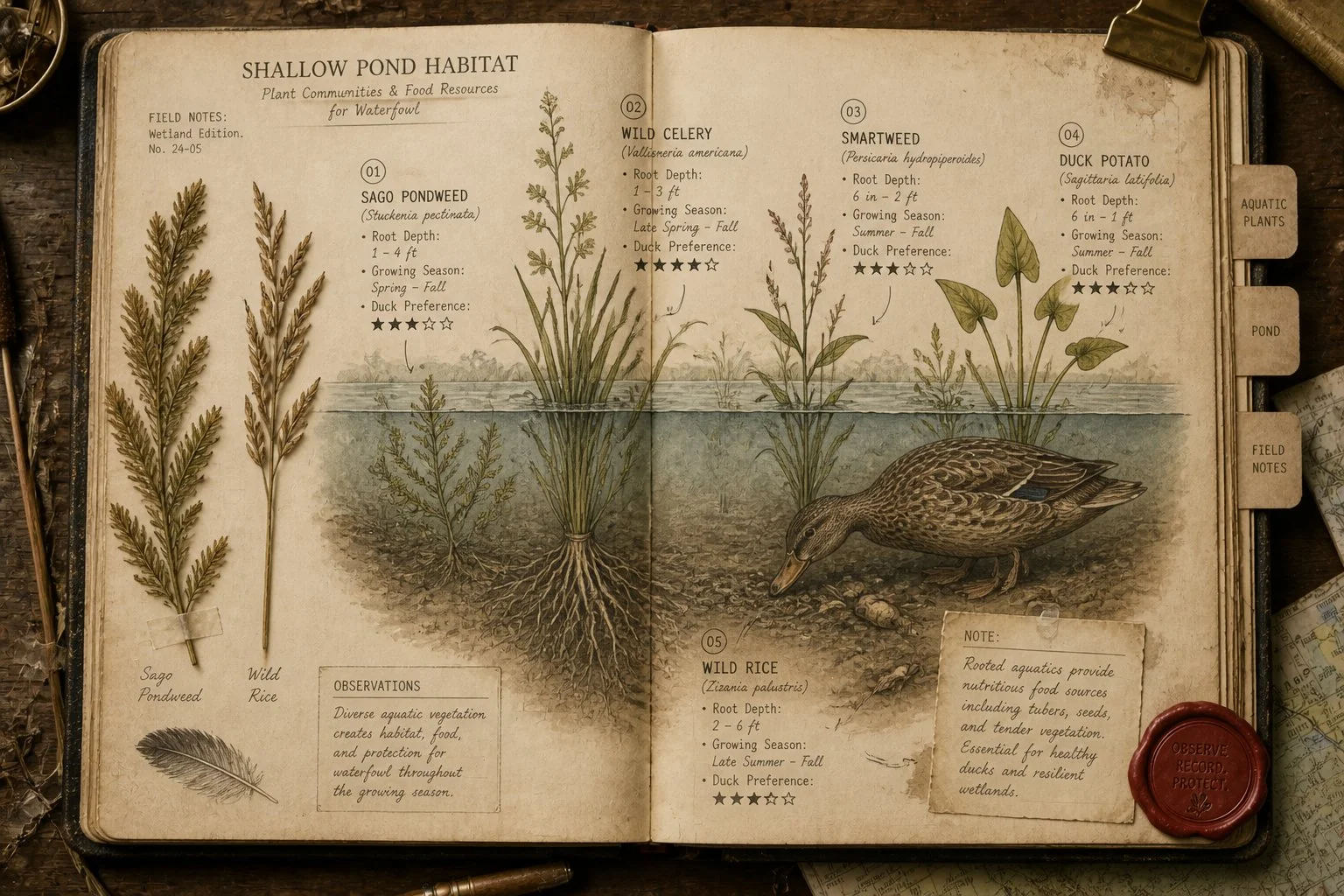
The short version: five aquatic plants cover most of what a working duck pond needs. (1) Sago pondweed - submerged, tuber-feeding, the gold standard. (2) Wild celery - submerged ribbon plant. (3) Smartweed - seed producer. (4) Duck potato (arrowhead) - tubers and leaves. (5) Wild rice - seasonal seed bonanza. Each one prefers a different water depth. Plant in spring, expect a year before the pond looks established, two years before the ducks treat it as a steady food source.
The five plants that do the work
1. Sago Pondweed (Stuckenia pectinata)
Type: submerged perennial. Depth: 1-3 metres of water. What ducks eat: tubers (most important), seeds, and entire plant. Who eats it: Mallard, Pintail, Canvasback, Redhead, Tundra Swan - the gold-standard waterfowl plant. Establishment: plant tubers in spring at a depth of 30 cm into soft pond substrate. Establishes by summer; full bed by year 2.
The single most useful submerged plant for a duck pond.
2. Wild Celery (Vallisneria americana)
Type: submerged perennial with long ribbon leaves. Depth: 0.5-2 metres. What ducks eat: entire plant, winter buds (turions). Who eats it: Canvasback (named for the food, almost), Redhead, Scaup, Tundra Swan. Establishment: plant rhizomes in spring; sometimes available as commercial wetland nursery stock.
The Canvasback’s preferred food. If you want to attract Canvasbacks, this is the plant.
3. Smartweed (Polygonum spp - several species)
Type: emergent annual (some perennials). Depth: wet soil to 30 cm of water. What ducks eat: seeds (massive seed crop in late summer). Who eats it: Mallard, Wood Duck, Pintail, Black Duck - most dabbling ducks. Establishment: broadcast seed in late spring, in moist soil. Re-seeds itself once established.
Often included in commercial wetland seed mixes. Easy to establish; produces seed in the first season.
4. Duck Potato / Arrowhead (Sagittaria latifolia)
Type: emergent perennial with arrow-shaped leaves. Depth: 5-50 cm of water. What ducks eat: tubers underwater, leafy parts above. Who eats it: Mallard, Wood Duck, Pintail, Hooded Merganser (the duck digs the tubers out). Establishment: plant tubers in spring into soft substrate. Multiplies rapidly.
A signature plant of any working duck pond. Visually distinctive.
5. Wild Rice (Zizania aquatica)
Type: annual emergent grass. Depth: 15-60 cm of water with consistent water levels. What ducks eat: seeds in late summer and autumn. Who eats it: Mallard, Wood Duck, Pintail. Also blackbirds, sora rails, indigenous people. Establishment: broadcast seed in late spring. Requires consistent water - it doesn’t tolerate drying out.
Spectacular in autumn when the seedheads ripen and ducks pile in.

The depth zonation
A working duck pond should have plantings stratified by water depth:
- Wet bank to 5 cm depth: smartweed (broadcast seed).
- 5-30 cm depth: duck potato.
- 30-60 cm depth: wild rice (if water levels are stable).
- 0.5-2 m depth: wild celery, plus some pondweed.
- 1-3 m depth: sago pondweed.
Aim for at least three of the five depth zones planted. A pond with only one depth zone (e.g., all 2-metre water) is much less productive than one with shallows and deep areas.
For the broader pond-build context, see how to attract ducks to your pond for the four-habitat framework these plants sit inside.
The wetland seed mix worth buying
For most pond owners, the easiest path is a pre-built native wetland seed mix that contains smartweed and similar species. The mix below establishes in one growing season around your pond margins.
True Native Seed Wetland Mix
The seed mix that does the bulk of the work in a duck pond.
A native wetland mix with smartweed, wild millet, duck millet, sedges, and other waterfowl-attracting species. Designed for direct-seeding around pond margins and into shallow flooded areas. Establishes in one growing season; produces seed and tubers in 1-2 years. Pairs well with planted tubers of sago, wild celery and duck potato for the deeper-water zones.
- Native mix - no invasive species
- Designed for pond-margin direct-seeding
- One-season establishment
- Sized for ponds from 1/4 acre upward
 True Native · Wetland

As an Amazon Associate we earn from qualifying purchases. Linked products are ones we actually use.
Plants to AVOID
These look attractive but cause problems:
- Cattails alone (Typha) - overrun a pond, reduce open water, close shorelines. Allow a small clump only; manage aggressively.
- Phragmites (common reed) - invasive across much of North America. Monoculture; chokes out other species.
- Water hyacinth (Eichhornia) - invasive in warm climates; can completely cover a pond surface.
- Water lettuce (Pistia) - same problem as water hyacinth.
- Eurasian milfoil (Myriophyllum spicatum) - invasive submerged plant; outcompetes natives.
- Hydrilla - banned invasive in many US states.
If you’re buying plants, source from native nurseries that label species properly. Avoid generic “pond plants” packs at chain garden centres - they often include invasive species.
The four-zone pond planting plan
For a new 1/4-1 acre pond:
Year 1, spring:
- Broadcast wetland seed mix around the wet bank and 0-15 cm zone.
- Plant 20-30 duck potato tubers in 15-30 cm water around the edge.
- Plant 10-20 sago pondweed tubers in deeper water (1-2 m).
- If conditions are right, broadcast wild rice into 15-60 cm water (consistent depth needed).
Year 1, autumn:
- Don’t expect heavy duck use yet. The pond is establishing.
Year 2:
- Pond looks more established. First broods may use the pond.
- If gaps remain, plant wild celery rhizomes (commercial nursery stock).
Year 3+:
- The pond is mature. Plant communities self-sustain.
- Manage cattails aggressively if they’re spreading. Manual cutting or controlled flooding works.
Maintenance through years
A planted duck pond needs:
- Year 1: weekly check for invasive species. Pull any phragmites, water hyacinth, milfoil.
- Year 2: check for cattail spread. Cut back as needed.
- Year 3+: annual review. Sometimes wild rice fails (water level was wrong); reseed.
- Drought response: if the pond drops more than 30 cm, the wild rice and sometimes wild celery stress. Add water if possible.
For specific species
If you want particular ducks:
- Wood Ducks: add a nest box plus duck potato and wild rice.
- Mallards: smartweed, duck potato, accessible shallows.
- Pintails: smartweed in mudflats, sago pondweed.
- Hooded Mergansers: open water + small fish + nest box.
- Canvasbacks: wild celery, deep water. The hardest to attract.
For the broader case, see best plants for ducks and how to attract ducks to your pond.
The bottom line
Five plants cover most of what a duck pond needs: sago pondweed, wild celery, smartweed, duck potato, and wild rice. Plant in depth-zoned strata; expect two years before you have a working ecology; avoid the invasive look-alikes. The pond does most of the work itself once it’s established.