Field notes after three winters of grey-squirrel war.
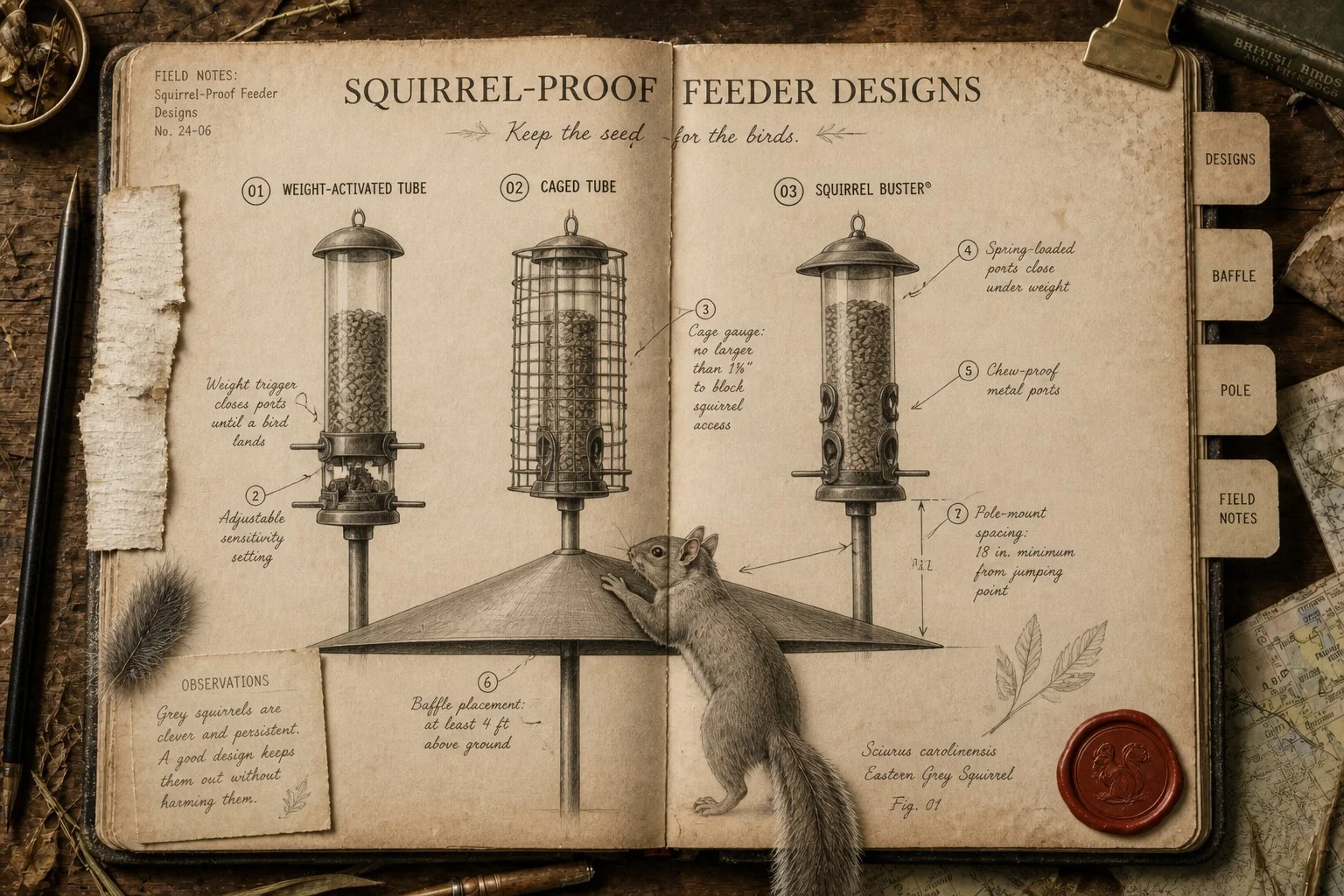
The short version: three designs work and the rest are gimmicks. (1) Weight-activated feeders close when anything heavier than a magpie lands on the perch. (2) Caged feeders surround the seed in a wire mesh small enough to admit songbirds and exclude squirrels. (3) Pole-mounted feeders with a properly-sized baffle on the pole and ten feet of horizontal clearance defeat squirrels by physics. Pick one of the three, hang it correctly, and the squirrel problem ends.
Why most "squirrel-proof" feeders fail
Grey squirrels are problem-solvers. They’ve defeated, in our garden alone:
- Greased poles (they wait for rain)
- Spinning perches (they grip the central tube)
- Capsaicin-treated seed (they get used to it)
- “Squirrel-proof” mesh that turned out to be 1-inch wire (squirrels squeeze through)
- Pole feeders mounted too close to a fence (8 feet was within jump range)
What does work is physics. Squirrels can’t open a hinged lid weighing more than themselves; can’t pass through a 1.5-inch wire mesh; can’t jump more than 10 ft horizontally or 5 ft vertically from a stable launch point. Defences based on those facts work permanently. Defences based on novelty or repellent get defeated within a week.

Design 1: weight-activated lid
The principle: a perch ring attached to a hinged lid by springs or counterweights. Light birds (chickadees, finches, titmice, sometimes cardinals) sit on the perch with no effect. Anything heavier than a calibrated threshold - typically around 150 g, so squirrels, jackdaws, magpies, and pigeons - closes the lid by its own weight.
Strengths:
- No setup, no maintenance, no calibration drift.
- Works regardless of how the squirrel arrives.
- All-metal construction lasts winters.
Weaknesses:
- Excludes large native birds too (cardinals if on a heavy port, large doves, jays). Acceptable trade-off in most gardens.
- Higher price than a basic tube feeder.
This is our default recommendation and what we’ve used for three winters.
Esschert Squirrel-Proof Feeder
Three winters tested, lid never failed, squirrels never got in.
A hinged jar holder with a weight-sensitive perch. Small birds feed; squirrels, magpies and jackdaws close the lid by their own weight. Steel, no batteries, no springs to fail. Takes a standard 16 oz peanut butter jar (or refill with sunflower hearts). Built to wash properly in hot soapy water - critical for disease control.
- Takes a standard 16 oz jar - no proprietary refills
- Weight-triggered closure - no setup or calibration
- All-metal, dishwasher-safe in hot water
- Powder-coated steel - rust-resistant through multiple winters
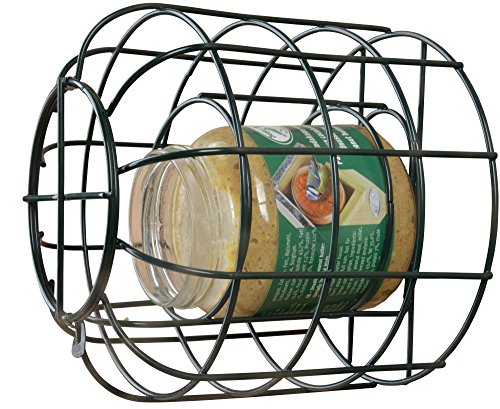 Esschert · FB289

Design 2: caged feeder
The principle: a wire mesh cage surrounds a standard tube feeder. The mesh openings are sized at roughly 1.5 inches square - small enough that squirrels (and grackles, starlings, pigeons) can’t pass through; large enough that chickadees, finches, sparrows and nuthatches enter freely.
Strengths:
- Excludes squirrels AND invasive birds (starlings, grackles) at the same time.
- No moving parts.
- Works with any tube feeder you already own (drop-over versions sold separately).
Weaknesses:
- Excludes cardinals, blue jays, doves - all of which won’t pass through the mesh.
- The cage itself can fill with seed dropped during chase-offs.
- Bulky on a hook.
Good for high-pressure squirrel situations or gardens with house sparrow / starling dominance.
Design 3: pole-mounted with baffle
The principle: any feeder, on a pole, with a wide baffle plate halfway up that a squirrel can’t climb past, AND positioned so the squirrel can’t jump to it from anywhere.
The 10-foot rule:
- 10 feet horizontally from any structure (tree, fence, shed, roof edge) a squirrel can launch from.
- 5 feet of clear air above the feeder.
- 5 feet of clear air below the feeder to the ground.
- The baffle has to be at least 16-18 inches wide; smaller ones don’t work.
Strengths:
- Cheapest defence if you already own a feeder.
- Doesn’t exclude any bird.
- Works for any feeder type.
Weaknesses:
- Requires actual 10 feet of clear ground in your garden - not always possible.
- A wide pole with a wide baffle is intrusive visually.
If you can spare the space, this is the most universal solution.
Audubon Torpedo Squirrel Baffle
The baffle that actually works at the size that matters.
A 16-inch wide torpedo-shaped baffle that clamps to a 1-inch pole. Squirrels climbing the pole hit the wide curved surface and can't get past it. We use this on every pole-mounted feeder; the smaller (12-inch) baffles let determined squirrels stretch around. The Audubon torpedo doesn't.
- 16 inches wide - the working diameter for grey squirrels
- Clamps to standard 1-inch shepherd's hooks and feeder poles
- UV-stabilised plastic - lasts seasons outdoors
- Used by wildlife centres for owl box poles - same principle
 Audubon · 16in baffle

As an Amazon Associate we earn from qualifying purchases. Linked products are ones we actually use.
The placement still matters
Even the best squirrel-proof feeder fails if it’s hung from a branch within 5 feet of a tree trunk. The feeder design is the second line of defence; placement is the first. The full placement breakdown is in best place for a bird feeder.
The same principles transfer to owl nest boxes and bluebird boxes - the squirrel pressure on a nest box can be more damaging than on a feeder. See how to keep squirrels out of an owl nest box for that version.
The "feed the squirrels separately" approach
If you don’t want squirrels on the bird feeder but you don’t mind them in the garden, an effective sub-strategy is a dedicated squirrel feeder (corn or peanuts) at the far end of the garden. A well-fed squirrel works less hard at the bird feeder.
This doesn’t fully solve the problem - squirrels still raid the bird feeder for variety - but it reduces the pressure noticeably. Not a substitute for a properly squirrel-proof feeder, but a useful addition.
What not to bother with
- Sticky / oily pole coatings. Wash off in rain, dangerous to birds if they land on the pole.
- Capsaicin (hot pepper) seed. Squirrels habituate; works briefly.
- Cayenne-coated peanut butter. Same problem.
- Ultrasonic deterrents. Squirrels ignore them, songbirds may not.
- Cheap plastic spinning perches. Squirrels figure them out.
Stick to physics. Hinged lids, wire cages, and properly-baffled poles. The squirrels can’t out-physics you.
The bottom line
Three designs work - weight-activated, caged, or pole-and-baffle. Pick one based on which birds you want (caged excludes cardinals and jays; weight-activated excludes the largest birds; pole-and-baffle excludes nothing if placed right). Combine with the placement rules in best place for a bird feeder and the seed inventory in best bird seeds, and you’ve solved the squirrel question for good.
For the broader case on whether bird feeders are worth the trouble at all - including the disease and cat issues that matter more than squirrels - see are bird feeders bad.