Field notes on whether to share the trail mix with the backyard ducks.
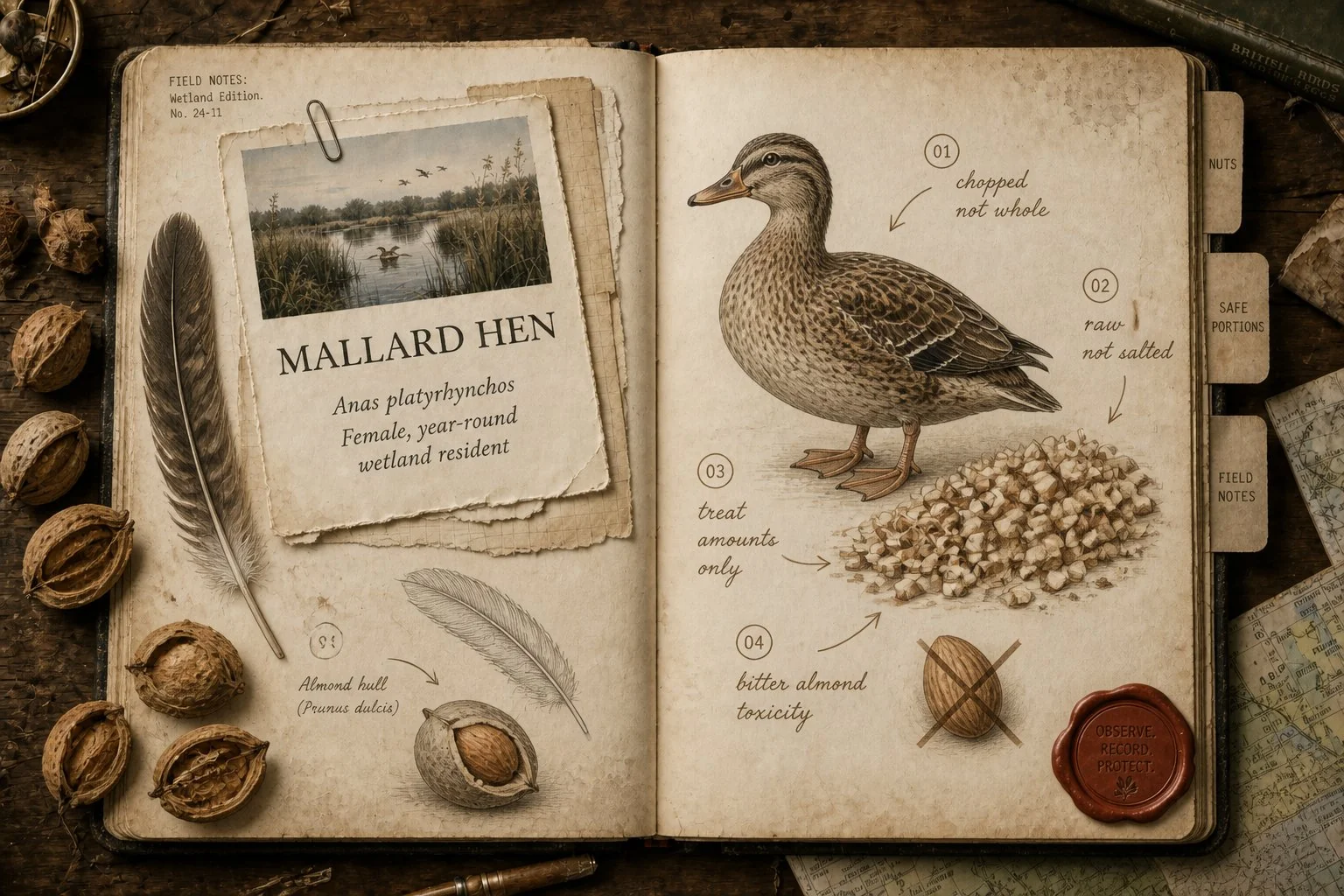
The short version: yes, ducks can eat sweet almonds in small quantities, but only raw, unsalted, and chopped fine enough that they can’t choke. A whole almond is a choking hazard. Bitter almonds (Prunus dulcis var. amara) contain amygdalin and are toxic - avoid them entirely. Salted, smoked, or flavoured almonds are unsafe at any quantity. Keep nuts as an occasional treat, not a daily food.
The three caveats, in order
1. Chopped, not whole
A whole almond is the wrong size and shape for a duck’s gullet. Ducks lack the chewing apparatus to break a nut down - they swallow whole and grind in the gizzard. A whole almond can lodge in the oesophagus and cause choking; in the worst cases it causes asphyxiation.
The safe form: chopped into pieces no larger than a grain of cracked corn (about 4-5 mm). A quick coarse chop with a knife on a cutting board is enough.
For ducklings under 4 weeks, skip nuts entirely - they’re still developing their gizzard function.
2. Raw, unsalted, unflavoured
Salted, smoked, honey-roasted, chilli-flavoured or otherwise processed almonds are unsafe for ducks. Salt is the main culprit - waterfowl kidneys can’t process sodium loads the way mammals can, and even a small handful of salted nuts is a real risk.
What’s safe: raw almonds, blanched almonds (skinless, unsalted), almond flour in trace amounts.
What’s not: roasted-and-salted, dry-roasted, flavoured, sugar-coated, chocolate-coated, or anything from the savoury snack aisle.
3. Sweet almonds only - never bitter
There are two main types of almond. Sweet almonds (Prunus dulcis var. dulcis) are what we eat - the kind sold in supermarkets. Bitter almonds (Prunus dulcis var. amara) contain amygdalin, a compound that breaks down to cyanide in the gut.
Sweet almonds are safe in small amounts. Bitter almonds are toxic - even small quantities can poison a duck. In the EU and US, bitter almonds aren’t sold for consumption; you encounter them only through almond extract (heavily processed and safe) or specialty Mediterranean grocers (avoid feeding to ducks).
If you can’t tell the difference, the labelling rule is: “almonds” in a supermarket = sweet almonds, safe in moderation. Anything labelled “bitter almond” or specifically marked as such = do not feed.
How much is "a small amount"?
The general nut-treat guideline for a backyard duck:
- Per duck, per week: roughly 1 small almond’s worth (chopped). That’s about 1 gram of chopped nut.
- Daily: no more than a quarter-teaspoon of chopped nut per duck.
- As percentage of total diet: less than 5% of weekly food intake.
Nuts are high in fat and calorie-dense. A duck that fills up on almonds skips the more nutritionally complete waterfowl pellets and develops imbalances - especially calcium-to-phosphorus ratio problems that affect bone and egg-shell development.
A treat is enrichment, not a meal.
What ducks should actually eat as a staple
The base diet for backyard ducks is a formulated waterfowl pellet (or a chick starter supplemented with brewer’s yeast for niacin). On top of that, the working treat list is:
- Cracked corn in moderation. The pondside staple. See best food to feed ducks and geese.
- Fresh chopped vegetables: lettuce, kale, peas, cucumber, courgette.
- Dried mealworms rehydrated in warm water.
- Occasional chopped fruit: apple (no seeds - see can ducks eat apples), berries, melon.
- Tiny amounts of chopped raw almonds or other safe nuts.
What to avoid entirely: bread, milk (see can ducks drink milk), avocado (toxic - see can ducks eat avocado), citrus, onions, garlic, anything salted.
Other nuts: how they rank
Quick reference for the wider nut category:
- Almonds (raw, chopped). Safe in moderation, with the caveats above.
- Peanuts. Safe (botanically a legume, not a nut), unsalted, raw or dry-roasted-no-salt. Chop or buy “peanut pieces.”
- Walnuts. Safe in tiny amounts, raw, chopped fine. High in fat - keep portions very small.
- Pecans. Safe, same caveats as walnuts.
- Hazelnuts / filberts. Safe, chopped fine.
- Cashews (raw, unsalted). Safe in moderation.
- Brazil nuts. Very high in selenium - feed only in trace amounts.
- Macadamias. Avoid - documented toxicity in some animals, insufficient research in waterfowl.
- Pistachios. Safe if unsalted and shelled, but the salt issue makes most retail pistachios unsafe.
The recurring rule: raw, unsalted, chopped, sparingly.
The bag we'd recommend for treats
If your ducks like cracked corn as a treat (most do), it’s the cheaper and safer everyday option than nuts. A 50 lb sack lasts a season and stores well.
CountryMax Cracked Corn 50 lb
The everyday duck treat - safer than nuts, much cheaper.
A 50 lb sack of cracked corn at the right size for backyard duck treats and pondside feeding. Calorie-dense enough to matter in winter, palatable, and stores stably in a sealed bin. The "saving the almonds for guests" alternative.
- 50 lb sack - season's supply for a small flock
- Cracked to the right size for ducks and geese
- Decant into smaller resealable bags
- Stores months in a sealed metal bin
 CountryMax · 50 lb

As an Amazon Associate we earn from qualifying purchases. Linked products are ones we actually use.
Wild ducks at the pond
If you’re feeding wild ducks at a park pond, skip nuts entirely. They’re harder to disperse, they sit at the bank where rats find them, and they’re not a natural food. Stick to cracked corn, frozen peas (thawed), and oats. See what can I feed ducks at the pond for the pondside breakdown.
For the broader case on what wild ducks should eat, see what to feed wild ducks.
The bottom line
Yes, ducks can eat sweet almonds - raw, unsalted, chopped, in small amounts, sweet variety only, never bitter. A few chopped almonds once a week is fine as enrichment for a backyard flock. Don’t make nuts a staple, don’t feed salted or roasted, and never feed bitter almonds. For wild ducks at a pond, skip nuts altogether.