Field notes from a spring count at Skagit Wildlife Area, the week the first Mallard hen disappeared into the cattails.
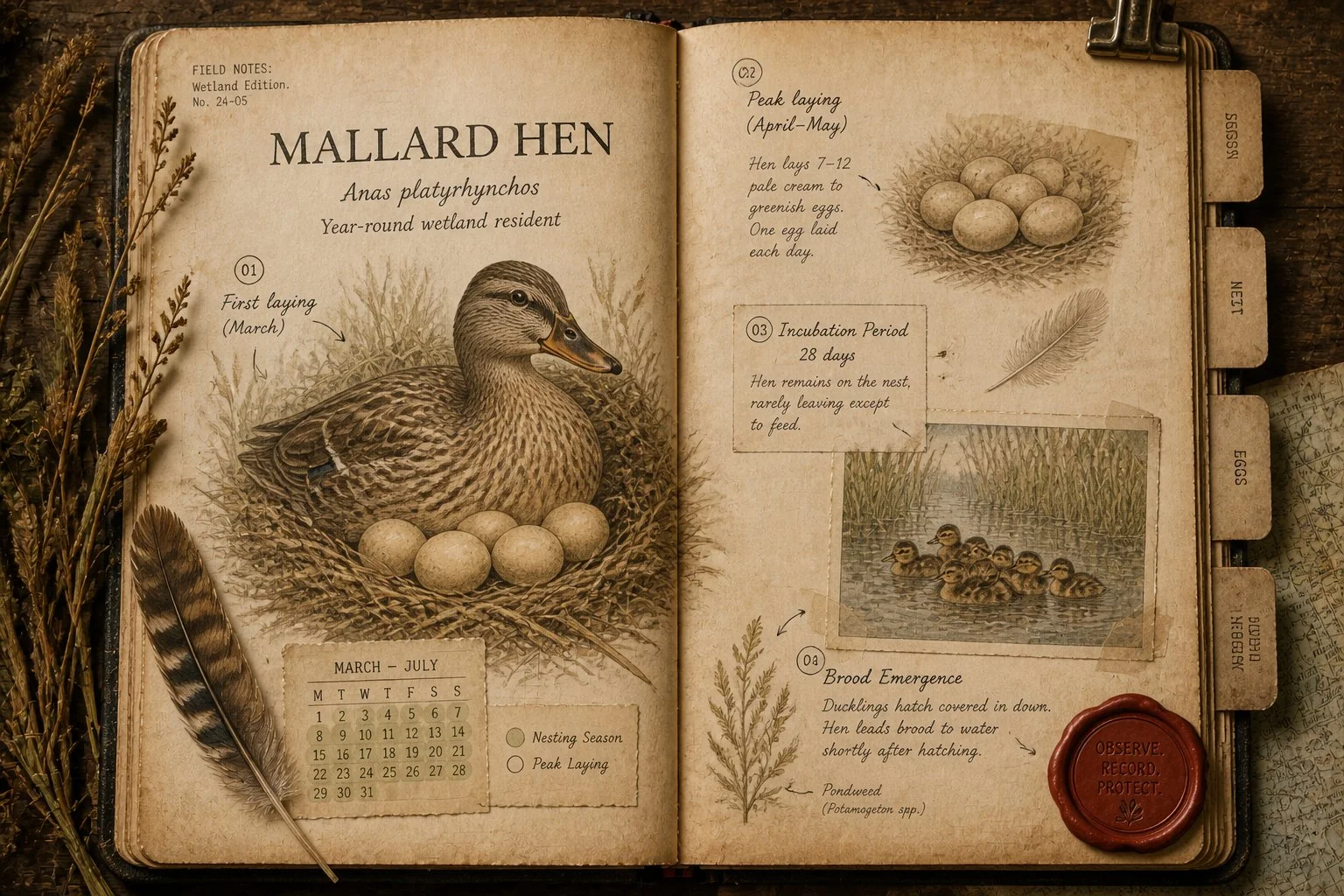
The short version: wild ducks in North America start laying eggs in mid-March (southern populations) to late April (northern populations). The peak laying window is April-May, with second broods in June-July for species that re-nest if the first fails. Mallards typically lay 8-13 eggs over 12-15 days; incubation is 26-28 days; ducklings fledge at 50-60 days. Wood Ducks start earliest (often late March); Pintails follow; teals are typically latest.
The general timeline
For most North American dabbling ducks (Mallard, Pintail, Wigeon, Teal):
- February-March: pair bonds form on wintering grounds.
- March-April: birds migrate to breeding areas. Pairs scout nest sites.
- April: peak laying. Hens lay one egg per day for 8-13 days.
- April-May: incubation. Hen sits on the nest, drake usually leaves and joins drake flocks.
- May-June: ducklings hatch. Hen leads them to water within 24 hours.
- June-July: ducklings grow, learn to dive, learn to fly.
- July-August: ducklings fledge (fly).
- August onward: family groups dissolve.
Wood Ducks start earlier - sometimes late February in the South, mid-March across most of their range. Their cavity-nesting habit means they’re less weather-dependent than ground-nesters.

The clutch and incubation breakdown
For Mallard (the most-studied):
- Clutch size: 8-13 eggs typically (rarely up to 15).
- Laying interval: one egg every 24-36 hours; clutch complete in 8-15 days.
- Egg colour: cream to pale greenish.
- Egg size: about 57 x 41 mm; 55 g each.
- Incubation: starts when last egg is laid. 26-28 days, hen only.
- Hatching: ducklings hatch within a few hours of each other (synchronous).
- Brood departure: hen leads ducklings to water 24 hours after hatching.
For Wood Duck:
- Clutch 9-14 eggs.
- Incubation 28-37 days.
- Ducklings jump from the nest box (up to 20+ feet) within 24 hours of hatching.
For Pintail:
- Clutch 7-9 eggs.
- Incubation 22-24 days.
Teals are similar to Pintail.
The renesting pattern
If the first nest is destroyed by a predator (fox, raccoon, snake), the hen will usually attempt a second clutch:
- Renest probability: 50-70% for Mallards.
- Timing: second laying typically 2-3 weeks after first failure.
- Clutch size: smaller (5-8 eggs).
- Outcome: lower brood survival rates than first clutches.
This is why hen Mallards keep being seen with smaller-than-normal broods in late June and July. They’ve already lost a first clutch.
For the broader duck-predator question, see duck predators.
Why the timing matters
Wild duck breeding aligns with three resources:
- Open water. Northern breeders can’t lay until lakes thaw. Mallards in central Canada don’t start until mid-April; in Texas they can start in late February.
- Aquatic insect emergence. Mid-spring is when chironomid midges, mayflies, and other duckling food blooms. Ducklings need invertebrate protein for growth.
- Long days. Daylight triggers the hormonal cascade. Northern breeding ducks evolved to use the long northern daylight for chick rearing.
A duck that starts too early loses chicks to cold; one that starts too late doesn’t fledge them before autumn migration pressure. The window is genuinely tight.
The Sibley reference
For per-species breeding-cycle detail (clutch size, incubation length, nest type, fledging period), the Sibley Eastern guide includes brief breeding notes alongside ID:
Sibley Field Guide to Birds of Eastern North America
The reference with per-species breeding-cycle notes alongside ID.
David Sibley's Eastern guide includes brief breeding notes (clutch size, incubation period, nest type) for every species. Useful when you find a nest and want to work out how soon ducklings will appear, or when to expect the hen back if she's away.
- All Eastern North American species
- Per-species breeding-cycle notes
- Multiple plumages including juvenile
- Pocket-sized softcover
 Sibley · Eastern

As an Amazon Associate we earn from qualifying purchases. Linked products are ones we actually use.
What you'll see on a backyard pond
If you have ducks on a backyard pond:
- March: drakes arriving back, displaying.
- Late March - April: pair formation, then the hen disappears.
- April-May: drake hangs around the pond alone or in drake flocks. Hen is incubating somewhere nearby.
- May-early June: hen reappears with ducklings. Brood may visit your pond for the next 8 weeks.
- August: family groups break up; juveniles disperse.
If you don’t see a hen for a fortnight in late spring, she’s probably incubating, not gone. Don’t search for the nest - disturbance is the #1 cause of nest abandonment.
For nest box owners
Wood Duck nest boxes get used heavily across the central and eastern US. The schedule:
- November-February: install or clean boxes.
- March-April: Wood Duck hens prospect; first eggs laid.
- May-June: chicks hatch, the “jump day” - ducklings drop from the box to follow the hen to water.
- July-August: if the first brood failed, second-clutch hens may use the box.
Don’t open or disturb the box during the breeding season. See how to attract ducks to your pond for the broader pond + nest box setup.
How long do they live?
For the wider lifecycle question, ducks in the wild rarely live more than 5-7 years. Captive birds live 8-12. See baby ducks for the raising side and are ducks a good pet for the pet-keeping side.
The bottom line
Wild ducks lay in spring - mid-March to early June, peak in April. The timing depends on species and latitude. Wood Ducks earliest, teal latest, Mallards in the middle. Renest is common after early failures. If you see a drake alone on a pond in May, the hen is on the nest. If you see a hen with eight tiny ducklings in late May, the timing is exactly right.