Field notes from a December weekend on the Texas Gulf coast, watching Pintail flocks that started the season 3,000 miles north.
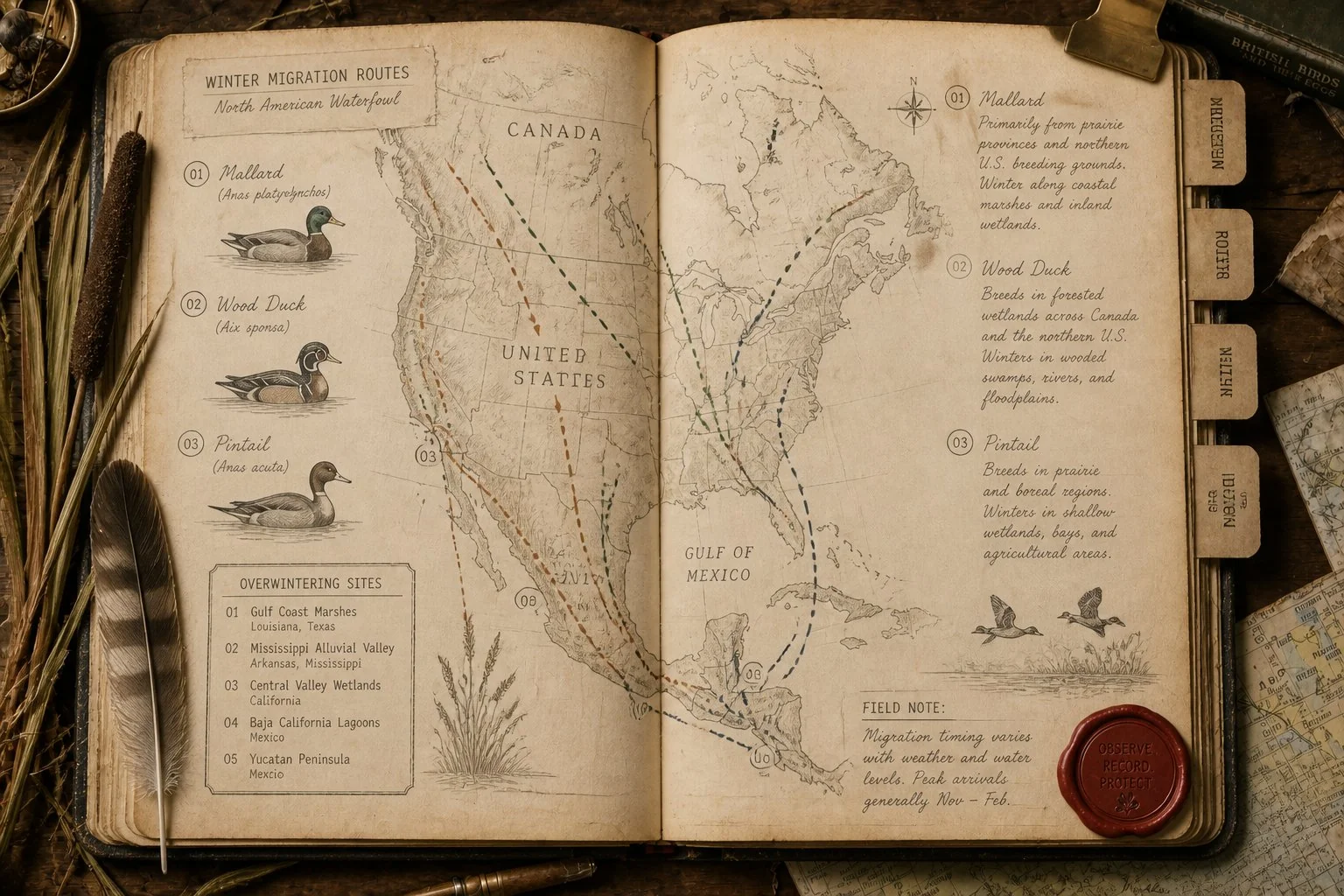
The short version: most North American ducks migrate. They follow four broad flyways - Pacific, Central, Mississippi, and Atlantic - between Canadian and Alaskan breeding grounds in summer and southern US plus Mexican wintering grounds. The biggest concentrations are the California Central Valley (Pacific Flyway), the Texas Gulf coast and Louisiana coastal marshes (Central + Mississippi), and the Chesapeake Bay (Atlantic). Some species (Mallard, Wood Duck) are non-migratory or short-distance migrants in mild climates.
The four North American flyways
Pacific Flyway
Runs from Alaska and western Canada down the Pacific coast through Washington, Oregon, California, and into Mexico. The California Central Valley is the single biggest wintering destination - millions of waterfowl converge on the rice fields and refuges.
Key stopovers: Skagit Flats (WA), Klamath Basin (OR/CA), Sacramento Valley, San Joaquin Valley.
Species that use it: Pintails, Mallards, Wigeon, Cinnamon Teal, Common Goldeneye, scoters, Tundra Swan (western population).
Central Flyway
Runs from arctic Canada and the Northern Plains down through the central US (Dakotas, Nebraska, Kansas, Oklahoma, Texas) and into Mexico. Heavily focused on prairie pothole breeding grounds and Texas/Louisiana wintering grounds.
Key stopovers: Cheyenne Bottoms (KS), the Texas Panhandle playas, the Texas coast.
Species: Mallards, Pintails, Northern Shovelers, Blue-winged Teal (most of the species that breed in the prairie potholes).
Mississippi Flyway
Runs from northern Canada (especially around Hudson Bay) down through the Great Lakes and Mississippi River corridor to Louisiana, the Gulf of Mexico, and Mexico. Largest by population - perhaps 40% of all North American waterfowl use this flyway.
Key stopovers: Detroit River, Lake St. Clair, Mississippi River bottoms, Catahoula Lake (LA), the Louisiana coastal marshes.
Species: Mallards, Wood Ducks, Pintails, Canvasback, scaup, Mergansers, Wigeon. Heavy.
Atlantic Flyway
Runs from Greenland, Labrador, and Newfoundland down the eastern seaboard to the Chesapeake Bay, the Carolinas, Florida, and the Caribbean.
Key stopovers: St. Lawrence River, Lake Champlain, the Hudson Valley, Delaware Bay, Chesapeake Bay, Pamlico Sound (NC), Florida Everglades.
Species: Atlantic Brant, scoters, Long-tailed Duck, Black Duck, Mallards, Mergansers, Tundra Swans (eastern population).

Why ducks migrate
Three drivers, all interlinked:
- Food. Breeding ground (Canada, Alaska, Northern US) summer is rich in invertebrates for chick-rearing and seeds for adults. Winter freezes everything; food disappears.
- Open water. Most ducks need open water to feed and to escape predators. Frozen lakes force them south.
- Day length. The hormonal trigger that starts breeding (long northern days) reverses in autumn; the same trigger drives migration south.
A duck that stays north in winter dies. The few species that do stay (some Mallards in urban heat-island ponds) are exploiting human-modified habitats that didn’t exist when their migratory behaviour evolved.
The species variation
Not all ducks migrate the same way:
Long-distance migrants (1,500+ miles):
- Northern Pintail - from Arctic Canada to Mexico and Central America.
- Blue-winged Teal - one of the longest-distance migrants; some winter in South America.
- Northern Shoveler - similar pattern.
- Tundra Swan - High Arctic to mid-latitude coast.
Mid-distance migrants (500-1,500 miles):
- Mallard - from prairie pothole region to southern US.
- Wood Duck - varies; eastern birds may travel 200-500 miles.
- Canvasback, Redhead - prairie potholes to southern coastal waters.
Short-distance migrants and non-migrants:
- Black-bellied Whistling Duck - resident in TX/LA/FL.
- Mottled Duck - resident on TX/LA coast.
- Hawaiian and tropical resident species - non-migratory.
- Wood Duck in southern US - some populations don’t migrate.
Altitudinal migrants:
- Harlequin Duck - between mountain streams (summer) and coastal salt water (winter), only a few hundred miles.
The big wintering concentrations
The places to see massive duck flocks in winter:
- California Central Valley (December-February). Sacramento NWR, Colusa NWR, San Joaquin Valley refuges. Pintails dominate.
- Texas Gulf coast (November-March). Aransas, Brazoria, San Bernard NWRs. Mixed species.
- Louisiana coastal marshes (December-February). The Gulf intracoastal zone has the highest waterfowl density in North America.
- Chesapeake Bay (December-March). Canvasbacks, scaup, Tundra Swans.
- Texas Panhandle playas (December-February). Sandhill Crane and dabbling duck concentrations.
- Klamath Basin (CA/OR) (December-February). Massive Pintail and Snow Goose concentrations.
For state-by-state breakdowns, see water birds in Texas, water birds in Florida, and ducks in Washington.
The non-migrators
Some ducks have stopped migrating where humans have changed habitat:
- Urban Mallards that find unfrozen water (heated city lakes, sewage outflows) often stay all winter.
- Park-fed Mallards lose migration urgency.
- Wood Ducks in southern states are largely sedentary.
- Black Ducks in coastal New England may stay if coastal waters don’t freeze.
This is a long-term ecological shift documented since the 1980s.
How they navigate
Four mechanisms working together:
- Magnetic compass. Iron-rich receptors in the eye and beak detect Earth’s magnetic field.
- Sun compass and circadian clock. Direction-finding by sun angle.
- Star compass. Used at night, calibrated against magnetic compass.
- Landmark memory. Returning birds remember specific water bodies, river bends, and coastlines.
Young birds making their first migration partly follow adults; partly use innate magnetic/celestial cues; partly learn the route.
The Sibley reference for migrating ducks
The Sibley Eastern guide has range maps showing breeding range, wintering range, and migration routes for every species. Essential if you want to understand who’s where in a given season.
Sibley Field Guide to Birds of Eastern North America
The pocket reference with range maps showing breeding, wintering, and migration zones for every duck.
David Sibley's Eastern guide shows breeding range (in red), wintering range (in blue), and migration corridors (in purple) for every duck species. Essential for understanding why a Pintail is on a Texas pond in January but in Manitoba in June. The same range-map convention covers waders, shorebirds, raptors, and songbirds.
- All Eastern North American species with range maps
- Breeding/wintering/migration zones marked
- Multiple plumages per species
- Pocket-sized softcover
 Sibley · Eastern

As an Amazon Associate we earn from qualifying purchases. Linked products are ones we actually use.
What to do for migrating ducks
If you want to support migration:
- Maintain habitat year-round. Resident plants and clean water serve migrants too.
- Don’t feed bread. Concentrating ducks at feeding sites in winter spreads disease. See can ducks eat bread.
- Support wetland conservation. Ducks Unlimited and similar organisations protect breeding and wintering habitat.
- Build a duck pond if you can. See how to attract ducks to your pond for the four-habitat-element framework.
The bottom line
North American ducks migrate along four flyways from northern breeding grounds to southern wintering grounds. The California Central Valley, Texas/Louisiana coast, and Chesapeake Bay hold the biggest winter concentrations. Most species are long-distance migrants; some have become urban residents in heated cities. The whole continental waterfowl spectacle compresses into a few weeks each spring and autumn - one of the great wildlife movements on the planet.