Field notes from the feed store, after one too many mouldy bags came out of the garden shed in March.
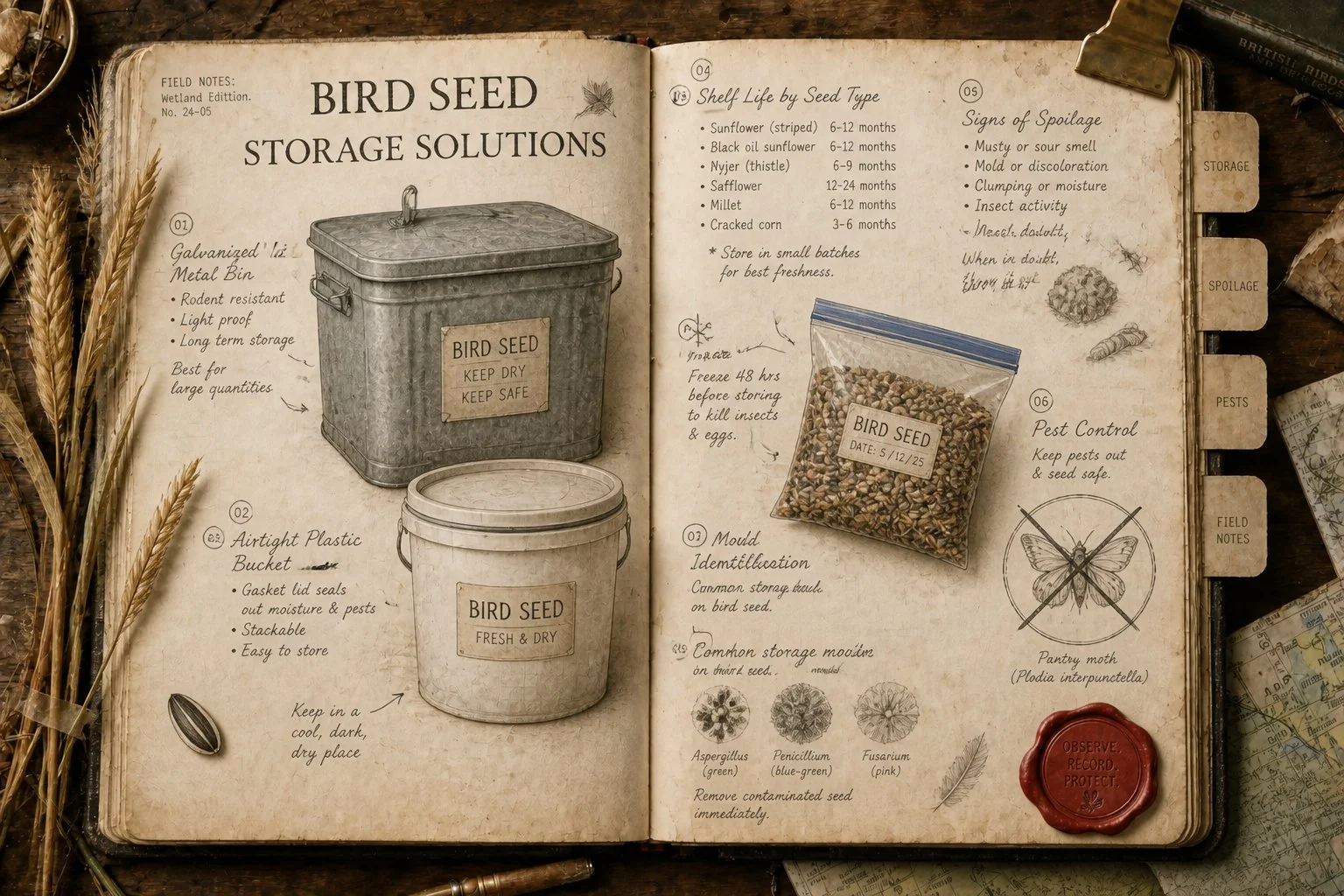
The short version: stored properly in a sealed metal bin in a cool dry place, most bird seed keeps 6-12 months. Stored badly - in a damp shed in plastic - it can spoil in eight weeks. Rancid sunflower seed is genuinely harmful to birds (the oxidised oils damage their liver), so the shelf-life question matters more than it sounds. Smell the seed when you refill - if it smells like old crayon or paint thinner, bin it.
The shelf-life table
Roughly, in a sealed dry container at room temperature:
| Seed type | Lasts |
|---|---|
| Whole black-oil sunflower (in shell) | 12 months |
| Sunflower hearts (shelled) | 6 months |
| Nyjer (sterilised thistle) | 6 months |
| White proso millet | 12 months |
| Cracked corn | 6 months |
| Whole peanuts (in shell, raw) | 9 months |
| Peanut pieces / chopped peanuts | 4 months |
| Suet cake (commercial, unopened) | 12 months |
| Suet cake (opened) | 1 month |
| Homemade peanut butter mix | 2 weeks |
| Dried mealworms | 12 months |
The pattern: whole seed in its natural protective coating keeps longest. Anything shelled, cracked, ground, or processed shortens the shelf life proportionally because the oils inside are now exposed to air. Sunflower hearts and peanut pieces are the two foods most likely to spoil before you notice.
Why rancid seed matters
Bird seed is mostly fat. The seeds we choose for back garden feeding (sunflower, peanut, nyjer, suet) are 25-90% fat by weight. Fats oxidise in contact with air; oxidised fats become rancid. The chemistry is the same as a cooking oil going off in a hot cupboard.
Birds eating rancid seed get:
- Lower vitamin uptake (the oxidised fats destroy fat-soluble vitamins A, D, E and K).
- Liver damage in cumulative exposure.
- Reduced breeding success in spring birds carrying over winter-stored fat reserves built from rancid seed.
The classic studies on this come from the British Trust for Ornithology in the 1990s - they tracked tit (chickadee equivalent) survival rates against feeder maintenance practice. Birds at well-stocked, fresh-seed feeders survived hard winters at noticeably higher rates than birds at neglected feeders, even when the neglected feeders had MORE seed in them. The seed at the neglected feeders was too rancid to do nutritional work.
The lesson: less seed, more often, stored properly, beats a bin-bag of cheap seed left in a shed all winter.
The smell test
Open the bag or bin and smell the seed. You’re looking for:
- Fresh seed: mildly oily, slightly nutty, no off notes. Should smell like raw peanuts or sunflower oil.
- Mildly stale: flat, no real smell at all. Still usable; use sooner.
- Rancid: sharp, paint-like, crayon-like, or solvent-like. Bin it.
- Mouldy: musty, earthy, slightly sour. Bin it.
If you can’t tell, eat one. Sunflower hearts should taste like a roasted sunflower seed without salt. If it tastes bitter or sharp, the seed is gone.
The fastest test is colour: fresh black-oil sunflower seed is glossy black with a faint stripe. Old or rancid seed becomes dull, sometimes greyish, and shells crack with less pressure.
How to store it properly
The single biggest decision is the container. A 20 lb bag of seed dumped into the right bin doubles or triples its shelf life. Dumped into the wrong bin, it goes off in months.
The right container:
- Sealed metal bin or galvanised steel can. Rodents chew through plastic; metal stops them. A galvanised feed can with a clamping lid is the standard answer.
- 5-gallon food-grade plastic bucket with a gasket lid (Gamma seal). Acceptable if rodents aren’t a problem. The gasket lid is critical - non-sealed lids let in moisture.
The right location:
- Cool. Below 20°C if possible.
- Dry. Garages and sheds get humid; basements often work better.
- Dark. Light accelerates oxidation. A dark bin in a basement corner is ideal.
The right rotation:
- Don’t decant a new bag on top of the old one. Use the old one first, scrub the bin between bags.
- Label each bin with the date you opened it.
- Buy seed in quantities you’ll use in a season, not in years.
Freezing seed extends life
A short freezer pass (2-3 days at -20°C) kills any pantry moth eggs that may have come in with the seed. After the cold treatment, store as normal. This is genuinely useful for peanut-based foods (peanuts often arrive with Indian meal moth eggs).
For longer-term storage, you can keep small quantities of sunflower hearts and peanut pieces in the freezer indefinitely - the cold halts oxidation almost entirely. Sub-divide into 1 lb freezer bags and pull one out at a time.
The pantry moth problem
Indian meal moth and other pantry moths are common in bird seed sold at warm storage temperatures. The eggs are microscopic; once they hatch, you’ll find webbing in the bag and small caterpillars climbing the inside of the bin.
The fix:
- Freeze new bags for 2-3 days when they arrive.
- Store in a tight-sealing metal bin.
- If you find an infestation, dispose of the contaminated seed, scrub the bin in hot soapy water, and freeze any remaining seed before reuse.
Pantry moths don’t directly harm birds - the larvae are protein - but they reduce seed quality and they spread to human pantries.
Buying smart
A few practical points:
- Buy in season. Sunflower seed bought in autumn from the current year’s harvest is much fresher than the same brand bought in summer (which is last year’s crop).
- Buy what you’ll use in 3 months. A 20 lb bag of black-oil sunflower lasts one hopper feeder roughly a winter. Don’t buy 50 lbs unless you have multiple feeders.
- Check the bag. A bag with seed dust at the bottom, visible damage, or any musty smell on opening is a return.
- Avoid mixed seed bags with milo / cracked corn fillers. Not only is the filler unloved, but it goes rancid at different rates and spoils the bag.
For the seed inventory question separately, see best bird seeds for the ranking and best winter bird seed for the cold-weather subset.
What to replace if you find old seed
If you’ve found a bag of old seed in the shed and aren’t sure what to do, the safe path is:
- Smell it. Rancid or musty - bin it. Use the compost (small birds in the compost won’t eat much, and what they do is buffered by the rest of the heap).
- If it smells fine, top a clean fresh-bag feeder with it but keep the proportion at no more than 25% old to 75% new. Birds will sort.
- Don’t pour an entire bag of questionable seed into a clean feeder. That’s how a dirty feeder happens; see are bird feeders bad for the disease side.
The bag we keep buying
We don’t have a single brand allegiance, but the format that travels best - sealed plastic bag inside a printed paper outer, 20 lb size, dated harvest - is the format we trust. Wagner’s black-oil sunflower is the bag we open every autumn:
Wagner's Black-Oil Sunflower 20 lb
The bag we open every September and finish by March.
A sealed 20 lb bag of single-ingredient black-oil sunflower seed. Decant into a sealed metal bin once you open it; the original bag is fine for transport but doesn't seal well long-term. Stored properly, the seed keeps the full winter and ships fresh from a current-season harvest.
- Single ingredient - no filler that goes rancid at different rates
- Thin-shell black-oil sunflower - the most-eaten winter seed
- 20 lb resealable bag
- Best decanted into a sealed metal bin for the season
 Wagner's · 20 lb

As an Amazon Associate we earn from qualifying purchases. Linked products are ones we actually use.
The bottom line
Treat bird seed like cooking oil - it’s mostly fat, and fat goes rancid. Buy seasonally, store in a sealed metal bin somewhere cool and dry, and smell the seed when you refill. Bin anything that smells off; the birds at your feeder are eating the calories you stored well enough to keep them fresh, and rancid seed undoes the whole reason you’re feeding them in the first place.
For the broader question of whether feeders are worth the maintenance at all, see are bird feeders bad; for the placement that affects how fast a fill is consumed (faster = less time for the seed to go off), see best place for a bird feeder.