Field notes from a hedgerow in August where the wild bramble berries dropped onto a goose pasture.
Updated: 2026-05-20.
The short version: yes, geese can eat blackberries. They’re safe, rich in antioxidants, and geese encounter wild brambles regularly in their natural foraging - the dropped berries from autumn hedgerows are part of their diet without human intervention. Offer fresh blackberries whole or halved, 1-2 times a week as a treat. The thorny canes themselves are fine; geese strip the berries cleanly and leave the woody stems.
What's in a blackberry
Blackberries (Rubus fruticosus and related species) are a high-value fruit nutritionally. Per 100g, according to USDA FoodData Central:
- Vitamin C: 21 mg - useful antioxidant.
- Vitamin K: 19.8 mcg - bone and clotting.
- Fibre: 5.3g - high. Good gut support in moderate amounts.
- Anthocyanins - the dark blue-purple pigments. Strong antioxidant capacity. Same compound family as blueberries.
- Sugar: 4.9g per 100g - relatively low for a fruit. Lower than apple, banana, or grapes.
The lower sugar plus high antioxidant content makes blackberries one of the better-balanced fruit treats for backyard waterfowl.
Wild geese already eat them
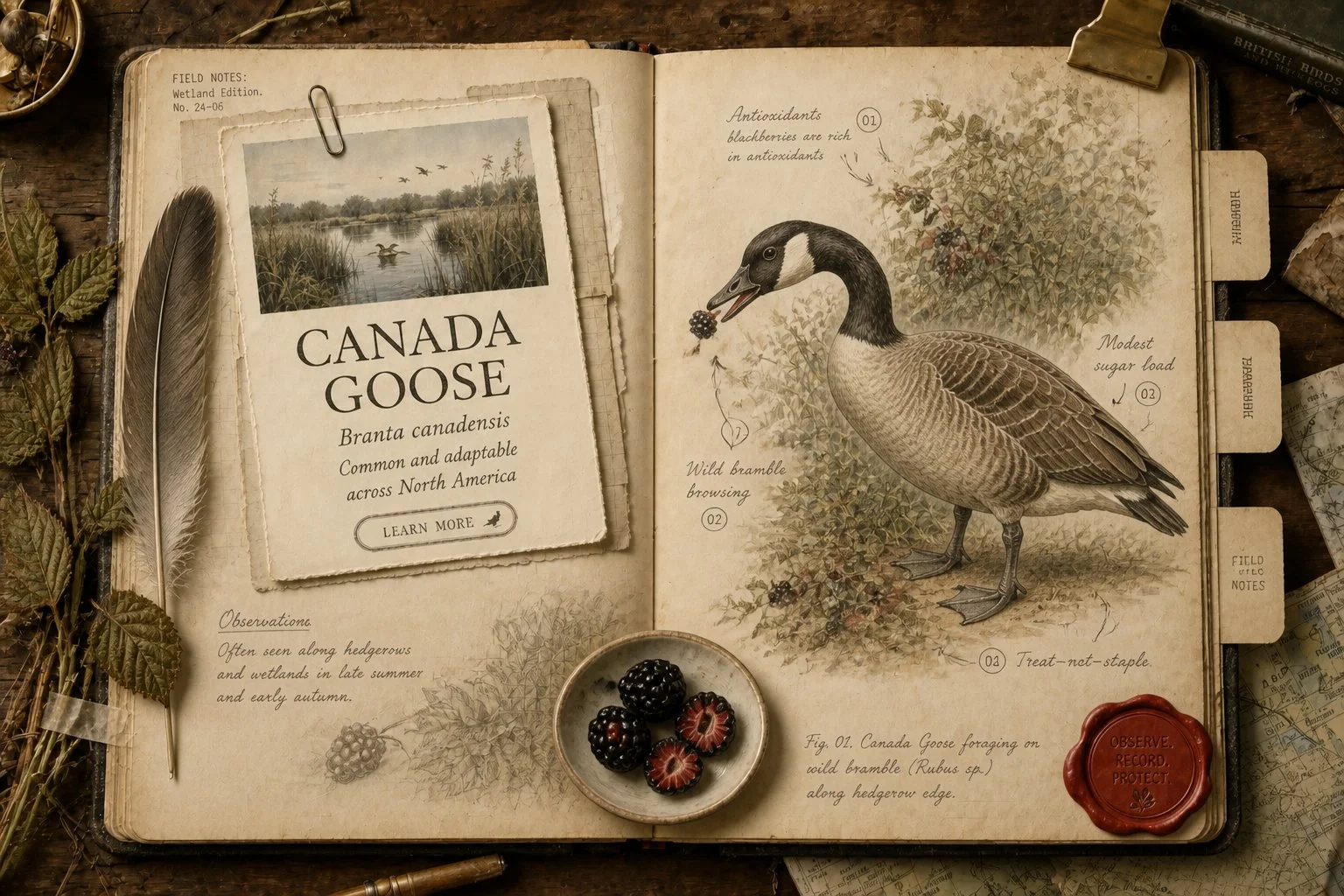
Geese are opportunistic foragers and any goose grazing along an autumn hedgerow will browse fallen blackberries that drop onto pasture. This isn’t a novel food for them - it’s an ancient one. Cornell Lab All About Birds notes the Canada Goose as an opportunistic grazer that takes “berries, seeds, and aquatic plants” alongside grass.
The implication: you don’t need to be cautious introducing blackberries. Domestic geese take to them immediately, recognising them as food.
How to prepare them
Simpler than most fruit treats:
- Wash thoroughly - blackberries are usually unsprayed (it’s hard to spray a bramble) but field-picked berries may carry mites or other insects.
- Offer whole to adult geese. The seeds are tiny, edible, and not a choking risk.
- Halve for goslings under 4 weeks.
- Scatter on a feeding tray or place in a shallow dish.
Don’t:
- Cook the berries - destroys vitamins.
- Mix with sugar - the natural sweetness is enough.
- Offer fermented or mouldy berries - mild alcohol risk and aspergillosis risk.
How much, how often
The fruit-treat guideline applies:
- Per goose per day: about a tablespoon of whole or halved berries.
- Per week: 1-2 times. Rotate with other safe fruit.
- As percentage of diet: under 10% by weight.
A handful of blackberries (50-100g) shared between 4-5 geese is a reasonable treat meal.
The bramble itself
Brambles are thorny, but geese aren’t particularly bothered by them - the bill plates handle the canes without injury. If your garden has a wild bramble patch and you’ve got free-ranging geese, the geese will:
- Strip the accessible low-hanging berries directly off the canes.
- Browse the young leaves (which are also safe).
- Generally leave the older woody canes alone.
It’s actually a nice ecological combination - the bramble produces seasonal food, the geese harvest some, the birds and small mammals get the rest. Wild blackberries are increasingly cited as a useful native plant for permaculture and small-flock setups.
The wider safe-fruit list
Blackberries sit in the cluster of “yes safely” fruits for waterfowl:
- Blueberries - top-tier. See can ducks eat blueberries.
- Strawberries, raspberries - safe.
- Apple flesh (cored) - see can ducks eat apples.
- Mango (peeled, pitted) - see can geese eat mango.
- Kiwi (peeled) - see can geese eat kiwi.
- Cantaloupe and melon - see can ducks eat cantaloupe.
What to avoid:
- Avocado - acutely toxic. See can ducks eat avocado.
- Citrus - too acidic.
- Cherry pits, apple seeds, mango pits - cyanogenic.
Wild geese vs. park feeding
If you’re at a park pond, skip blackberries even though they’re safe - the soft fruit goes mushy in water and attracts pests. Cracked corn or oats are the appropriate park-pond foods. See what can I feed ducks at the pond and best food to feed ducks and geese.
Blackberries are a backyard or free-range flock food, not a park-pond food.
The base diet
Blackberries are seasonal enrichment. The everyday base is grass, formulated waterfowl pellets, and cracked corn.
CountryMax Cracked Corn 50 lb
The everyday calorie treat that pairs with seasonal fruit.
A 50 lb sack of cracked corn - the everyday calorie supplement for backyard geese. The base calorie source; blackberries and other seasonal fruit sit on top as enrichment.
- 50 lb sack - a season's supply for a small flock
- Cracked to the right size for geese
- Pairs with autumn hedgerow fruit treats
- Stores stably in a sealed metal bin
 CountryMax · 50 lb

As an Amazon Associate we earn from qualifying purchases. Linked products are ones we actually use.
The bottom line
Yes to blackberries for geese - safe, natural, lower-sugar than most fruit, easy to prepare (just wash). The wild geese already eat them in autumn hedgerows. Offer whole, 1-2 times a week, as enrichment alongside the everyday pasture-and-pellet base. One of the easiest “yes” answers in the goose food category.
Sources
- USDA FoodData Central: Raw Blackberries Nutritional Profile
- Cornell Lab All About Birds: Canada Goose Life History and Diet
- The Open Sanctuary Project: Daily Diet, Treats and Supplements for Geese