Field notes from a country club golf course that spent £400 on swan decoys and another £900 on actual deterrents the following spring.
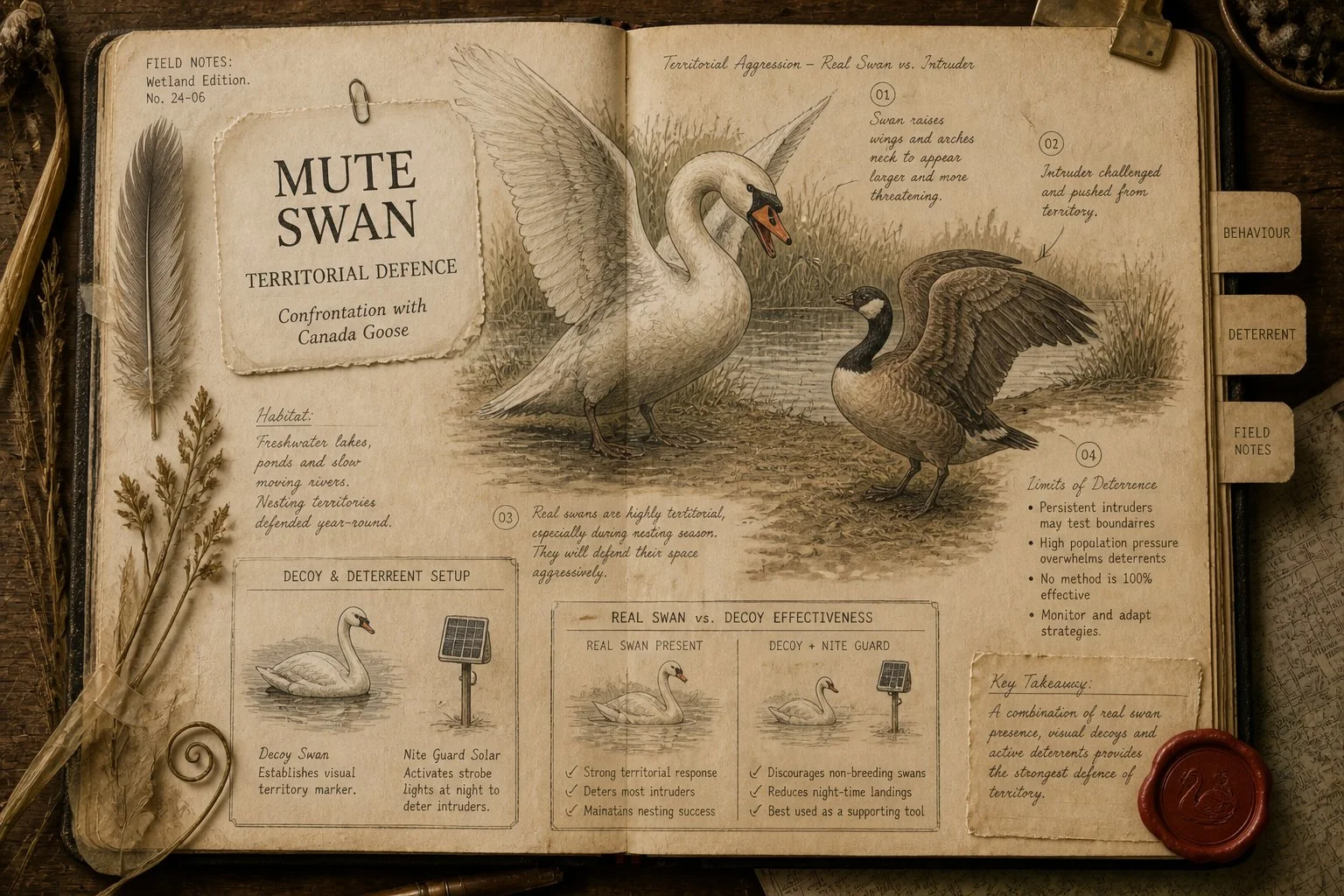
The short version: yes, a real territorial Mute Swan pair will keep Canada Geese off a small pond - they’re aggressive enough to chase geese off and the geese learn within a few days. But plastic swan decoys, which are sold widely as goose deterrents, mostly don’t work. Geese habituate to them within a week. The actual working solutions for pond goose problems are scare devices, dog presence, habitat modification, and (occasionally) a real swan pair if your pond is big enough.
Why a real swan works
Mute Swans are aggressively territorial during the breeding season (March-July). A male (cob) defending a nest and cygnets will:
- Chase intruders across the water. A pursuing cob with raised wings is a genuinely threatening animal - up to 12 kg, wingspan of 2-2.5 metres, sharp wing bones can break a goose’s leg.
- Attack actively. Documented strikes break goose feathers and occasionally injure smaller birds.
- Patrol continuously. A breeding cob spends much of his day moving around the territory perimeter, especially during the cygnet-rearing phase.
Canada Geese are not stupid. After two or three encounters with a defending swan, they learn the pond is occupied and move on. The lesson typically holds for the rest of that breeding season.
The swan-effective-defence rule: works for breeding territory (March-July). In winter the swans flock with other waterfowl and don’t defend - geese can return.
Why decoys don't
The plastic swan decoys sold at garden centres and lawn-care shops are marketed as goose deterrents on the theory that geese will see them, assume the pond is occupied, and leave. This works for about a week.
The problems:
- Decoys don’t move. A real swan moves all day. A static plastic body is read as a non-threat after 2-3 days of observation.
- Decoys make no sound. Real swans hiss, snap their wings, and splash. Plastic ones do nothing.
- Decoys don’t smell right. Geese have decent olfaction at close range; they detect the polyethylene.
- Geese habituate. Same reason scarecrows don’t work in cornfields long-term - the response curve for an inert stimulus drops to zero within a few exposures.
The pattern in dozens of customer reports: decoys reduce goose pressure for 5-10 days, then the geese return and ignore the decoy.
The only marginal exception: moving decoys that float and rotate on a wind-driven mount might extend the effective period by a few weeks. Even then, habituation eventually wins.
What actually works for pond goose control
In order of effectiveness:
1. Dogs
The single most effective goose deterrent for golf courses, parks and large gardens. Border Collies or other working herding dogs trained to chase but not harm geese clear properties durably. Geese don’t habituate to a predator they perceive as real and unpredictable.
Caveat: this is a working-dog setup, not a backyard pet. Professional services like Geese Police rent dog-and-handler teams for golf courses and corporate campuses.
2. Habitat modification
Geese prefer:
- Short, well-fertilised grass within 30 m of water (they graze it, easy walk to water for escape).
- Gentle pond shorelines they can walk on and off.
- Open sightlines (they like to see incoming predators).
Make the pond hostile to them:
- Let the bank grass grow tall (more than 15 inches). Geese avoid tall grass - they can’t see through it.
- Plant dense bank shrubs. Same logic; they want clear sightlines.
- Make the shoreline steep or rocky. Hard to walk up.
Habitat modification is the most permanent solution and the one that holds without recurring cost.
3. Scare devices with rotation
Devices that move or fire intermittently DO work if rotated frequently:
- Predator-eye flashers (red LED lights at night).
- Wind-driven Mylar streamers.
- Propane cannons (for large agricultural ponds).
- Motion-activated water sprinklers.
The trick is rotation - move the device every few days so geese don’t pattern it. A static device fails the same way a static decoy does.
Nite Guard Solar (4-pack)
The flashing predator-eye lights that hold off geese, foxes and raccoons at night.
Solar-powered red LED units that mimic the eye-shine of a predator. Four-pack covers the perimeter of a small pond. Auto-on at dusk, auto-off at dawn, no wiring. Works on geese, foxes, raccoons, deer. Move every 4-6 weeks to prevent habituation. Effective for permanent installations where you can't have a dog.
- 4-pack covers a perimeter (corners of a small pond)
- Solar-powered, no wiring or batteries
- Auto-on dusk to dawn
- Documented on geese, deer, foxes, raccoons
 Nite Guard · Solar

As an Amazon Associate we earn from qualifying purchases. Linked products are ones we actually use.
4. Auditory deterrents
Predator distress calls, propane cannons, and ultrasonic devices all have some effect but habituate. Best used as part of a rotation. See sounds that scare geese for the full breakdown of what works and what’s just noise.
5. A real swan pair (if your pond is big enough)
Mute Swans need:
- At least an acre of open water for a breeding pair. Smaller and they get stressed.
- Submerged plant food or supplemental grain in winter.
- Acceptance that they’ll dominate your pond. Swans drive off ducks too, not just geese.
In the right pond, a breeding swan pair is a permanent goose solution for the breeding season. The trade-off is they’re also a predator on ducklings and chicks of smaller waterfowl, and they’re aggressive toward humans during the cygnet phase.
For the species side of this, see North America swans.
6. Eggshakers and goose harassment (regulated)
In the US and Canada, Canada Geese are federally protected but homeowners can apply for nest-disturbance permits (USDA APHIS in the US). Trained operators shake or oil eggs to suppress breeding - this is a long-term population-level solution, not a quick fix.
What doesn't work
Things sold as goose deterrents that don’t:
- Plastic swan decoys (already covered).
- Plastic owl statues.
- Snake-shaped rope on the grass.
- Capsaicin-based grass sprays. Geese learn around them.
- Ultrasonic devices alone. Geese mostly ignore them.
- Garden gnomes, flags, painted eyes on stones.
The lawn-care market for goose deterrents is full of products that worked once for someone in a YouTube video. Most fail habituation testing.
The why-do-they-flock-here question
Geese pick a property because:
- Open water for escape.
- Short fertilised grass for grazing.
- No predators or persistent deterrents.
- Other geese already there (social attractor).
Once a flock has used a pond for a season, they remember it. Removing them is harder than preventing arrival. The implication: deploy deterrents BEFORE the geese settle in, in late winter / early spring. Once a brood is on your pond it’s a long battle.
For the broader case on why geese behave the way they do, see geese behaviors, why do geese attack each other, and sounds that scare geese.
The bottom line
A real territorial swan pair will clear geese off a small pond during the breeding season. A plastic swan decoy won’t. The working solutions for pond goose control are dogs, habitat modification (tall grass, dense banks), rotated scare devices, and occasionally a real swan pair if you have an acre of water. Skip the decoys; they’re £40 of polyethylene that buys you a week.