Field notes after the call from a backyard keeper who'd lost two ducks the morning after sharing guacamole leftovers.
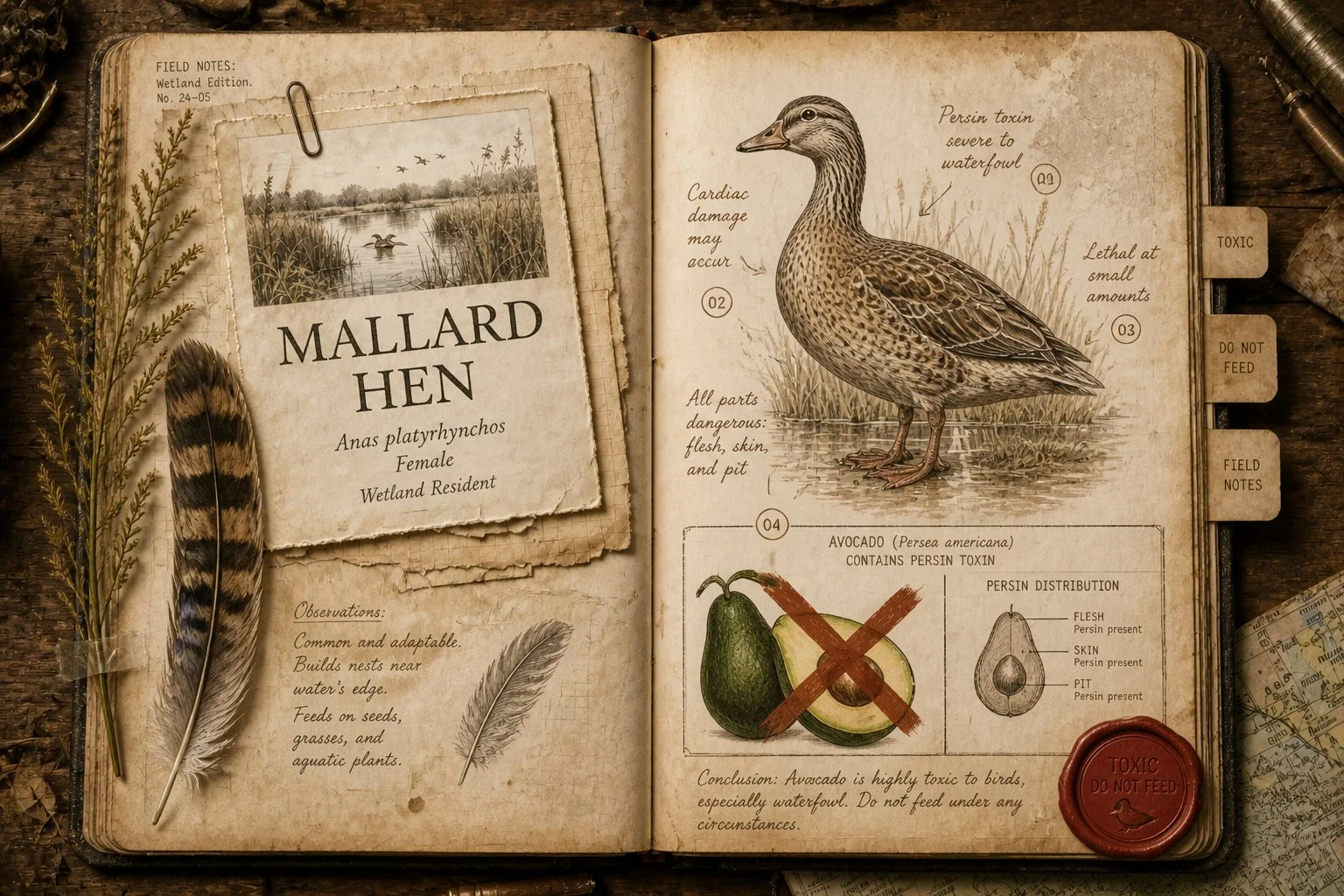
The short version: no, ducks cannot eat avocado in any form. The whole avocado tree - flesh, skin, pit, leaves - contains persin, a fungicide that causes cardiac muscle damage and fluid build-up in the lungs of most bird species. Avocado is one of the few foods that’s genuinely lethal to ducks in small quantities; documented cases include death within 24-48 hours of ingesting amounts as small as a teaspoon of flesh. Don’t share guacamole leftovers, don’t compost avocado peels where ducks can reach them, don’t keep avocado plants where ducks browse.
What persin actually does
Persin is a fatty-acid derivative produced by avocado plants to defend against fungal pathogens. In most mammals (including humans), persin is metabolised without noticeable harm. Birds are different.
In birds, persin causes:
- Myocardial necrosis. The heart muscle cells die in patches.
- Pulmonary oedema. Fluid accumulates in the lungs.
- Sterile mastitis in egg-laying species.
- Acute respiratory failure in severe cases.
The progression is typically:
- Within hours of ingestion: lethargy, depression, reluctance to move.
- Within 12-24 hours: rapid breathing, weakness, sometimes neurological signs.
- Within 24-48 hours: heart failure, respiratory failure, death.
By the time symptoms are obvious, there is no effective antidote. Supportive veterinary care (oxygen, fluids, cardiac support) may help in some cases but recovery is uncertain.
What parts are dangerous
All of them. The whole avocado tree produces persin, in varying concentrations:
- Flesh - the eating part. Lower persin concentration than other parts, but still toxic. Documented deaths from flesh-only exposure.
- Skin - higher concentration than flesh.
- Pit (stone) - highest persin content. A duck that swallows a piece of avocado pit is at acute risk.
- Leaves and branches - high concentration. Avocado trees in gardens with backyard ducks are a hazard.
- Bark - high concentration.
So the rule isn’t “give them the flesh, just not the pit.” The rule is “no avocado, at all, in any form.”
The documented cases
Avocado toxicity in birds is well-documented in veterinary literature - parrots, canaries, finches, ostriches, ducks, geese, chickens. Mortality rates in case series are high - 50-80% of birds that ingest avocado die within 48 hours, even with veterinary intervention.
The Gwen variety (the common supermarket avocado) is among the more toxic. Mexican and Guatemalan varieties show similar effects.
Quantity matters but not in a reassuring way:
- A budgerigar can die from a single chunk of flesh the size of a fingernail.
- A duck has been reported to die from approximately a teaspoon of mashed avocado.
- The pit appears to be lethal in smaller amounts.
There is no documented “safe small dose.”
Why the question keeps coming up
Three reasons people ask:
- Guacamole leftovers. “Can I share the dip with the ducks?” No.
- Avocado pit compost. Composting kitchen scraps in a heap where ducks free-range. Risk - especially the pit.
- Backyard avocado trees. In warm climates (parts of the US, the Mediterranean, Australia), avocado trees are common. Fallen fruit is a real hazard.
For each:
- Guacamole/leftovers - bin them, not in a compost the ducks reach. Same for hummus with avocado, sushi with avocado, smoothies with avocado.
- Compost - secured compost only. A duck pecking through an open compost heap is at risk from avocado peels and pits.
- Backyard trees - if you have avocado trees in a duck garden, fence them off. Pick up windfalls daily.
If your duck has eaten avocado
Time matters more than dose:
- Call an avian vet immediately - within 1-2 hours if possible. Activated charcoal may bind some of the persin if given quickly enough.
- Don’t induce vomiting - ducks don’t vomit reliably and the attempt is more stressful than useful.
- Provide warmth and water - supportive care.
- Monitor breathing - laboured breathing is the most reliable early sign of trouble.
Recovery from avocado poisoning in birds is not common. The honest answer is that prevention is the only real defence.
The other "yes you can feed" lookup posts make the contrast
Most of the “Can Ducks Eat X” lookups have a “yes, in moderation” answer. Avocado is one of the few hard “no” cases. The others:
- Bread: harmful, not acutely toxic. See can geese eat bread.
- Milk: harmful via lactose intolerance. See can ducks drink milk.
- Bitter almonds: toxic. See can ducks eat almonds for the sweet vs bitter distinction.
- Apple seeds: toxic in quantity. Flesh fine. See can ducks eat apples.
- Onions, garlic, leeks: toxic.
- Raw potato: toxic.
- Avocado: acutely toxic - this post.
The avocado case is genuinely different from the others - the harm comes from a small amount, ingested once, with no opportunity to course-correct.
What ducks should eat as treats
The safe-list, since the “no” list above leaves the question open:
- Cracked corn (the staple treat - see best food to feed ducks and geese)
- Frozen peas, thawed
- Chopped leafy greens (kale, lettuce, spinach)
- Chopped apple flesh, no core
- Berries
- Dried mealworms, rehydrated
- Chopped cooked asparagus, courgette, sweet potato
- A few chopped raw sweet almonds
CountryMax Cracked Corn 50 lb
The safe everyday duck treat - the absolute opposite of the avocado problem.
A 50 lb sack of cracked corn - the everyday duck treat for backyard flocks and pond visits. The complete opposite of avocado: cheap, abundant, safe, palatable, and ducks have eaten it without harm for as long as humans have kept them.
- 50 lb sack - a season's supply for a small flock
- Cracked to the right size for ducks and geese
- Genuinely safe daily treat
- Stores months in a sealed metal bin
 CountryMax · 50 lb

As an Amazon Associate we earn from qualifying purchases. Linked products are ones we actually use.
For the broader keeping question
If you’re new to keeping ducks, the avocado problem is one of a handful of dietary hazards that’s worth memorising. The full list of what to avoid and what to provide is at are ducks a good pet; the wild-feeding parallel is at what to feed wild ducks.
The bottom line
No avocado, ever, in any form, for any duck. The persin in flesh, skin, pit and leaves is acutely toxic to birds, and small amounts have killed ducks within 48 hours. It is one of the few foods where the answer is a hard “no” rather than “in moderation.” Treat it like chocolate to a dog: not a debate, just a rule.