Field notes from a conversation with an RSPB warden about the widowed cob at a local reservoir, who lasted six months on his own.
Updated: 2026-05-20.
The short version: no, swans do not “kill themselves” in any meaningful sense - the idea is a romantic projection. But the grieving behaviour after a mate dies is documented and real. The RSPB confirms that bereaved swans show mourning - lethargy, withdrawal, vocalising, reduced feeding - and that this stress can in some cases trigger health decline and death, particularly in older birds. The “swan dies of a broken heart” story is mostly metaphor with a real biological core: prolonged stress can kill a weakened bird. They don’t choose it.
The folklore vs. the biology
The “swans die when their mate dies” story is one of the most-told pieces of wildlife folklore in the English-speaking world. It’s been romanticised in poetry, film, and casual conversation for centuries. The truth is more measured than the legend.
What’s actually true:
- Swans pair-bond strongly and most stay with one mate for many years.
- When a mate dies, the surviving bird shows clear behavioural changes - mourning behaviours.
- In some cases the surviving swan declines in health and dies within months.
- In many cases, the surviving swan eventually re-pairs and continues for years.
What’s not true:
- Swans do not commit suicide.
- They don’t “refuse to eat” deliberately.
- They don’t seek out death.
- The mortality after bereavement isn’t a choice; it’s a stress response.
The RSPB’s species page on the Mute Swan covers the pair-bonding behaviour. An RSPB spokesperson has been quoted explaining: “Swans do form monogamous pairs and generally remain together for life. Should one die, ‘grieving’ behaviour is often observed so this is normal and to be expected.”
What grief looks like in a swan
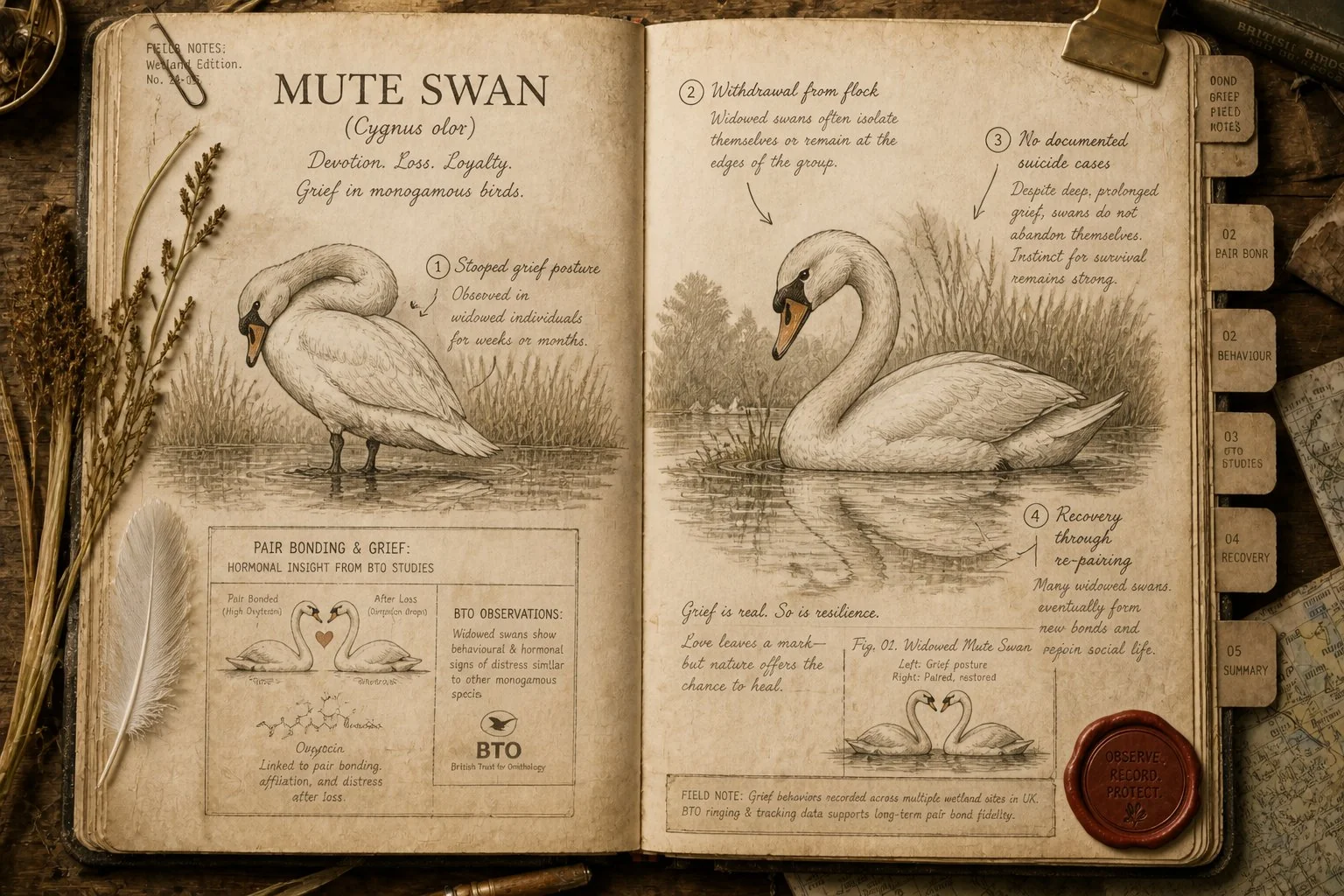
The documented behaviours in a recently-bereaved swan, drawn from RSPB observation reports and wildlife trust reports:
- Reduced feeding for days to weeks. The bird visibly loses weight.
- Withdrawal from the flock. Even gregarious species spend time alone.
- Increased vocalising - particularly mournful contact calls.
- Searching behaviour - repeatedly returning to the place where the mate was last seen.
- Reduced preening - feathers become dishevelled.
- Lethargy - extended periods of stillness.
The pattern can last weeks to months. In healthy younger birds, recovery is typical and the bird may re-pair within a season or two. In older birds or those already weakened, the stress can be the final straw.
The biology of grief-related death
Grief in animals isn’t psychological the way humans experience it. But the physiological response to extended stress is real and well-documented across vertebrates:
- Cortisol levels rise during prolonged stress.
- Immune function drops - the bird becomes more susceptible to infection.
- Body weight declines as feeding reduces.
- Behaviours that maintain plumage and body condition decline - waterproofing fails, hypothermia risk increases.
- Predator vigilance drops - increased predation risk.
Any one of these can be fatal in a wild bird. The combination - common after a bereavement - explains why some bereaved swans die. They don’t die of heartbreak in the literal sense; they die of accumulated stress effects on a body that was already aging.
This pattern isn’t unique to swans. Cornell Lab All About Birds documents similar pair-bond grief responses in geese, cranes, parrots, and various other monogamous species.
What about pair-bonding generally
Swans are famously monogamous, but the species variation matters:
- Mute Swan: lifelong pair-bonding the rule; about 6-9% divorce rate per year in studied populations.
- Trumpeter Swan: lifelong pair-bonding; lower divorce rate.
- Tundra Swan: lifelong but with higher divorce rate in years with poor breeding success.
- Black Swan: lifelong pair-bonding but with notable rates of “extra-pair copulation” - they’re monogamous about pair maintenance, not about absolute genetic fidelity.
For the broader pair-bonding question, see do swans pair for life.
What happens after a bereavement
The typical sequence in a healthy bereaved Mute Swan:
- Weeks 1-4: acute grief behaviours. Reduced feeding, withdrawal.
- Months 1-3: behaviours gradually normalise. The bird returns to feeding and preening.
- Months 3-6: if young/healthy, the bird may begin seeking new mates - particularly during the late winter / early spring pair-formation period.
- Year 1-2: if successful, new pair formed; if not, the bird may remain solitary or join a flock.
Older or weakened birds may not progress past the early stages. Their mortality rate in the year following bereavement is documented as higher than baseline.
The famous cases
A few documented “grief swan” stories have made headlines:
- Loch Lomond: a widowed Whooper Swan that visibly mourned for an extended period after her mate’s death.
- Various RSPB reserves: wardens have documented individual swans declining after losing a mate, often in years where the surviving bird was already aged.
These cases are real but rare relative to the population. Most bereaved swans recover.
For backyard or rescued swans
If you keep ornamental swans on a private lake or rehab one through wildlife rescue, the management of bereavement is straightforward:
- Don’t separate the surviving bird from the flock if there is one.
- Provide a quiet, safe environment during the acute grief period.
- Watch for weight loss and underfeeding. Supplement food if the bird is reducing intake significantly.
- Veterinary check if the bird shows signs of declining body condition past 4-6 weeks.
- For long-term solitary birds: consider introducing a compatible mate if possible. This is delicate; wildlife rescues sometimes facilitate.
For the broader swan-keeping context, see can swans be pets and north america swans.
The related swan posts
For the wider swan question cluster:
- do swans pair for life - the pair-bond biology.
- do swans have predators - what eats them.
- swan symbolism - the cultural arc that produced the “broken heart” folklore.
- do swans quack - vocalisations.
- north american swans - species ID.
The bottom line
Swans don’t kill themselves. The folklore that they do is romantic, persistent, and untrue. What IS true is that they form strong pair bonds, that the death of a mate triggers documented grief behaviours, and that in older or weakened birds the stress of bereavement can contribute to declining health and death. The story is half-myth, half-real. Don’t say “they kill themselves.” Do say “they grieve, and some don’t recover.”
Sources
- RSPB: Mute Swan species page and pair-bonding behaviour
- Cornell Lab All About Birds: Mute Swan Life History
- BTO BirdFacts: Mute Swan
- Birdfact: Do Swans Mate for Life