Riverside notes, late March.
Canada geese fight each other for a small number of very specific reasons - territory, mates, and goslings - and the season matters more than the bird. A goose that’s docile in October will charge you head-down in March. The behaviour is not random hostility. It’s a precise four-step warning ladder, and every step is worth learning to read.
The four reasons geese actually fight each other
In years of watching mixed flocks, almost every observed fight falls into one of these:
- Territory. A pair has selected a stretch of pond bank or lawn for nesting. Anything goose-shaped that crosses the invisible line gets warned, then chased.
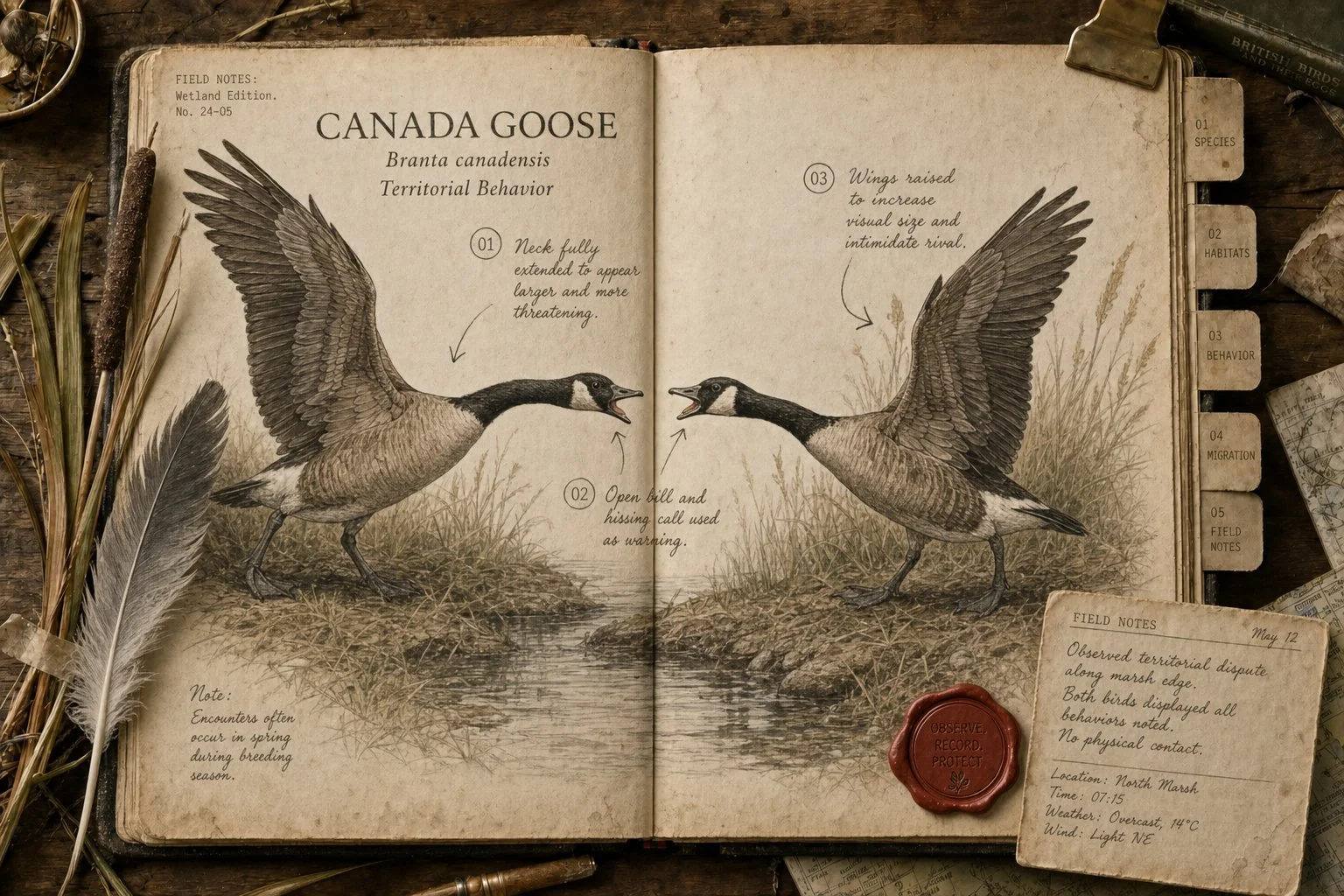
- Mate rivalry. Unpaired males try to interlope with bonded pairs in late winter. The defending gander hisses and charges.
- Gosling defence. A hen with downy young is the most aggressive bird in the flock by a wide margin. She will face down a heron.
- Resource pressure. Crowded flocks at a single food source produce squabbles - not real fights, but the same posturing.
What you almost never see, despite the internet’s framing: random aggression between strangers in a winter flock. Out-of-season Canada geese are noisy but mostly tolerant.
The four-step attack ladder
A defensive goose escalates in a fixed, readable sequence. Knowing it means you can de-escalate by backing off at step one or two, before it turns into a chase.
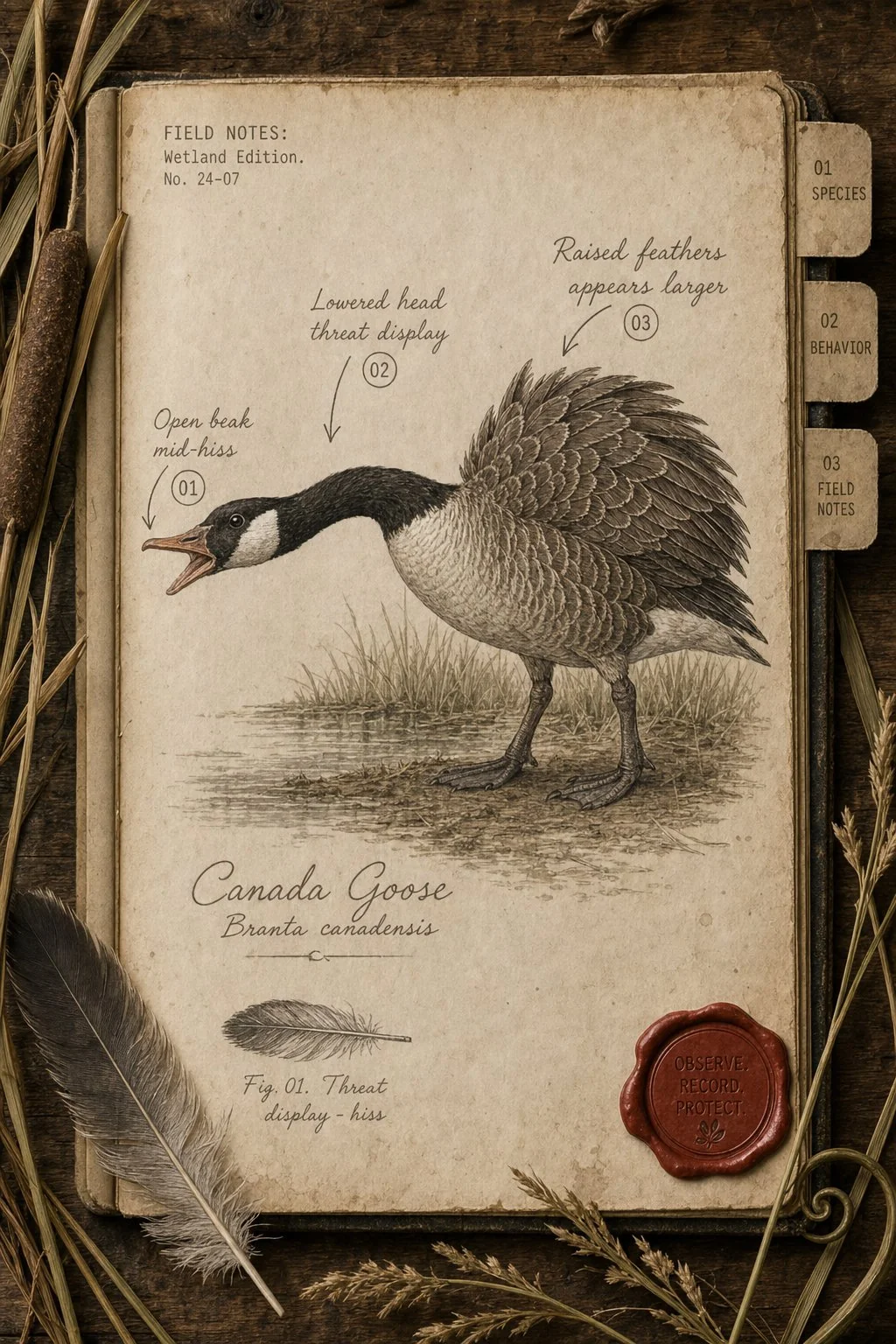
- Stare. Head lifted high, eye locked on you, body still. This is the goose asking are you a threat? If you keep approaching, you’re answering yes.
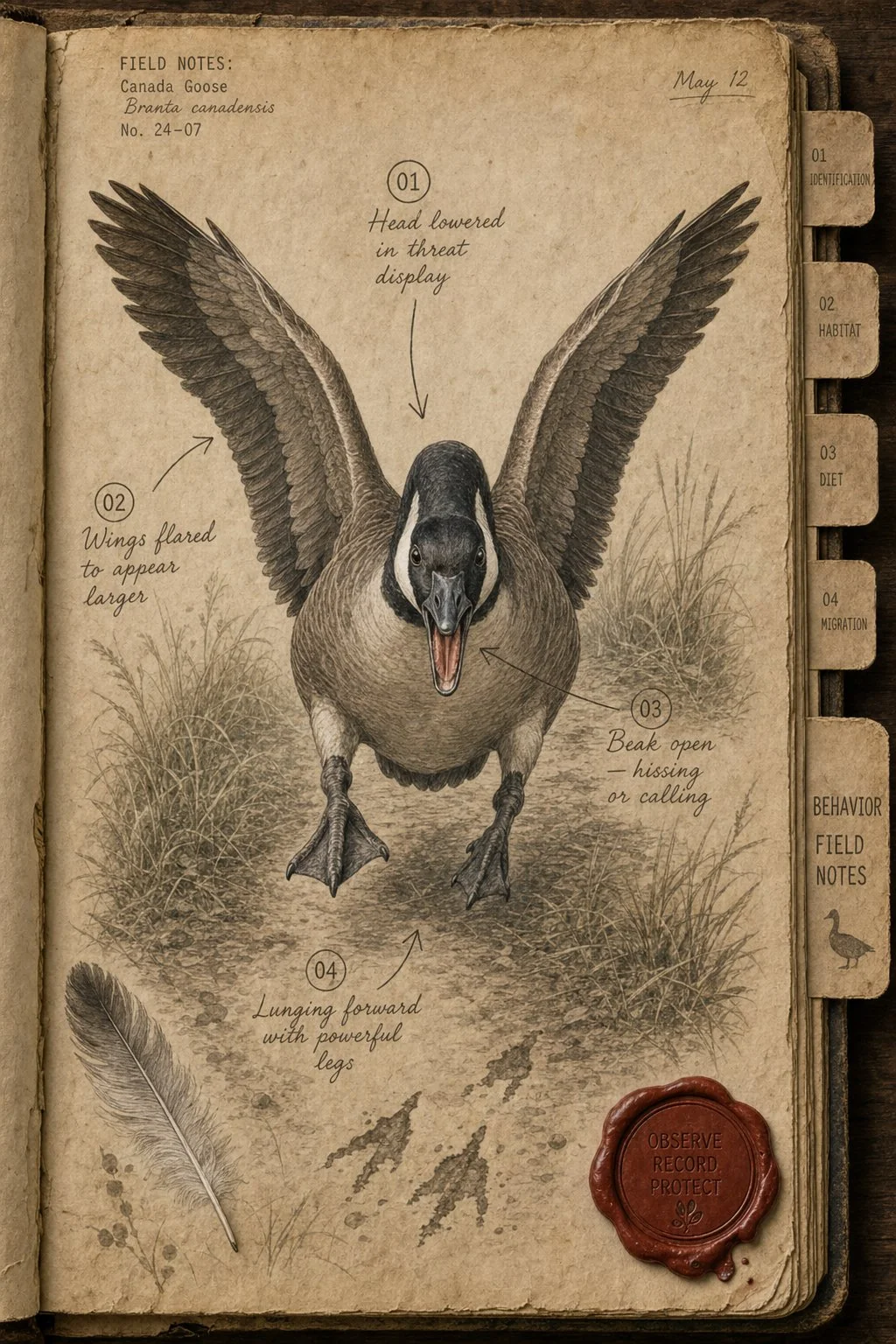
- Lower and parallel. Head dropped until the neck is parallel to the ground, walking deliberately forward. This is the warning posture. Hissing usually starts here.
- Wings out, faster walk. Wings half-spread, neck still extended, accelerating. The goose has decided you’re getting hit.
- Charge. Full run, wings out, head low. The strike comes from the leading edge of the wing - the carpal joint - which is hard enough to bruise a forearm.
Most ganders will stop at step 2 if you visibly retreat. Don’t run; don’t turn your back. Walk slowly backwards facing them until you’re at least 30 metres clear.
What the hiss actually means
The hiss is not a call. It’s a warning. A goose making a sound like a punctured tyre has already moved through step 1 and is at step 2 of the ladder. There is no situation where a hissing goose is playing.
It’s also worth knowing: geese hiss at predators (foxes, dogs), at conspecifics (other geese), and at humans, with the same sound. They’re not differentiating - the hiss is back away in goose, regardless of audience.
What the fight actually looks like
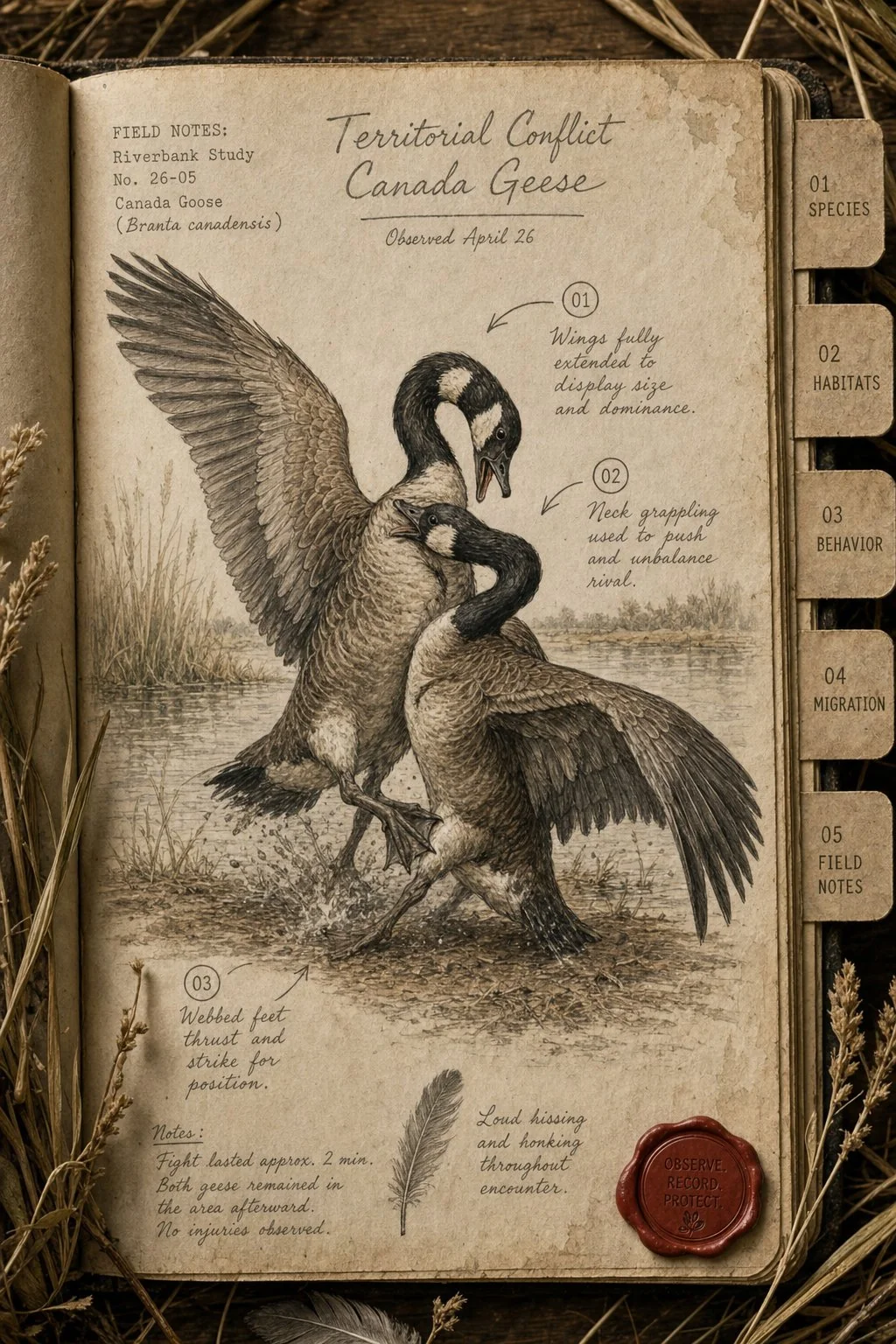
When two ganders genuinely commit to a fight, the choreography is unmistakable. They face each other, lock beaks, and twist necks. The wings come out wide for balance. One bird tries to push the other backwards into water or off-balance. The losing bird is usually the one that breaks first and flies off.
Real, blood-drawing fights are rare. Most “goose fights” people see in parks are step 2 or 3 of the warning ladder - posturing and short charges, then disengagement. Sustained combat is reserved for genuine territorial disputes, usually during nest-site selection in February or March.
What time of year you should expect it
In the northern hemisphere, the seasonal arc runs:
- December to January - low aggression. Mixed winter flocks tolerate each other.
- February to March - rapid escalation. Pairs leave the flock, select nest territories, start defending them.
- April to May - peak. Hens on nests, ganders patrolling. This is when humans get attacked walking through parks.
- June to August - high but easing. Goslings on the water; both parents defensive. Adults are also in their flightless wing moult, which makes them more, not less, aggressive (no flight escape).
- September to November - dropping fast. Birds re-flock for migration; territorial boundaries dissolve.
If you only have to walk past Canada geese once a year, October is the safe month. April is the worst.
How to avoid being attacked
The aggressive geese in a park are almost always defending a nest you can’t see. The hen will be sitting on eggs 30-100 metres away, often higher than you’d expect (geese nest on rooftops, traffic islands, anywhere with a sight line). The gander patrols an arc between her and you.
Three rules:
- Don’t approach. Stay 30+ metres from any goose pair that looks settled.
- Walk wide. Give them a broad arc, ideally with water between you.
- Read the ladder. Stop and back off the moment you see step 2 (head down, neck parallel).
If you do get charged, the safest reaction is to keep facing the bird, keep walking slowly backwards, and let it follow you out of its territory. It will stop pursuing once you cross what it considers the boundary.
Do geese ever fight to the death?
Almost never between conspecifics. Real goose-on-goose fights end when one bird disengages, which usually happens within a minute or two. Injuries do occur - a torn wing, a damaged eye, occasionally a broken leg - but mortal combat between geese is documented only rarely in the literature, mostly in cases where one bird was already injured.
The exception is interspecies aggression at the nest. A defending Canada goose will kill a small mammal (rat, weasel) that gets too close to eggs. They will not hesitate.
Common misconceptions
- “Geese hate humans.” They don’t. They’re indifferent to you outside the breeding window and protective of a specific patch of ground inside it.
- “Hissing means they’re scared.” No. Hissing is the warning before an attack. A scared goose flies.
- “You can tame them with food.” Habituating geese to food makes them more aggressive, not less. Park geese that expect handouts are statistically more likely to chase, because they read you as a food source you’re suddenly denying them.
- “They forget you.” They don’t. Canada geese can recognise individual humans by face over multiple seasons.
The bottom line
Goose-on-goose aggression is almost entirely seasonal, nearly always over territory or young, and choreographed by a four-step ladder you can read from twenty metres away. Walk wide, read step 2, and you’ll have very few problems even in April.
For the broader picture of how geese actually behave through a day, see our companion piece on interesting Canada goose behaviours and the long-distance question of how far a goose can fly in a day.