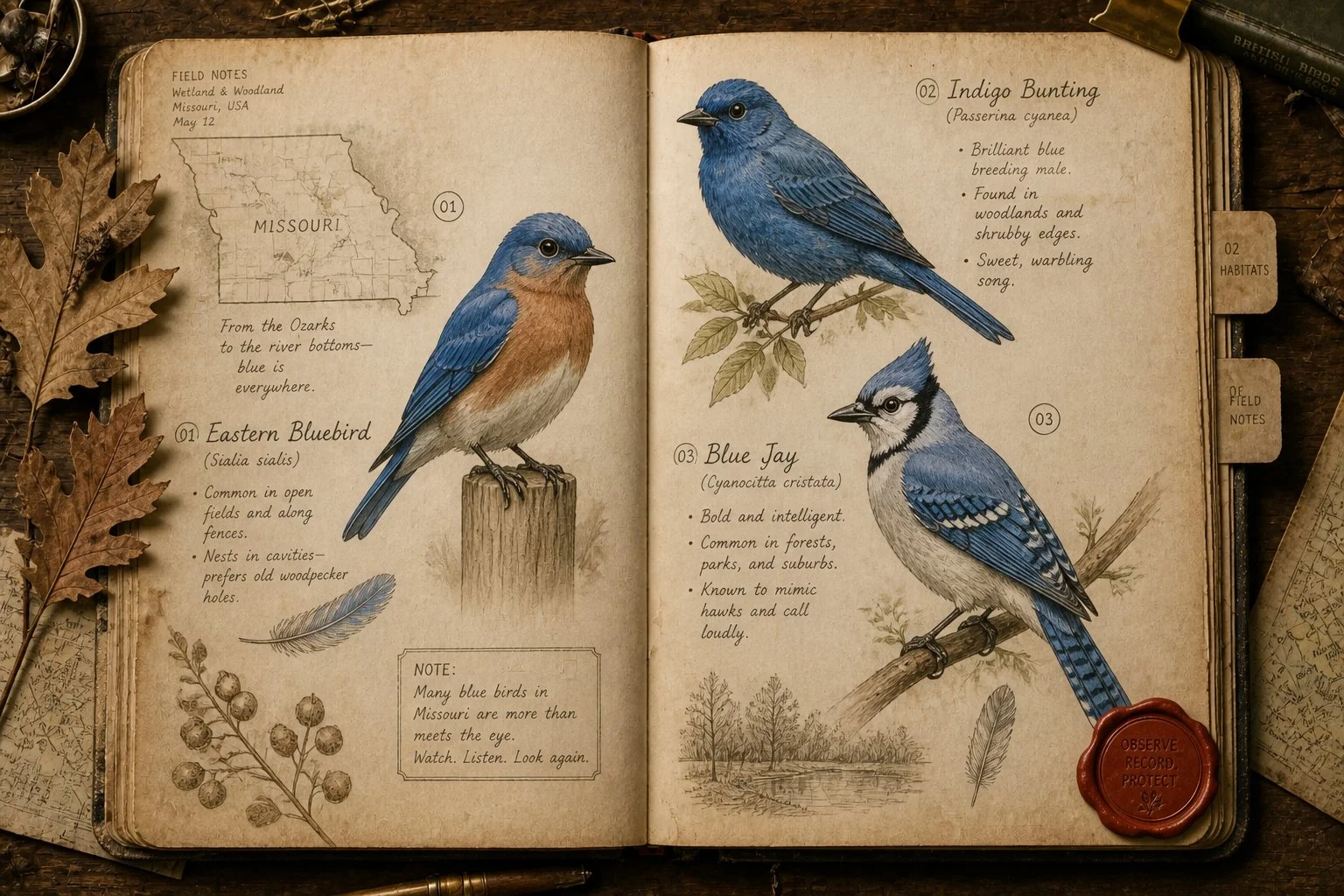
Eastern Bluebird on a fence post, Ozark glade, July sun. State bird.
Missouri holds 13 species with prominent blue feathers, ranging from the state bird (Eastern Bluebird) to small migrant warblers and the larger Blue Jay. Most are common, several are easy to attract to backyard nest boxes and feeders, and only a few require a deliberate trip to specific habitat to see. The state’s mix of Ozark hardwood forest, prairie, river bottomland, and farmland gives all 13 species adequate breeding or migration habitat.
The 13 species
Resident or breeding year-round:
- Eastern Bluebird - state bird. Open country with scattered trees, nest boxes, fence posts. Common.
- Blue Jay - oak woodlands, suburban yards. Common year-round.
- Belted Kingfisher - rivers, streams, ponds. Blue-grey back with rust belt on female. Year-round.
- Tree Swallow - migrant breeder. Open country with nest boxes. April-October.
- Barn Swallow - migrant breeder. Farms and bridges. April-September.
- Cliff Swallow - migrant breeder. Bridges, eaves. April-September.
- Purple Martin - migrant breeder. Martin houses, open country. April-September.
Summer breeders only:
- Indigo Bunting - male is iridescent deep blue. Brushy edges, woodland clearings. May-September.
- Blue Grosbeak - larger, darker blue with brown wing-bars. Brushy edges. May-September.
- Cerulean Warbler - sky-blue back. Tall hardwood canopy, Ozark forests. May-August. Hard to see.
Migrants only (passing through):
- Black-throated Blue Warbler - rare migrant through Missouri. May and September.
- Lazuli Bunting - very rare migrant from the west. Records are exceptional.
Less prominently blue but worth noting:
- Eastern Kingbird - dark blue-black back. Migrant breeder, open country with scattered trees.
(Some checklists also count Painted Bunting due to blue head colour, but the bird is primarily green and red in Missouri.)
Where to find them
- Backyard with nest boxes - Eastern Bluebird, Tree Swallow, Purple Martin (with martin house).
- Open farmland with fence lines - Eastern Bluebird, Blue Grosbeak, Indigo Bunting at brushy edges.
- Ozark hardwood forest - Cerulean Warbler (tall canopy), Indigo Bunting (clearings), Blue Jay (everywhere).
- River corridors - Belted Kingfisher, Tree Swallow, Cliff Swallow at bridges.
- Mark Twain National Forest - good for woodland species.
- Squaw Creek (Loess Bluffs) NWR - migration concentration.
- Big Oak Tree State Park - bottomland forest, Cerulean Warbler.
The structural blue trick
Most “blue” feathers in birds aren’t blue at all. There’s no blue pigment in bird feathers. The colour comes from microscopic feather structure that scatters light to reflect only the blue wavelengths back. Crush a blue jay feather between your fingers and the structure breaks - the feather looks brown or grey afterward.
This is why “blue” birds look most vibrant in sunlight and almost grey in deep shade. The colour depends on light source, not embedded pigment.
Bluebird attraction - what works
Eastern Bluebirds are the easiest “blue bird” to attract:
- Nest box on a post - 1-2 metres off the ground, in open country with a clear flight path. Entrance hole 1½ inches.
- Predator baffle on the post - mandatory; without it, raccoons or snakes will raid the box.
- Mealworms in a tray feeder - the highest-value bluebird food.
- Open ground for foraging - they hunt insects from low perches over short grass.
A pair often raises 2-3 broods between April and August.
Indigo Bunting attraction
Indigo Buntings come to brushy edges, often along forest clearings. They’re hard to attract to a feeder but will use a thistle (nyjer) seed feeder and may visit a backyard with native shrubs. Listen for their song - a repeating “fire fire where where” pattern from a high perch.
Woodlink NABB Audubon Cedar Bluebird House
The right box matters.
Generic "bird house" boxes have the wrong hole size and wrong floor depth for Eastern Bluebirds. The Audubon-standard NABB-pattern box has a 1½-inch hole (excludes starlings), proper drainage, and side-opening cleanout. The Woodlink version uses inland cedar and assembles without tools. Mount it on a baffled pole, not on a tree.
- NABB-pattern entrance hole sized for bluebirds, excludes starlings
- Western cedar construction, naturally rot-resistant
- Side-opening for inspection and cleanout
 Woodlink · NABB

As an Amazon Associate we earn from qualifying purchases.
The bottom line
Missouri has 13 species with prominent blue feathers, led by the state bird (Eastern Bluebird) and the eye-catching Indigo Bunting in summer. Most are common; only the Cerulean Warbler requires effort to find. Backyard nest boxes attract bluebirds reliably. Remember the colour is structural, not pigment-based - it depends on sunlight to look vibrant.
For more, see blue birds in Kentucky and blue birds in Arkansas.