Low country field notes, October.
South Carolina is one of the wettest US states by area - four major wetland types, over 4 million acres total, and some of the densest waterbird concentrations in the east. The four to know: bottomland hardwood swamps (cypress and tupelo), Carolina bays (the mysterious shallow elliptical depressions), freshwater marshes, and salt marshes. Most of the state’s iconic bird species depend on at least one of them.
The four major wetland types
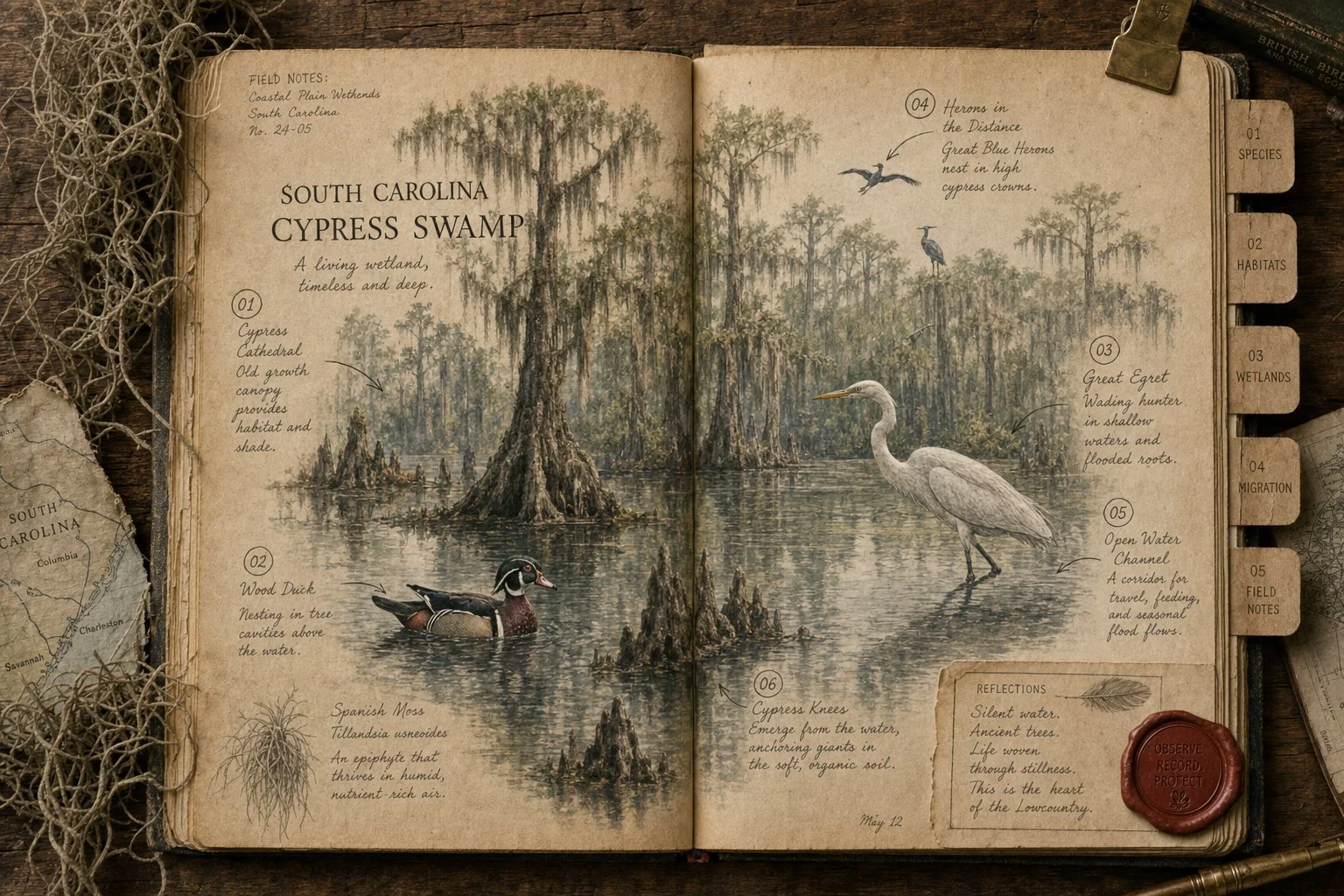
Bottomland hardwood swamp - cypress, tupelo, water oak in standing water. The classic Lowcountry forest. Black water, Spanish moss, alligators. Wood Ducks nest in tree cavities here; Prothonotary Warblers in the cypress; Barred Owls call at dusk.
Best examples: Congaree National Park, Francis Beidler Forest (the world’s largest virgin cypress-tupelo forest), Four Holes Swamp.
Carolina bay - shallow, elliptical, oriented NW-SE, all aligned. Origin debated for a century (likely glacial or wind-formed). Distinct ecosystem of cypress, gum, and a unique flora. Many are drained or degraded; the surviving ones are conservation priorities.
Best examples: Lewis Ocean Bay Heritage Preserve, Woods Bay State Park.
Freshwater marsh - open, herbaceous wetland with cattails, sedges, and shallow water. Hosts wading birds, waterfowl, marsh wrens, rails.
Best examples: ACE Basin NWR (mixed), Donnelley Wildlife Management Area, Bear Island WMA.
Salt marsh - the coastal grasslands of Spartina, tidal creeks, oyster beds. Most extensive salt marsh on the US Atlantic coast.
Best examples: ACE Basin (coastal portion), Cape Romain NWR, Charleston Harbor estuary, Hunting Island State Park.
What lives in each
Bottomland hardwood swamp:
- Wood Duck (cavity-nester)
- Prothonotary Warbler (the “golden swamp warbler”)
- Barred Owl
- Yellow-crowned Night-Heron
- Anhinga
- River otter, American alligator
Carolina bay:
- Pine Warbler, Yellow-throated Warbler
- Wood Duck on flooded sections
- Specialist insect fauna (rare moths and butterflies)
Freshwater marsh:
- Snowy Egret, Great Egret, Tricolored Heron
- King Rail, Common Gallinule
- Marsh Wren
- Wintering waterfowl: Northern Pintail, Northern Shoveler, Mallard
Salt marsh:
- Clapper Rail (the secretive marsh bird)
- Boat-tailed Grackle
- Saltmarsh Sparrow
- Seaside Sparrow
- Brown Pelican on tidal creeks
- Bottlenose dolphin in tidal creeks
When to go
- October-February - winter waterfowl peak, especially in ACE Basin and Bear Island.
- March-May - migrant warblers, breeding waders.
- June-August - mosquitoes brutal; mid-day is unpleasant. Early-morning only.
- September-October - shoulder season; comfortable temperatures, returning migrants.
The Lowcountry is one of the few parts of the eastern US that genuinely rewards winter birding - both for the waterfowl numbers and for the mild climate.
Practical: what to wear and bring
South Carolina wetlands range from waist-deep mud to manicured boardwalks. For an active day of low country wetland birding:
- Waterproof boots (knee-high muck boots for the bottomland forests; ankle-high will do for boardwalks).
- DEET-based insect repellent (the gnats and mosquitoes are real).
- Tick spray (permethrin on clothing).
- A field guide for the Eastern US.
- Binoculars (8x42 standard).
Muck Boot Chore Mid Waterproof Boot
The boot that handles ACE Basin mud.
Mid-calf waterproof rubber boots, rated for cold and wet alike. The Chore Mid is the work-grade Muck Boot used by every wetland naturalist who has had to wade tidal creeks or walk a saturated bottomland forest. Genuinely waterproof, comfortable for all-day use.
- 100% waterproof rubber, comfortable to mid-calf
- Aggressive tread for muddy terrain
- Insulated for cool-weather wading
 Muck Boot · Chore Mid

As an Amazon Associate we earn from qualifying purchases.
The bottom line
Four wetland types, all distinct, all accessible from Charleston in under two hours. The bottomland hardwoods (Congaree, Beidler) are the must-see; the salt marsh of the ACE Basin is the iconic Lowcountry experience. Winter for waterfowl, spring for warblers. Bring boots.
For comparable wetland reads, see Florida water birds and planting a duck-friendly pond.