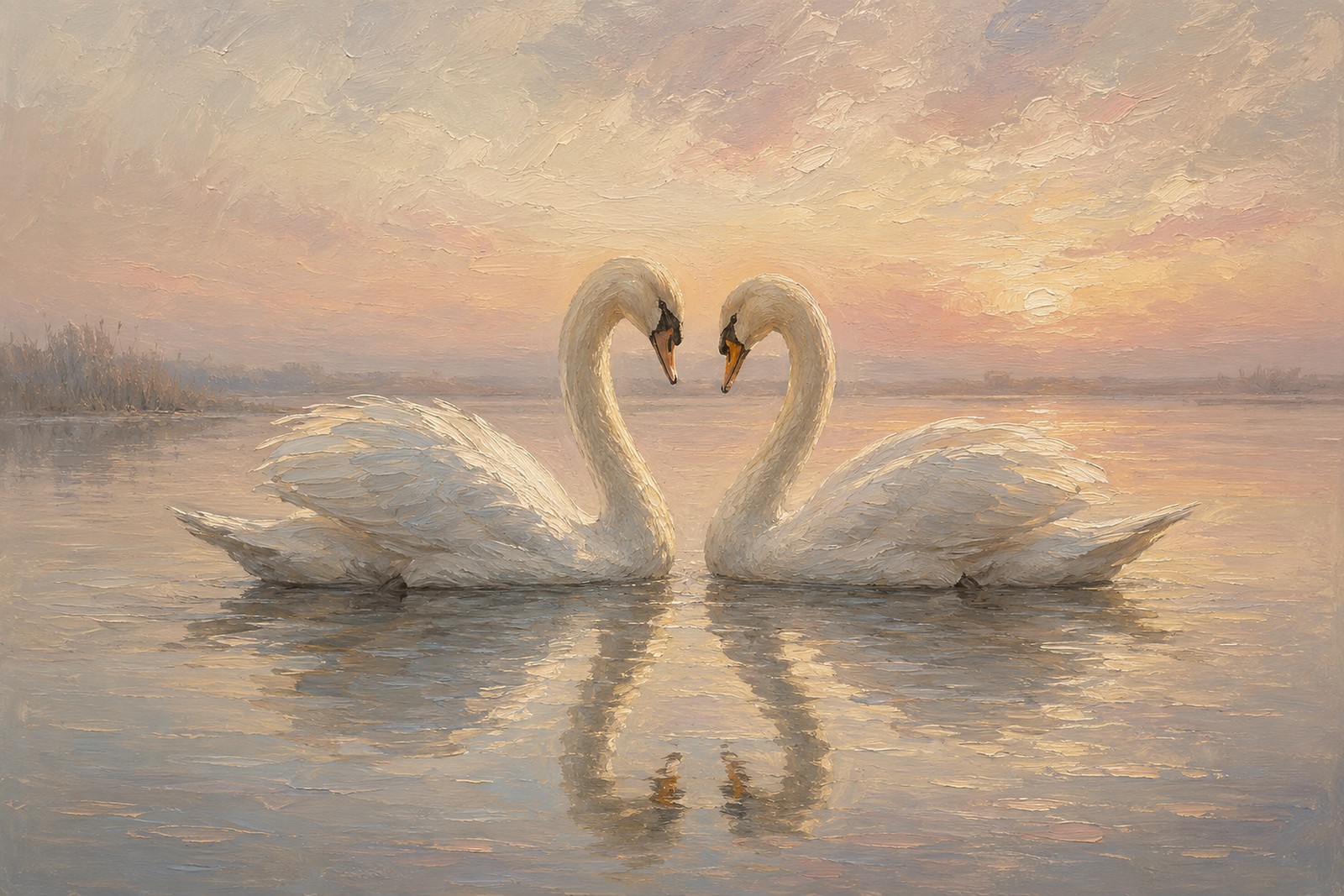
A bedroom asks something different of its art than any other room in the house. The living room can take drama. The dining room can take formality. The bedroom’s art is the last thing you see with the lamp on and the first thing you see when the curtains open, and it should be chosen the way you choose a mattress: for how it makes the room feel at 11pm, not how it photographs at noon. By that standard, very few subjects beat two swans on still water. This guide covers why that composition works so specifically well in bedrooms, what the trumpeter swan brings that other birds do not, and how to get the size and hanging height right above a headboard.
Why is still water the most restful thing you can hang?
Calm is not a mood a picture has; it is a set of visual properties you can point at. The first is the horizontal line. Level horizons and flat water read as settled in a way vertical and diagonal compositions never quite do, and a bedroom, whose largest object is itself a low horizontal, is the natural home of the level line. The second is low contrast. Restful images keep their tonal range narrow, mist rather than noon glare, and avoid hard edges and saturated colour. The third is reflection. Still water doubles its subject symmetrically, and that mirroring reads as order without the stiffness of true symmetry.
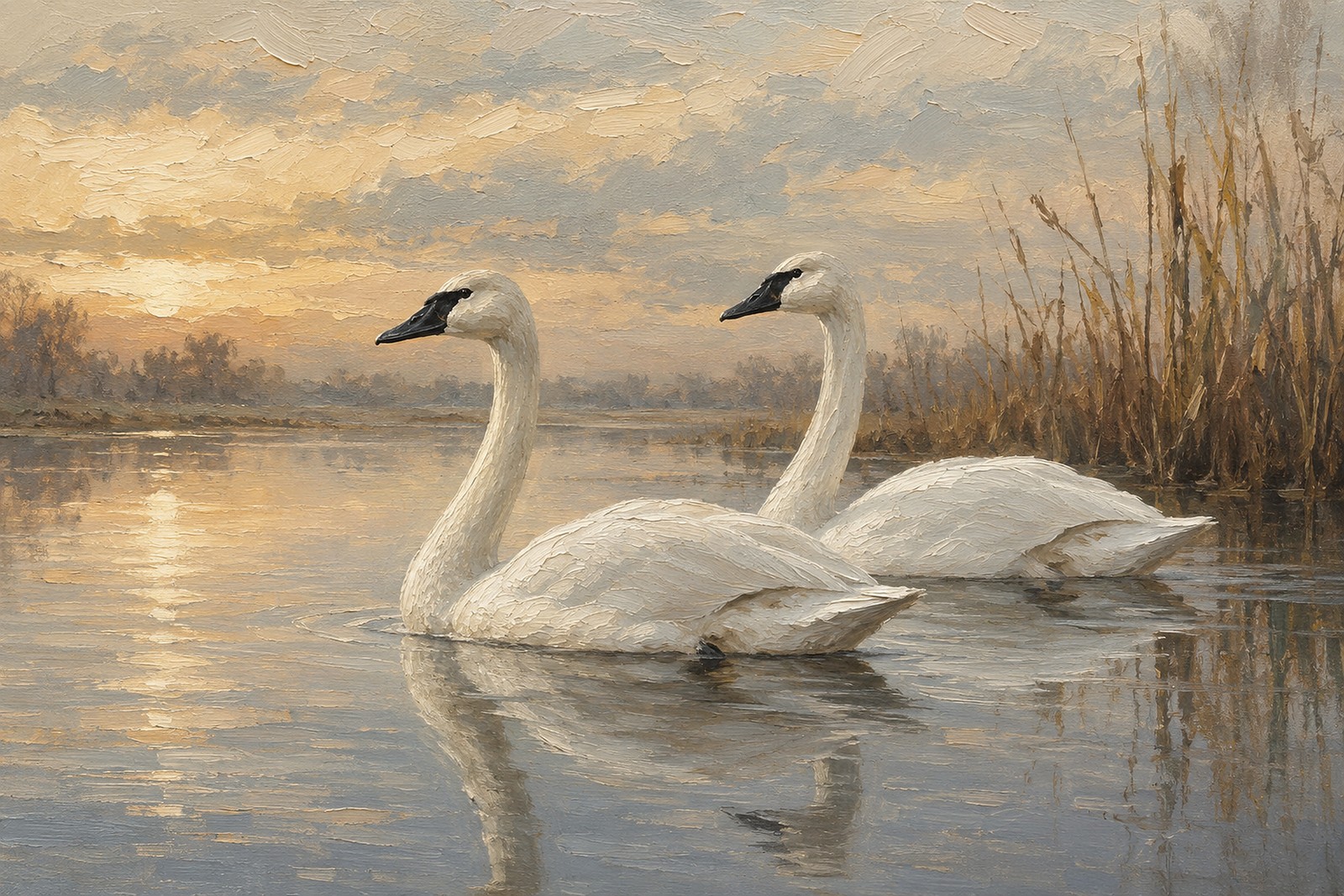
A trumpeter swan pair on still water is close to a checklist of all three. Unbroken water plane, white birds against soft grey-blue, each swan answered by its own reflection. The composition is a 3:2 landscape printed edge to edge, no border, so the water runs off both sides of the sheet and the image reads as a wide, quiet window rather than a contained object. Landscape orientation matters more in bedrooms than anywhere else in the house, because the wall above a bed is a wide, short space that portrait-format art fights and landscape art fits.
The trumpeter swan: North America’s quiet giant
Most swan art defaults to the mute swan, the orange-billed, curve-necked bird of European park lakes. The trumpeter is the continent’s own swan, and the bigger, rarer story. It is North America’s largest native waterfowl, a bird that can run to a wingspan approaching eight feet, with an all-black bill and a straighter, more upright neck carriage that gives it a quieter dignity than the mute swan’s theatrical curve. Its name comes from its call, a deep, resonant note produced by a windpipe that loops inside the breastbone, more French horn than honk.
The species also carries one of American conservation’s great recoveries. By the early 1930s only a few dozen trumpeters were known to survive in the contiguous United States, and the bird was widely assumed to be finished; protection, decades of restoration work, and the later discovery of a healthy Alaskan population brought it back to tens of thousands today. A trumpeter pair on a bedroom wall is, quietly, an image of endurance, which suits the room where a couple does its own enduring. Trumpeters, like other swans, generally hold their pair bonds long term, year over year, with rare separations and re-pairing after loss, so the symbolism is honest as well as handsome. For how the trumpeter sits alongside the tundra and mute swans, our guide to North America’s swans covers all three species properly.
What size should art be above a headboard?
The working rule for any art over furniture: the piece should span roughly half to two-thirds the width of the furniture below it. Above a bed, that translates concretely.
Queen bed, 60 inches wide. The 20x30 print, thirty inches of width, sits exactly at the half-way mark and reads as a confident single anchor. The 16x24 works in a smaller room or under a low ceiling, but do not go below it; undersized art above a queen bed is the most common bedroom hanging mistake there is.
King bed, 76 inches wide. A single 20x30 is at the lower bound of correct, and it will look best centred with generous wall around it in a room that leans minimal. The stronger arrangement is a pair: two 16x24 prints hung side by side with a couple of inches between them span around fifty inches and fill the wall the way one oversized piece would, while keeping the still-water horizontal running across both.
Full or double bed. The 16x24 centred is right; the 20x30 suits it only if the wall is tall and otherwise bare.
Hanging height matters as much as width. Leave 8 to 10 inches between the top of the headboard and the bottom of the frame; higher than that and the art floats away from the bed, lower and it crowds the pillows. And above a bed, fix the piece properly, into a stud or a rated anchor, for the same obvious reason that applies in a nursery.
Palettes that settle: building the bedroom around the print
The trumpeter pair’s palette is whites, silver greys and muted blue-greens, which behaves as a cool neutral and cooperates with the bedroom colours people actually choose: white, cream, grey, sage, dusty blue. Against a deeper wall, slate blue or green-grey, the white birds carry further and the room reads more formal.
Frame choice sets the temperature. Black is the crispest and suits tailored, modern-leaning bedrooms; brown wood is the warmest and belongs with oak and walnut furniture; gold reads traditional and pairs naturally with the grandmillennial direction. If the bedroom already has metal lamps or hardware, matching the frame to that finish is the low-risk move. All three framed options are $189, $259 and $329 across the three sizes, and the unframed print, $59, $89 or $119, is the choice when you want a framer to match something specific.
Beyond the headboard
The wall above the bed is the obvious spot, not the only one. The wall directly opposite the bed is arguably the more valuable position, since it is what you actually look at from the pillow; a single 16x24 centred at eye height from the bed works well there. Above a dresser, the same two-thirds rule applies as above a headboard. A reading corner takes the 12x18 nicely at seated eye level. If you are furnishing more than one room and want the swan thread to run through the house, the bedroom pieces sit within the full set of swan and crane prints, and our swan prints guide covers placements in entryways and formal rooms beyond the bedroom.
Every print is an original AI-created artwork in the style of antique oil painting, described plainly as exactly that, made to order and dispatched in 2 to 5 business days, with free shipping to the US, Canada, the UK, Europe, Australia and New Zealand. A $19 digital download exists for anyone printing and framing locally, and the 30-day policy replaces or refunds anything that arrives damaged, defective or wrong.
Frequently asked questions
What is the best print size above a king bed?
Two 16x24 prints hung side by side, a few inches apart, fill a king-width wall better than any single piece in this range. A lone 20x30 works in a minimal room where empty wall is part of the look, but it is the floor, not the target, for a 76-inch bed.
Is landscape or portrait orientation better for bedroom art?
Landscape, almost without exception, above the bed itself: the wall over a headboard is wide and short, and a 3:2 landscape composition fills it the way the bed fills the floor. Portrait-format pieces belong on the narrow walls beside windows or above a tall chest instead.
How high should the print hang above the headboard?
Leave 8 to 10 inches of wall between the headboard’s top edge and the frame’s bottom edge. That ties the art and the bed into one visual unit. The generic eye-level rule matters less here, because the bed, not the standing viewer, sets the composition.
Is the trumpeter swan print a photograph?
No. It is an original AI-created artwork in the style of antique oil painting, printed edge to edge in 3:2 landscape format. We say so directly on every product page, because knowing what the piece is belongs to knowing whether it is right for your room.