Every field has its obvious choices and its insider’s choice. In coastal bird art, the heron is the statement piece and the pelican is the silhouette everyone recognises from the boardwalk. The American avocet is something else entirely: the bird people choose when they know exactly what they are looking at. It is a strong candidate for the most elegant bird on the continent, and the case is easy to make from a single glance, which is precisely what an avocet print asks a wall to deliver.
What makes the avocet the collector’s shorebird?
Most beach birds earn their place on walls through familiarity. Everyone has watched a sanderling outrun a wave or a pelican patrol the surf line, so those prints trade on recognition. The avocet inverts the logic. Most people have never consciously seen one, because avocets favour shallow saline lakes, estuaries and quiet managed wetlands over busy swimming beaches. Its audience is the person who has stood at the edge of a lagoon with binoculars and watched a line of them feed.
That is what “collector’s shorebird” means here. An avocet print does not say coastal theme. It says a specific bird, known and chosen, the way a shelf of first editions says something a shelf of bestsellers does not. In a room, that specificity reads as confidence: the picture was not bought to match a sofa.
The recurved bill and the cinnamon head
Two field marks carry the whole picture, and both are worth understanding before you hang one.
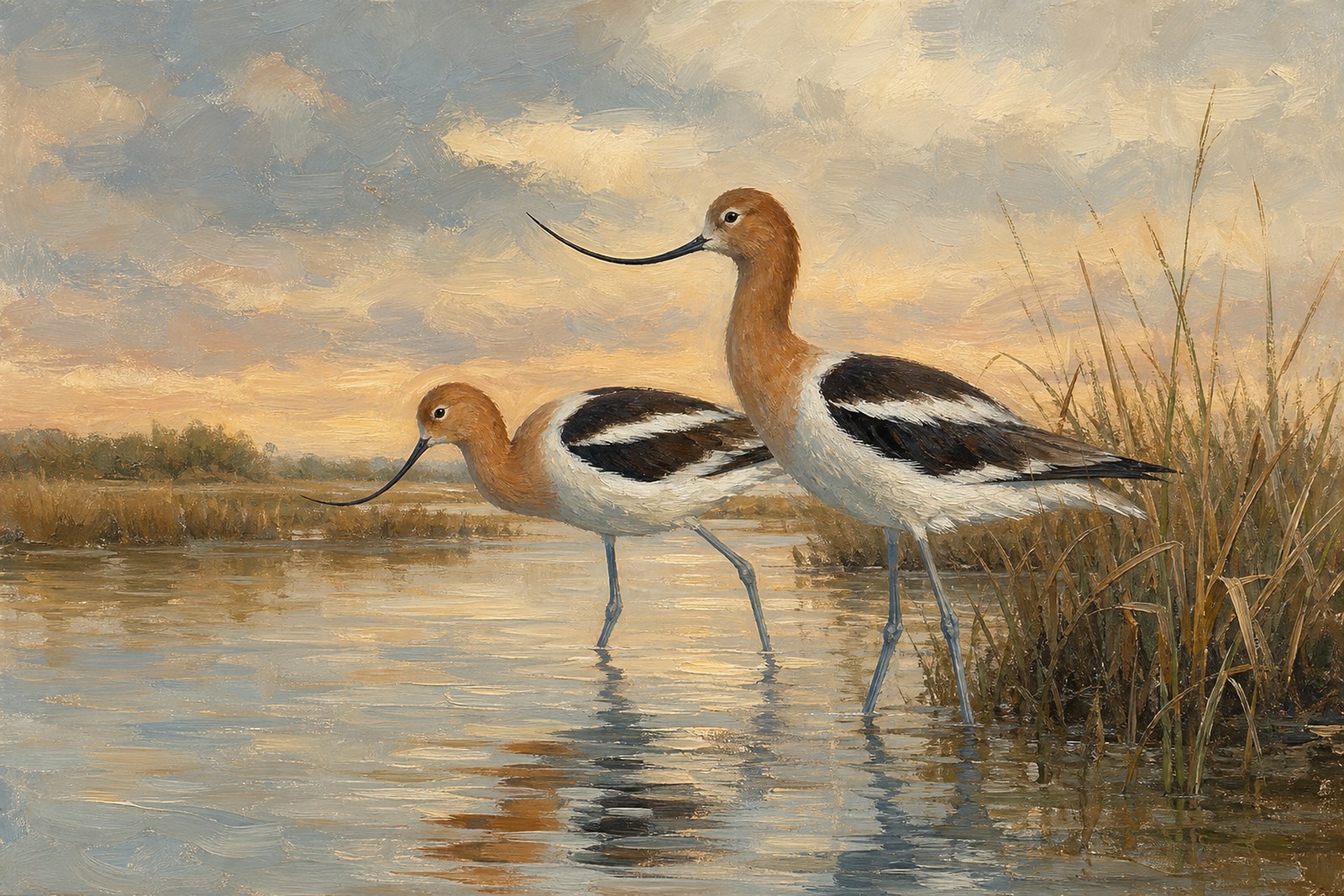
The first is the bill. An avocet’s bill sweeps upward, a recurve that almost no other North American shorebird shares, finer than a curlew’s bill is heavy, and drawn like a single calligraphic stroke. The birds feed with it in a motion called scything, the bill slightly open and swept side to side through shallow water to catch small invertebrates. Even standing still, an avocet looks like a bird designed by a draughtsman with one clean line left in the pen.
The second is the head. In breeding plumage the avocet’s head and neck turn a soft cinnamon, a warm rust that fades gradually into a white body set off by bold black wing bars. Winter birds trade the cinnamon for pale grey, but it is the breeding colour that defines the species and the artwork. Cinnamon against silvered water is a natural two-tone palette: one warm accent held inside a field of cool neutrals.
Our American Avocets in Shallow Water print is built on exactly that engine. The birds wade mid-scythe through calm water, their reflections doubling the composition’s lines, the cinnamon heads supplying the only warmth in a picture of silver, oyster and pale sky. It is quiet from across a room and precise up close.
Why do birders give avocet art?
A heron print is a safe gift. An avocet print is a specific one, and that is its advantage.
For a recipient who keeps a life list, the bird on the wall is a bird they remember finding, at a salt lake in the interior West or an estuary in winter, and the print becomes a record of that as much as a decoration. For the giver, the choice signals that you know the difference between generic coastal decor and this bird, which is the difference between a present and a placeholder.
There is a practical side as well. Because the avocet’s palette is cinnamon, white, black and water-silver rather than seaside blues, the print does not force a beach theme on anyone’s house. It hangs as comfortably in a study or a dining room as in a shore-facing hallway, so you can give it without knowing how the recipient decorates. And where distance is a problem, the $19 digital download exists, though with free shipping to the US, Canada, the UK, Europe, Australia and New Zealand, sending the physical print to their door is usually the better gesture.
Avocet art in the elegant hall
If the heron owns the console table, the avocet owns the hallway. Its horizontal water line steadies a narrow space, and the fine lines of bill and leg suit close viewing in a way heavier compositions do not.
Over a hall console, follow the classic proportion: the print, or print plus frame, should span roughly half to two-thirds the width of the table beneath it. A 16x24 covers most consoles; a 20x30 suits a wide entry wall viewed straight on. For paired arrangements, the symmetry logic in our heron prints guide applies just as well here: paired pieces should face the centre of the arrangement, and the avocet’s strong directional profile makes that facing read clearly from across a room.
Dining rooms are the other natural home. They are rooms for slow looking, and the avocets’ unhurried wading suits a wall you sit opposite for an hour at a time.
What wall colours flatter an avocet print?
The print’s structure, one warm cinnamon accent inside a cool silver field, tells you most of what you need.
Blue-greens and muted greens are the strongest partners, because cinnamon and blue-green sit opposite each other on the wheel: against a soft eucalyptus or a deep slate-green wall, the heads glow without the print ever raising its voice. Navy does the same job more formally, and it is the classic pairing for a hall with dark timber and brass. Putty, greige and warm grey are the quiet options, letting the silvered water blend while the cinnamon supplies the room’s accent colour on its own.
Two cautions. Pure white walls need the frame to do the separating, since the print’s pale water tones can drift into a white wall without a black or brown line between them. And orange-heavy or terracotta walls are the one genuine clash, because they swallow the exact colour that makes the bird read.
Sizes, frames and the details
All prints are 3:2 landscape, printed edge to edge with no border or mat line on archival fine-art paper. Unframed prints are $59 for 12x18, $89 for 16x24 and $119 for 20x30. Framed prints come in black, brown or gold at $189, $259 and $329. Gold flatters the cinnamon head and suits formal halls, brown grounds the print among wood furniture, and black sharpens it against pale modern walls.
Every piece is an original AI-created artwork in the style of antique oil painting, made to order and dispatched in 2 to 5 business days, with free shipping to the US, Canada, the UK, Europe, Australia and New Zealand, and a 30-day replacement or refund policy for anything that arrives damaged, defective or wrong. The avocets wade alongside sandpipers, plovers and godwits in our shorebird and beach house prints, and the wider world they feed in, salt lagoon to tidal flat, is covered on the Coastal & Estuary habitat page.
Frequently asked questions
Is the avocet’s bill really curved upward?
Yes. The recurved bill is the species’ defining mark, and females carry a shorter, more strongly curved bill than males. Avocets feed by scything, sweeping the slightly open bill side to side through shallow water, which is the behaviour most avocet artwork, ours included, sets out to capture.
What colours does an avocet print bring to a room?
Cinnamon, white, black and silvered water tones. It behaves as a single warm accent inside a cool neutral field, which makes it easy to place: it works with navy, grey-green, cream and most wood tones without asking the room to go coastal.
Is this a photograph or a painting?
Neither. It is an original AI-created artwork in the style of antique oil painting, printed to order on archival fine-art paper. We say that plainly on every listing, because knowing what you are buying matters as much in art as the picture itself.
What size avocet print suits a hall console?
Half to two-thirds the width of the console is the working rule. That makes 16x24 the standard choice for most hall tables, with 20x30 reserved for wide consoles and entry walls viewed head-on from the door.