Every coastal and wetland decorating scheme eventually arrives at the same bird. The heron is tall, still, and utterly composed, standing motionless in the shallows for so long it becomes part of the landscape until, without warning, it strikes. That combination, patience and precision, is exactly what makes a heron print work so well on a wall. It doesn’t compete for attention the way a burst of colour or a busy composition does. It commands a room the way the bird commands a shoreline, quietly, and by simply being the tallest, most deliberate thing in the frame.
If you’re choosing one bird to anchor a coastal, lake house, or wetland-themed room, the Great Blue Heron is the obvious answer. Here’s why it works, and how to hang it properly.
Why the heron is the decor world’s favourite bird
Part of the heron’s appeal is pure proportion. At three to four and a half feet tall with a six-foot wingspan, it’s the largest wading bird most people will ever see up close, and that scale translates directly onto a wall. A heron print reads as a substantial, room-anchoring piece even at a modest print size, because the bird’s own silhouette, that long neck, those impossibly thin legs, does the visual work of a much bigger composition.
The other part is the stillness. Herons hunt by standing motionless for long stretches, sometimes twenty minutes at a time, waiting for a fish to come within striking range. A print capturing that stillness has a quality almost no other bird print can match: it looks composed rather than caught mid-motion, which is exactly the tone you want from a piece hanging over a console table or a mantel, somewhere it’s meant to be looked at slowly rather than glanced at in passing.
Herons also carry the coastal and wetland aesthetic without tipping into a novelty theme. A print of a heron standing in still water reads as classic interior art first and “beach house” or “lake house” second, which means it works in rooms that aren’t overtly coastal-themed at all: a study, a formal dining room, an entry hall.
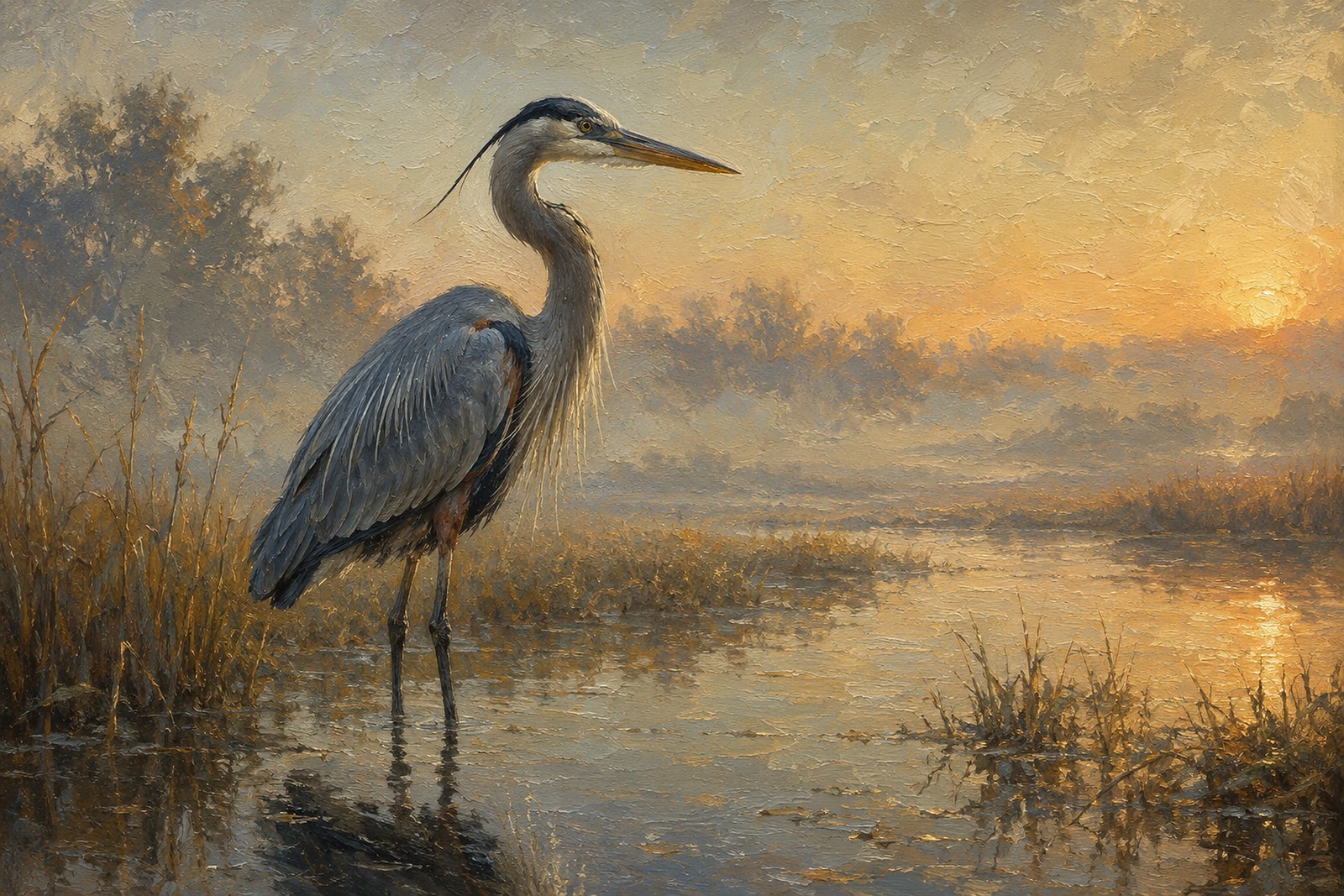
The Great Blue Heron print
Our Great Blue Heron print is rendered in the style of a classic oil painting, the bird standing in shallow water with the kind of quiet, layered brushwork that traditional wildlife art has used for centuries. It’s built to be a solo statement piece: a wide, edge-to-edge landscape composition that reads clearly from across a room.
Hung alone, it suits the wall above a console, a mantel, or a sideboard, anywhere a long piece of furniture needs one confident horizontal anchor above it. Its wide 3:2 proportions do what landscape art has always done over furniture: settle the wall rather than fight it.
The great egret companion, and how to hang a wader pair
For anyone decorating around a console table, a mantel, or a wide wall meant to be viewed head-on rather than approached from one side, a single heron print isn’t always the right call. This is where the Great Egret print earns its place as the natural coastal companion. It’s a second wader in the same oil-painting style and the same landscape format, the egret’s pure white plumage playing against the heron’s blue-grey.
Hung as a pair on either side of a mirror, a fireplace, or a piece of furniture, the two prints read as one deliberate set, which is the classic symmetry rule traditional decorators have used for centuries: paired art should match in size, frame, and subject weight so the arrangement holds together around its centre. Hang them at matching height, roughly eye level from the center point between them, with even spacing on both sides of the anchor piece. A console table with a lamp on each end and a wader print above each lamp is one of the most reliable formal arrangements in traditional interior decorating, and it works precisely because the two birds complement each other across the symmetry line rather than repeating.
This pairing also solves a common framing problem: a single large print over a wide console can look stranded, too small for the wall, too large for the table. Two matched prints fill the same width with more visual rhythm and none of the awkward scale mismatch.
Where to hang heron prints
Over a console or entry table. The single most natural home for the heron and egret pairing. The wide landscape format matches the horizontal span of a console perfectly, and the two-print symmetry reads as considered and formal from the moment someone walks in.
Over a mantel. A single heron print, sized to roughly two-thirds the width of the mantel, works as a classic single anchor. If the mantel is wide enough, the heron and egret pair with a clock or mirror between them repeats the same symmetry logic as the console arrangement.
Over a sideboard or dresser. The wide 3:2 format is built for exactly this kind of space, where a long run of furniture leaves a broad horizontal band of wall asking for one substantial piece.
Studies and formal living rooms. Because the heron’s stillness reads as composed rather than decorative, it holds up in rooms with a more serious, traditional feel, alongside dark wood furniture and leather, not just in overtly coastal interiors.
Pairing a heron print with the rest of a coastal room
The heron’s blue-grey plumage is one of the easiest colours in nature to build a room around, since it sits between blue and grey and reads as neutral rather than a strong accent colour. That makes it compatible with almost any coastal or classic palette: navy, sand, white, deep green. If you’re building a broader shorebird theme rather than a single heron statement, our coastal wall art guide covers how the heron sits alongside sanderlings, plovers, pelicans, and egrets in a full beach house scheme. And if the room in question is a lake house or hunting cabin rather than a beach house, our duck hunter gift guide covers the waterfowl side of the same wetland aesthetic.
For the wider habitat this bird calls home, see our Marsh & Reedbed habitat page, where herons work the shallows alongside egrets, bitterns, and rails.
Both the Great Blue Heron and Great Egret prints are AI art rendered in the style of a classic oil painting, printed to order, from $59 unframed and $189 framed in black, brown or gold, with free shipping to the US, Canada, UK, Europe, Australia & NZ.
FAQ
What size should a heron print be over a console table?
For a single print, aim for roughly half to two-thirds the width of the console. For a two-print pairing, each print should be sized so the two together, plus the gap between them, span about the same proportion of the wall. A common working size is 12x18 or 16x24 per print for a standard-depth console table.
What print pairs best with the Great Blue Heron?
The Great Egret is the natural coastal companion, a second wader in the same oil-painting style and the same landscape format, its white plumage balancing the heron’s blue-grey. Buying one of each is how you build the matching two-print pairing described above.
Is the Great Blue Heron print a real painting or a photograph?
Neither. It’s AI-generated art created in the style of a classic oil painting, not a photograph and not an antique or historical piece. We describe it that way deliberately, since the “in the style of” distinction is part of what we think buyers should know before they order.
What wall colour works best behind a heron print?
The heron’s blue-grey plumage holds up against almost any neutral, cream, soft white, pale sand, or warm grey. For more drama, a deep navy or forest green wall lets the pale tones in the bird’s plumage stand out sharply, which suits a study or formal dining room more than a light, airy coastal space.