Field notes after a season working raptor migration counts in Rockfish Gap and the Shenandoah hawkwatches.
The short version: Virginia’s three big physiographic zones (Blue Ridge mountains, Piedmont plateau, Tidewater coastal plain) each have their own raptor signature. Ten species cover 95% of what you’ll see in the field across a year: Red-tailed Hawk, Cooper’s Hawk, Sharp-shinned Hawk, Red-shouldered Hawk, Bald Eagle, Osprey, American Kestrel, Black Vulture, Turkey Vulture, and Barred Owl. The other ten or so species (Golden Eagle, Merlin, Peregrine, Northern Harrier, Rough-legged Hawk, Mississippi Kite, Broad-winged Hawk, Northern Saw-whet Owl, Great Horned Owl, Eastern Screech-Owl) are either seasonal, scarce, or hard to spot.
The ten you'll actually see
In rough order of how often you’ll encounter them:
1. Red-tailed Hawk (Buteo jamaicensis)
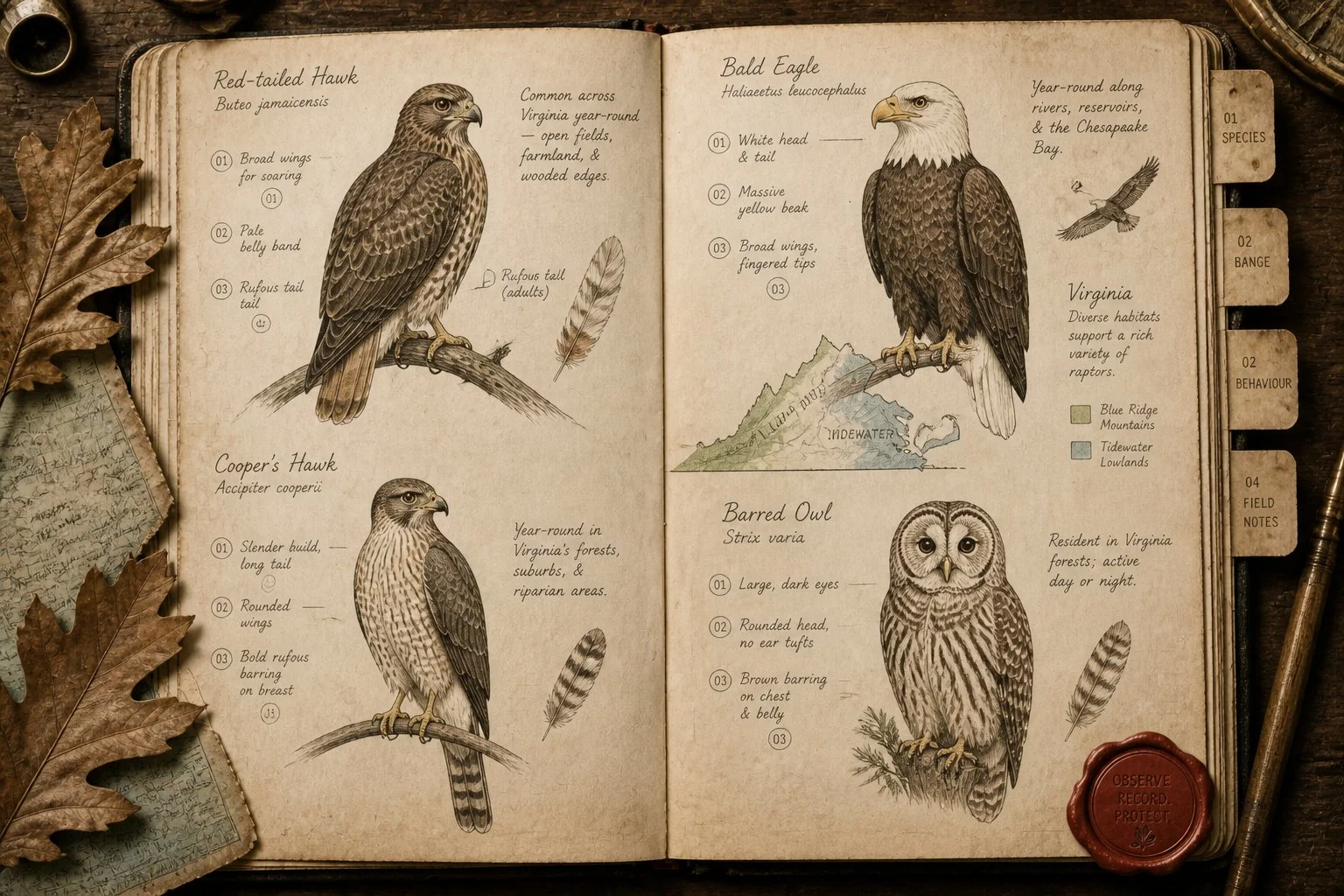
Virginia’s most common large raptor. Year-round resident on every interstate corridor - the bird you see perched on highway light poles. Brown above, pale below, rust-coloured tail visible in flight against sun. Hunts rodents and rabbits from a perch. Open country, farmland, woodland edge.
2. Cooper’s Hawk (Accipiter cooperii)
The backyard accipiter. Year-round, but more visible in winter when songbird traffic at feeders increases. Long banded tail, rounded wings, fast pursuit hunter. If a Sharp-shinned-shaped hawk is bigger than a Mourning Dove, it’s a Cooper’s. Hunts at feeders - see why crows attack hawks for the mobbing response.
3. Sharp-shinned Hawk (Accipiter striatus)
The smaller accipiter, mostly winter visitor in Virginia. Same shape as Cooper’s but compressed - if it’s smaller than a Mourning Dove, it’s a Sharpie. Same backyard-hunting behaviour. Smaller songbird prey.
4. Red-shouldered Hawk (Buteo lineatus)
The forested-wetland buteo. Bottomland hardwoods, swampy creeks, slow rivers. Loud descending “kee-yaaar” call carries half a mile. Year-round; most vocal February-April.
5. Bald Eagle (Haliaeetus leucocephalus)
The Chesapeake Bay watershed conservation success story. Now common around the James, Rappahannock, Potomac, and Chesapeake. Mature birds (white head/tail) easily ID’d; immature birds are confusingly all-brown for the first 4-5 years. Year-round, breeding January-March.
6. Osprey (Pandion haliaetus)
Spring through autumn only - migrates south in October. Fish specialist; nests on channel markers, utility poles, and dedicated osprey platforms along every navigable waterway. The bird on every nest cam from March through September.
7. American Kestrel (Falco sparverius)
The smallest North American falcon. Year-round in agricultural Virginia; less common in suburbs as nest cavities disappear. Hovers over fields hunting insects and small mammals. Population is in long-term decline - one of the conservation concerns for VA’s grassland habitats.
8. Black Vulture (Coragyps atratus)
Mostly southern bird, expanding north. All-black, short tail, white wingtips. Soars on flat wings; pumps wings more than turkey vulture. Year-round across most of the state now.
9. Turkey Vulture (Cathartes aura)
Year-round, abundant. All-dark with grey trailing-edge wing pattern, holds wings in shallow V (dihedral) when soaring, rocks side to side. The classic “vultures circling” bird is almost always this species.
10. Barred Owl (Strix varia)
The Virginia owl you’re most likely to hear (the “who cooks for you, who cooks for you all” eight-note call). Wooded swamps, mature deciduous forest. Year-round resident, vocal year-round but especially January-March. See are owls dangerous for the nest-defence question.
The seasonal and scarce ones
Worth knowing about but you have to work for them:
- Broad-winged Hawk - migrates through in big numbers in mid-September; concentrated at Rockfish Gap, Snickers Gap, and the Shenandoah hawkwatches. Otherwise gone.
- Peregrine Falcon - urban resident on Richmond bridges and a few cliff sites; winter visitor on coast.
- Merlin - winter visitor, scarce.
- Northern Harrier - winter visitor on coastal marshes and Eastern Shore farmland.
- Mississippi Kite - scarce summer breeder in southeastern VA forests.
- Rough-legged Hawk - rare winter visitor, mostly Eastern Shore.
- Golden Eagle - rare winter visitor to high mountain country; banded studies show small wintering population.
- Great Horned Owl - year-round resident, vocal but easy to miss. Nests in February.
- Eastern Screech-Owl - year-round, common but small and hidden. Trill call.
- Northern Saw-whet Owl - rare winter visitor, mountain dense conifer.
Where to look, by region
Tidewater (coast, Chesapeake, Eastern Shore):
- Bald Eagles along every major river.
- Ospreys nesting on channel markers and platforms.
- Northern Harriers in winter over coastal marshes.
- Black Vultures expanding inland from coast.
Piedmont (Richmond, Charlottesville, Lynchburg):
- Red-tailed Hawks on every interstate corridor.
- Cooper’s and Sharp-shinned in suburbs.
- Red-shouldered along wooded creeks.
- Barred Owls in mature forest.
Blue Ridge & Shenandoah:
- Broad-winged Hawks on autumn migration.
- Resident Red-tails and Red-shouldereds in the parkland.
- Great Horned and Barred Owls in old-growth pockets.
- Occasional Golden Eagle in winter.
The Rockfish Gap hawkwatch (mid-September peak) is the single best location in the state for raptor migration. Volunteers count migration totals from late August to late November.
The field guide that puts it all together
For Virginia birders, the Sibley Eastern field guide covers every raptor you’ll see in the state and shows plumage variation (light and dark morphs, immature vs adult) that other guides skip.
Sibley Field Guide to Birds of Eastern North America
The Virginia birder's pocket reference for raptors and everything else.
David Sibley's Eastern guide covers every Virginia raptor with adult and immature plumages, flight silhouettes, and range maps. Particularly strong on the confusing accipiter pair (Cooper's vs Sharp-shinned) and the buteo morph variation that catches most beginners out. Pocket-sized softcover.
- All Eastern North American raptors with multiple plumages
- Flight silhouettes and range maps
- Voice descriptions (essential for Barred Owl ID at night)
- Pocket-sized softcover - fits a coat pocket
 Sibley · Eastern

As an Amazon Associate we earn from qualifying purchases. Linked products are ones we actually use.
Conservation notes
Virginia’s raptor populations split into three trends:
- Recovering: Bald Eagle and Osprey from DDT-era lows. The Chesapeake Bay watershed is now home to over 3,000 eagle pairs.
- Stable: Red-tailed Hawk, Red-shouldered Hawk, Cooper’s Hawk, both vultures, Barred Owl.
- Declining: American Kestrel (long-term loss of grassland and cavity nest sites). Some grassland-dependent species follow.
For the broader raptor context, see birds of prey for the genus-level overview, and do hawks attack cats and dogs for the urban-suburban question owners often ask.
The bottom line
Virginia raptor diversity is real but most birders see the same ten species across the state. Learn those ten cold and the seasonal additions become easy to spot when they show up. The Rockfish Gap hawkwatch in mid-September is the single best annual outing for adding species fast. Outside migration, the residents are reliable year-round.