Most birds mean something somewhere. The crane means something almost everywhere. Across Japan, China, and the marshlands of North America, this one family of tall, dancing, long-lived birds has accumulated more consistent symbolism than nearly any other animal: long life, good fortune, and faithfulness between mates. That consistency is worth understanding before you hang a crane on a wall or give one as a gift, because it is what separates a crane print from generic bird decor. The image comes pre-loaded. This guide covers what it carries, culture by culture, and which occasions it genuinely fits.
Japan: the thousand-year crane
Japan holds the crane closer than any other culture. The old saying gives the crane a thousand years of life and the turtle ten thousand, and from that root the bird grew into one of the country’s central emblems of longevity and good fortune. Cranes appear on kimono, lacquerware, family crests and New Year decorations, and most famously in folded paper: the senbazuru, a garland of one thousand origami cranes, folded as a wish for recovery from illness, for long life, or for luck at a threshold moment such as a wedding or a birth.
The paper crane also carries a heavier, more modern meaning. After the story of Sadako Sasaki, the Hiroshima schoolgirl who folded cranes through her illness, the senbazuru became an international symbol of peace, and strings of folded cranes are still sent to memorials in Japan today. It is a reminder that crane symbolism is not decorative trivia; people fold these wishes by hand, a thousand times over.
For couples, the relevant bird is the red-crowned crane, the tancho, whose pairs hold together year after year and dance together in the snow. That fidelity is why paired cranes embroidered on a wedding kimono are among the most traditional of all Japanese bridal motifs. Two cranes, in Japanese visual language, simply mean a lasting marriage.
China: the bird that carries immortals
Chinese tradition ranks the crane as the most exalted of birds short of the mythical phoenix. It stands for longevity, wisdom and high standing, and in Taoist imagery the immortals travel the sky on the backs of cranes, which made the bird a passenger vehicle between this world and a longer one. Cranes appear beside pine trees in countless works of art, the two longevity symbols reinforcing each other.
The bird’s status was literal as well as mystical. Under the Ming and Qing dynasties, the embroidered rank badges worn by civil officials placed the crane on the chest of the first rank, the highest of the nine. To wear the crane was to have risen as far as the examination system allowed. A bird that spent centuries marking the top of a civilisation’s hierarchy carries a certain formality onto a wall, and you can feel it in crane art to this day.
What does the crane mean in the American West?
North America’s crane is the sandhill, and its symbolism is less embroidered but no less real. Each spring, hundreds of thousands of sandhill cranes gather on the Platte River in Nebraska to rest and feed before pushing north, one of the last truly vast wildlife spectacles on the continent, and people drive across the country simply to stand in the cold and watch them lift off the river at dawn. Cranes are also genuinely ancient; fossil cranes from the American interior, millions of years old, are strikingly close in form to the birds on the Platte today. Aldo Leopold, writing about crane marshes, put it as “when we hear his call we hear no mere bird”, and that sense of deep time is exactly what the West hears in them.
Among the continent’s first peoples the crane carried standing long before Leopold. In Anishinaabe tradition, to give one documented example, the crane is a clan animal associated with leadership and voice. The threads differ from nation to nation, but the pattern matches the rest of the world’s: the crane as a bird of consequence, not ornament. How wetland birds gathered this kind of cultural weight is a story of its own, and our guide to wetlands in folklore, myth and tradition traces it across the whole habitat.
Devotion: the pair bond underneath all of it
Strip away the embroidery and the symbolism rests on real biology. Cranes form long-term pair bonds. Mated sandhill cranes generally stay together from year to year, migrate together, and defend territory together, and a bird that loses its mate will usually pair again rather than remain alone, which is the honest, unvarnished version of “cranes mate for life.” Bonded pairs reinforce that partnership constantly: they dance, bowing and leaping with wings half spread, and they perform unison calls, a synchronised duet with heads thrown back, each pair’s pattern its own.
This is why the crane’s devotion symbolism has held for so long. It is not projection; it is observation. Anyone who has watched a crane pair work a marsh understands where the wedding kimono got the idea. The swan carries a parallel legend built on parallel biology, and our swan symbolism guide is the companion piece to this one if you are choosing between the two birds.
Which occasions does crane art genuinely fit?
Milestone anniversaries. The strongest match. The crane brings both threads a long marriage wants, devotion and longevity, into one image. It suits the later milestones especially, the twenty-fifth and beyond, where the years themselves are the point.
Weddings. Paired cranes are traditional wedding iconography in Japan for exactly the right reasons, and the meaning translates. For a couple, two cranes read as a wish for the marriage to last, which is a more articulate sentiment than most registry items manage.
Retirement. The longevity thread, plus the crane’s standing as the first-rank bird, makes crane art a fitting close to a long career and a wish for a long chapter after it.
Recovery and encouragement. The senbazuru tradition makes the crane the classic get-well symbol. A print is a lasting version of the same wish.
A new home. Good fortune at a threshold is the crane’s oldest job.
Putting the symbol on a wall
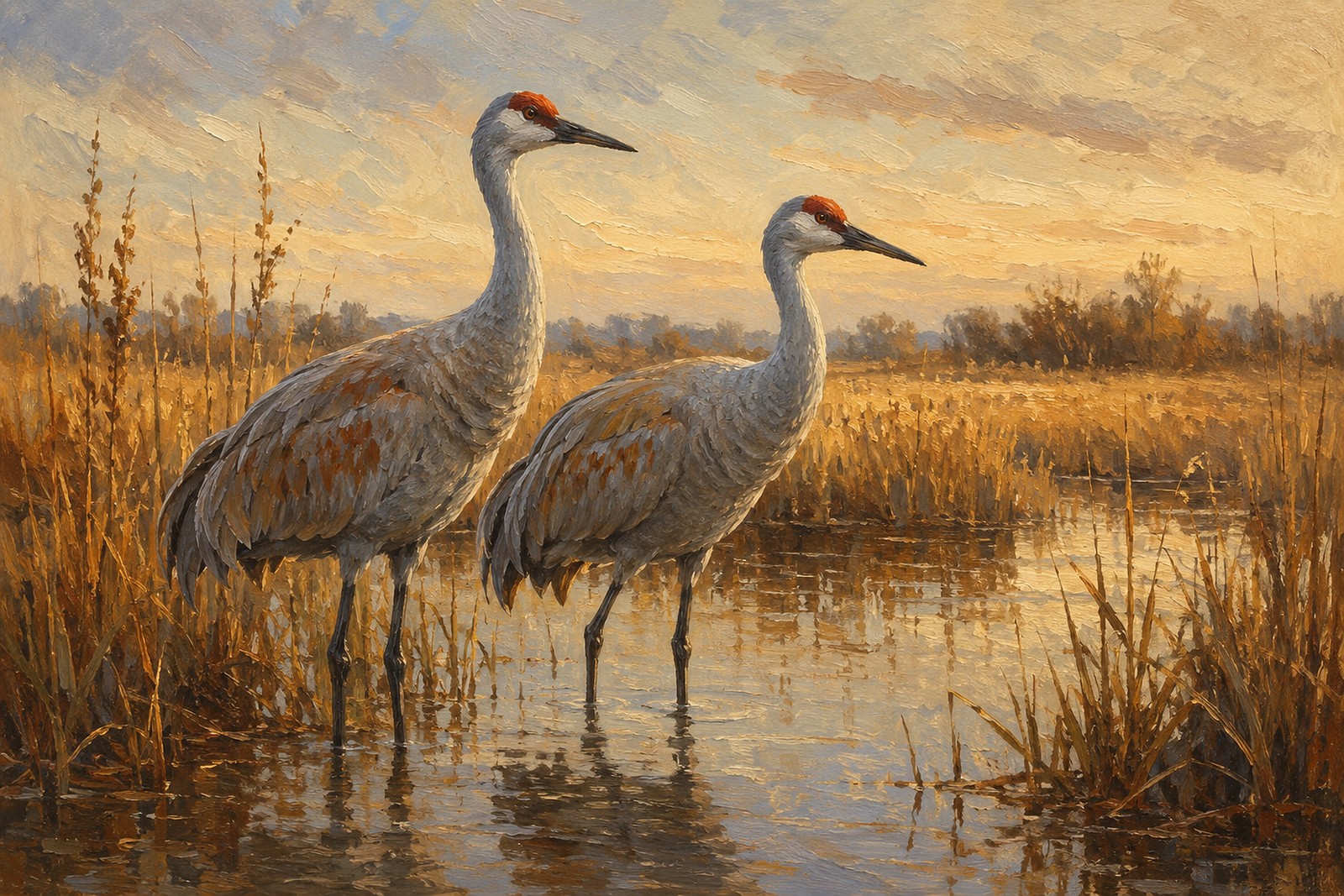
Our sandhill crane pair print shows two birds in a golden evening marsh, an original AI-created artwork in the style of antique oil painting, and we describe it exactly that way: an oil-painting-style print, not a photograph and not a historical piece. The warm ochre-and-grey palette, in the tradition of classic American sporting art, is what lets a heavily symbolic subject hang in a dining room or bedroom as simply a handsome image; the meaning is there for those who know, invisible to those who do not. That double life is the mark of good symbolic decor, and it is the thread running through the anniversary collection of swan and crane prints.
The format is 3:2 landscape, printed edge to edge with no border. Unframed prints are $59, $89 and $119 across 12x18, 16x24 and 20x30; framed in black, brown or gold they are $189, $259 and $329; a digital download is $19. Every print is made to order, dispatched in 2 to 5 business days, ships free to the US, Canada, the UK, Europe, Australia and New Zealand, and carries a 30-day replacement or refund policy for anything that arrives damaged, defective or wrong.
Frequently asked questions
Are cranes good luck?
In Japanese and Chinese tradition, emphatically yes: the crane is one of East Asia’s central emblems of good fortune and long life, which is why cranes mark weddings, births and new years. No equivalent superstition attaches to cranes in the West, where the bird’s meaning runs more toward wildness, deep time and devotion.
Do cranes symbolise marriage?
Paired cranes do. Because crane pairs hold together year after year, two cranes together have long stood for a lasting marriage, most explicitly in Japanese wedding dress and gifts. A single crane leans instead toward longevity and standing.
Do cranes really mate for life?
Generally, with honest caveats. Mated pairs typically stay together across years, and pairs reinforce the bond through dancing and synchronised unison calls. Birds that lose a mate usually re-pair, and separations, while uncommon, do occur. The symbolism is built on a real pattern, not a myth.
Which anniversary is the crane associated with?
There is no traditional year assigned to cranes the way paper belongs to the first or silver to the twenty-fifth. Its longevity meaning makes it most at home from the tenth anniversary onward, and it is an especially strong fit for the twenty-fifth and fiftieth, where a symbol of accumulated years says the right thing.