The oldest reliable trick in traditional decorating is two of a thing. Two lamps on a console. Two candlesticks on a mantel. Two porcelain dogs, two sconces, two chairs angled toward the fire. Symmetry is how formal rooms breathe, and it costs nothing but a second object and a tape measure.
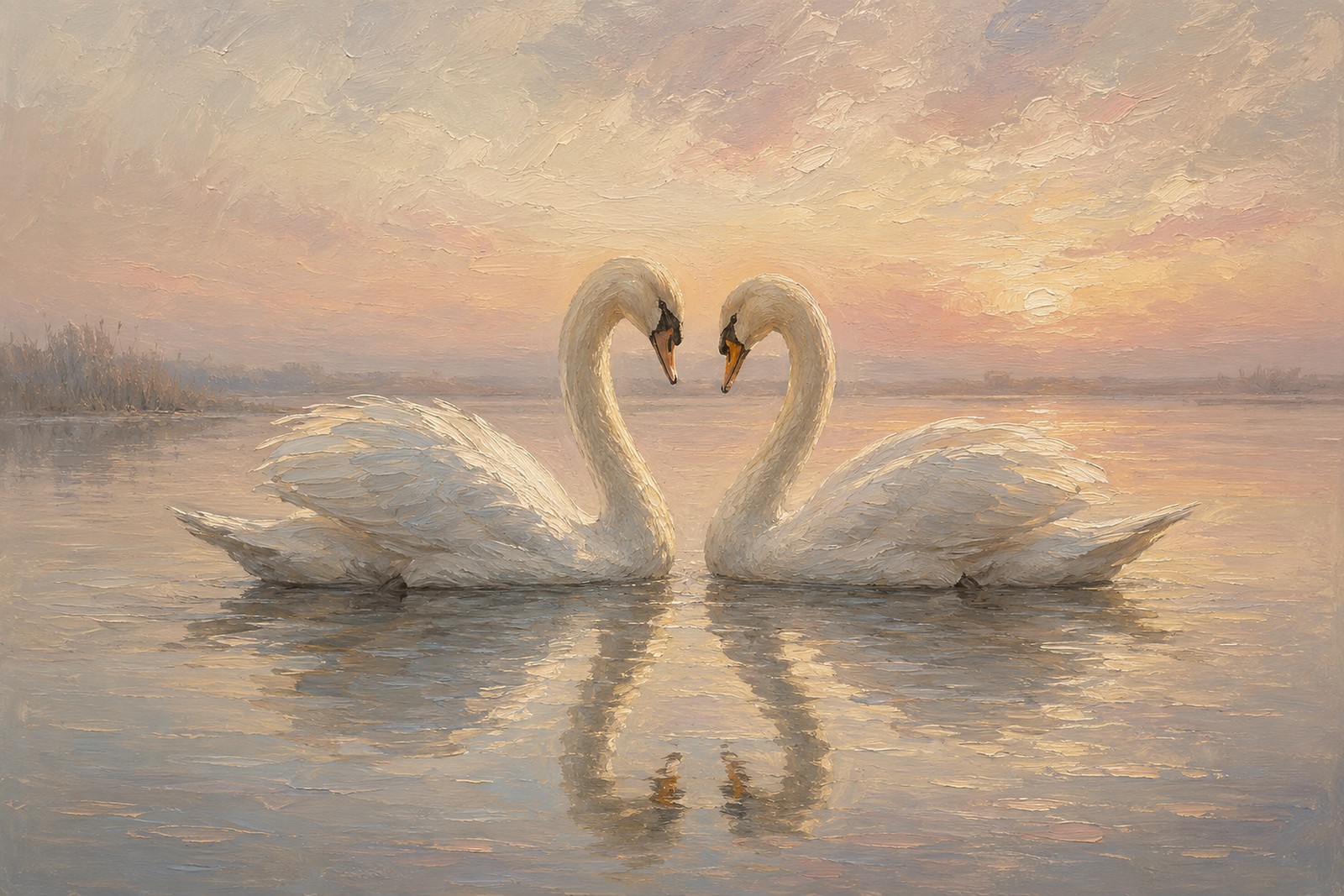
Paired art is the wall-mounted version of the trick, and it comes with one rule that has governed it for centuries: the pair should face inward. Two prints whose subjects angle toward each other close a composition; two that face away leak the eye off both ends of the wall. Birds obey this rule more gracefully than any other subject in art, because a bird visibly faces somewhere, and this guide covers how to use that: what makes a true facing pair, where pairs belong, and the measurements that make them look inevitable.
Why should paired prints face inward?
Because a wall arrangement is a composition, and compositions need closing. When the two subjects angle toward the centre, the viewer’s eye enters at either edge and is handed back inward, settling on the middle: the mirror, the clock, the lamp, or simply the space between the frames. The arrangement becomes one object.
Face the subjects outward and each print points the eye off the wall in opposite directions. The pieces read as two strays that happen to be hung level. Decorators have understood this since long before anyone wrote it down: portrait pairs of husbands and wives were angled toward each other on panelled walls centuries ago, and the convention survives because the eye still works the same way. With birds the effect is doubled, since a bird’s gaze and body both point. Two ducks swimming toward each other hold a wall the way two facing armchairs hold a hearth.
What makes a true mirrored pair?
Not two copies of the same print. Two identical images hung side by side read as a printing error at close range: the same bird cannot swim toward itself. A true pair is a composition and its facing companion, one subject bearing right, one bearing left, matched in light, water and treatment so they read as halves of a single scene.
Our waterfowl series is composed with this use in mind. The prints share one palette and one unhurried light, rendered in antique oil-painting style, and the collection includes left-bearing and right-bearing compositions so a wall can be closed properly. The print this article wears, a mallard pair in morning reeds, states the rule inside a single frame: drake and hen angled together in the dawn water, a facing pair at the scale of one sheet. Hang two prints that do across a wall what those two birds do inside one image, and you have understood the whole tradition.
Where do facing pairs belong?
Over the console. The classic. Lamp, print, print, lamp: the arrangement guests meet in every well-dressed entry hall, with the birds facing each other across the centre line. Our heron prints guide walks through the same arrangement with tall wading birds, which suit consoles that sit under high ceilings.
Over the mantel. A pair flanking a mirror or a clock, birds turned inward toward it. This beats a single small print over a wide mantel, which tends to look stranded.
Over the bed. One print above each nightstand, facing in across the headboard. The symmetry reads as calm, which is the entire job of bedroom walls. Swans are the traditional bedroom subject for pairs, two birds that mate for life, facing each other above the bed, and our swan prints guide covers that particular romance in full.
Over the sideboard. The dining room version of the console arrangement, and the reason facing pairs feel at home in traditional dining rooms.
Flanking a doorway or window. One print each side, facing inward toward the opening, turning a pass-through into an occasion.
How far apart should a pair hang?
Two arrangements, two answers. When the pair hangs as one unit on an open wall, leave 2 to 4 inches between frames: close enough to read as a single composition, open enough that the frames do not crowd. When the pair flanks an anchor, a mirror, a bed, a doorway, centre each print over its own side, each above its own lamp or nightstand, and let the anchor set the gap.
Heights are not negotiable: identical, measured to the centre of each print, 57 to 60 inches from the floor on open walls. Over furniture, keep the bottoms of the frames level, 6 to 10 inches above the surface or headboard. A facing pair hung a half inch off level undoes everything the symmetry was for, so measure twice and use two hooks per frame.
What sizes make a pair?
Work from the furniture the pair sits above. Two 16x24 prints with a 3 inch gap span about 51 inches: right over a 5 to 6 foot console or sideboard. Two 20x30s span about 64 inches: right over a full sofa or a king bed, whose headboard runs 76 to 80 inches. Two 12x18s flanking a mirror dress an entry without crowding it. And the frames must match exactly, same colour, same size, black, brown or gold; a mismatched pair is not a pair, it is two prints having an argument.
One species or two?
A mirrored pair of the same species is the most formal arrangement, and the right one for entries and dining rooms. Two different species facing each other reads as more relaxed, a den and lake house move, and it works whenever the two prints share palette and light: a mallard bearing right toward a wigeon bearing left, teal facing pintail down a hallway. Every print in the waterfowl collection is rendered as one series precisely so those cross-species pairs hold together.
Prints run 12x18 at $59, 16x24 at $89 and 20x30 at $119 unframed, or $189, $259 and $329 framed, each a 3:2 landscape printed edge to edge with no mats or borders. A digital download is $19. Everything is made to order, dispatched in 2 to 5 business days, and ships free to the US, Canada, the UK, Europe, Australia and New Zealand, which matters when you are ordering two of a thing and want them to arrive as a set.
Frequently asked questions
Do both prints in a pair need the same frame?
Yes, without exception: same colour, same size. The pair reads as one composition, and the frames are its punctuation. Reserve mixed framing for casual gallery walls, where variety is the point rather than symmetry.
What if my wall or furniture is off-centre?
Centre the pair on the furniture, not the wall. The eye reads the console, bed or sofa as the arrangement’s base and forgives the wall; centre on the wall instead and the whole assembly looks like it slid. Where a wall is hopelessly asymmetric, drop the pair and hang a single print over the furniture’s centre line.
Can I just buy two copies of the same print?
At a distance, and flanking a wide anchor, two identical prints can pass. Seen close, the repetition reads as accidental. A true facing arrangement, two compositions bearing toward each other, is what makes the wall look composed rather than duplicated, and it is worth the small extra thought.
Are these prints real oil paintings?
No. Each is an original AI-created image in the style of classic American sporting art, printed to order on archival paper, and described exactly that way in every listing. Damaged, defective or wrong deliveries are replaced free or refunded within 30 days; there are no change-of-mind returns, so confirm sizes and frame colours before ordering the set.