In 1934, in the middle of the Dust Bowl, the United States government began selling a small piece of art once a year. It was not framed and it was not optional: every waterfowl hunter in the country had to buy one and carry it. The federal duck stamp has been issued every year since, and it has quietly become one of the most successful conservation instruments in American history, and one of the most collected pieces of art the country produces.
If you have ever wondered why so much waterfowl wall art looks the way it does, the bird low on the water, the long horizon, the big worked sky, the duck stamp is the answer. Its composition rules shaped a century of American sporting art, and they are exactly why stamp-style teal and pintail prints read so well on a wall today.
What is the federal duck stamp?
Formally, the Migratory Bird Hunting and Conservation Stamp: a stamp that every waterfowl hunter aged sixteen or over must purchase annually, created by the 1934 act that bears its name. The first design was drawn by J.N. “Ding” Darling, the Pulitzer-winning cartoonist and conservationist, and showed two mallards dropping into a marsh pond.
The genius is in where the money goes. A stamp costs $25 today, and 98 cents of every dollar goes into the Migratory Bird Conservation Fund, which buys and protects wetland habitat for the National Wildlife Refuge System. Over its lifetime the program has secured more than six million acres of American wetlands. Hunters fund it, but anyone can buy one, and plenty of birders and collectors do: a current stamp also serves as a free admission pass to national wildlife refuges that charge an entry fee.
It is hard to name another piece of art that does this much work for $25.
The only art contest the federal government runs
Since 1949 the stamp’s design has been chosen by open competition, and the Federal Duck Stamp Contest remains the only art competition of its kind run by the United States government. Any artist may enter. The judging is public, the standard is exacting, and the reward is not money but the thing itself: the winning image becomes the next year’s stamp, reproduced by the million.
Careers have been built on it. Maynard Reece, the most successful artist in the contest’s history, won five times across three decades. Whole families of wildlife artists have traded wins. There is a junior duck stamp program that starts schoolchildren down the same road. For wildlife artists, the contest is the country’s most democratic prize: no gallery, no dealer, just a panel of judges and a bird that has to be right.
Why do teal and pintail keep appearing on stamps?
Stamp art has a brutal constraint: the image must read at the size of a large postage stamp. That favours ducks with unmistakable silhouettes, and few species are more unmistakable than the teal and the pintail. The green-winged teal is the smallest dabbling duck in North America, compact and quick, with a wine-red head slashed by iridescent green. The northern pintail carries the most elegant line in waterfowl, a long neck and needle tail that hunters nicknamed the greyhound of the air; our pintail species profile covers the bird in full.
Both species, teal in one form or another and the pintail again and again, recur across the federal and state stamp runs, and collectors prize those issues for the same reason decorators do: the birds are legible at any size, from an inch and a half to twenty by thirty.
How does stamp-style composition read on a wall?
Better than almost anything else, and for a reason worth understanding. An image designed to read at stamp size obeys a strict discipline: the bird sits large and low in the frame, the water runs to a low horizon, the sky does the atmospheric work, and nothing extraneous enters the picture. Scale that discipline up and you get a print that reads clearly from across a room, which is precisely the test most wall art fails.
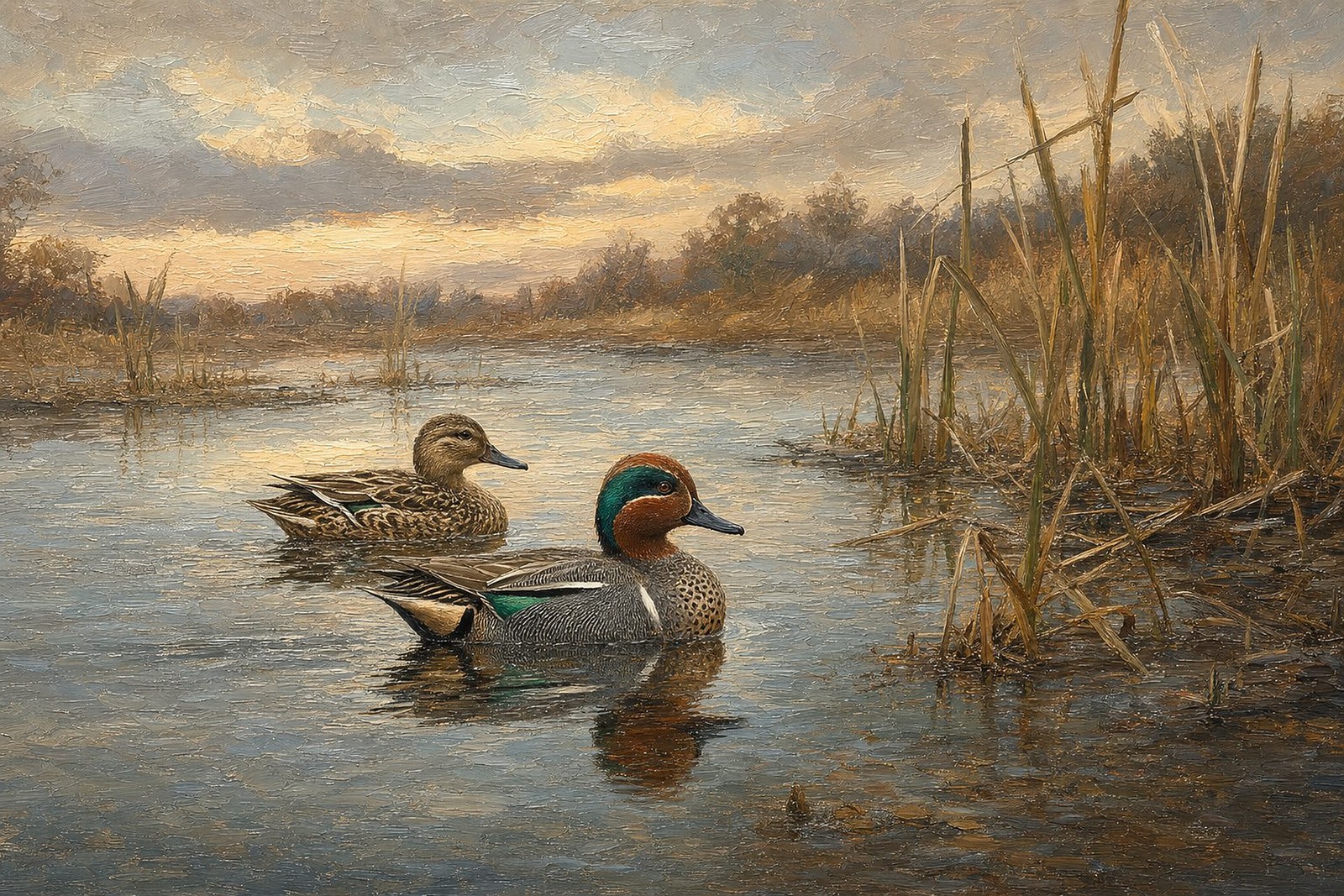
Our green-winged teal pair in a shallow marsh is composed in that tradition, in the style of classic American sporting art: two small ducks given the full dignity of a big sky, rendered in antique oil-painting style as a 3:2 landscape and printed edge to edge, no mats, no borders. On a hallway wall or above a desk it behaves exactly as stamp art should: instantly legible, then rewarding at close range.
Decorating with conservation history
A stamp-style print suits the rooms where quiet seriousness belongs: the study, the office, the hall of a lake house. Gold framing gives it the clubby, collected look; brown suits a lodge room; black sharpens it for newer interiors. For a gift with real weight, pair the print with an actual $25 federal duck stamp, purchased from the postal service or a sporting goods counter: the recipient gets the art and six million acres of wetlands get their cut.
It helps to remember what the stamp money protects: the marshes, potholes and staging waters strung along the continent’s great migration flyways, the routes every teal and pintail in these images travels twice a year. A print in this tradition is not just a picture of a duck. It is a picture of the system that saved the duck.
The teal and pintail hang alongside every other species in the waterfowl and marsh birds section of The Print Room. Prints run $59, $89 and $119 unframed by size, $189, $259 and $329 framed in black, brown or gold, with a $19 digital download. Everything is made to order, dispatched in 2 to 5 business days, and ships free to the US, Canada, the UK, Europe, Australia and New Zealand.
Frequently asked questions
Do you have to be a hunter to buy a federal duck stamp?
No. Anyone can buy one, and many birders, refuge visitors and collectors do so every year as a direct contribution to wetland conservation. A current stamp also admits you free to national wildlife refuges that charge an entrance fee, which makes it one of the better $25 purchases in American life.
Are your prints reproductions of actual duck stamps?
No. Duck stamp designs belong to their artists and the federal program, and we reproduce none of them. Our prints are original AI-created images in antique oil-painting style, composed in the same sporting art tradition that stamp artists work in, and our listings state that provenance plainly.
What size works for a hallway or study?
The 12x18 suits halls and small walls; the 16x24 is right above a desk or between windows. A facing pair of 12x18 teal and pintail prints down a hallway, hung at matching height, is a quietly excellent arrangement that borrows the stamp tradition’s discipline twice over.
Do you ship outside the United States?
Yes: shipping is free to the US, Canada, the UK, Europe, Australia and New Zealand. Every print is made to order and dispatched in 2 to 5 business days, and anything that arrives damaged, defective or wrong is replaced free or refunded within 30 days. We do not take change-of-mind returns.