Among people who take shorebirds seriously, the long-billed birds are a genre of their own. Curlews carry bills that sweep down, godwits carry bills that sweep up, and in both cases the bill is the longest unbroken line in the picture, longer than seems structurally reasonable, longer than any casual beach visitor expects a bird to own. That line is the whole point. A curlew print or a godwit print is not really a picture of a bird so much as a picture of a single drawn stroke with a bird attached, and that is what makes the genre a connoisseur’s choice rather than a crowd-pleaser.
Why do long bills make such good art?
Three reasons, all of them about composition rather than ornithology.
The first is line. Every strong picture has a line that leads the eye, and most artists have to construct one out of shoreline, horizon or shadow. A curlew brings its own. The down-swept bill drops the eye toward the ground the bird works; a godwit’s up-swept bill lifts it toward the sky. The bird is subject and compositional device at once.
The second is silhouette. The long-billed shorebirds are identifiable by outline alone, at distances where colour has long since given up. That kind of shape-first identity translates directly to walls: the print reads from across a room the way the bird reads from across a flat.
The third is space. A bill that long needs open ground around it to make sense, which forces the compositions outward: low horizons, wide sky, a single figure on open terrain. The long-billed look and the open-plain look are the same look, and rooms respond to that openness the way they respond to a window.
The long-billed curlew: the largest statement on the flats
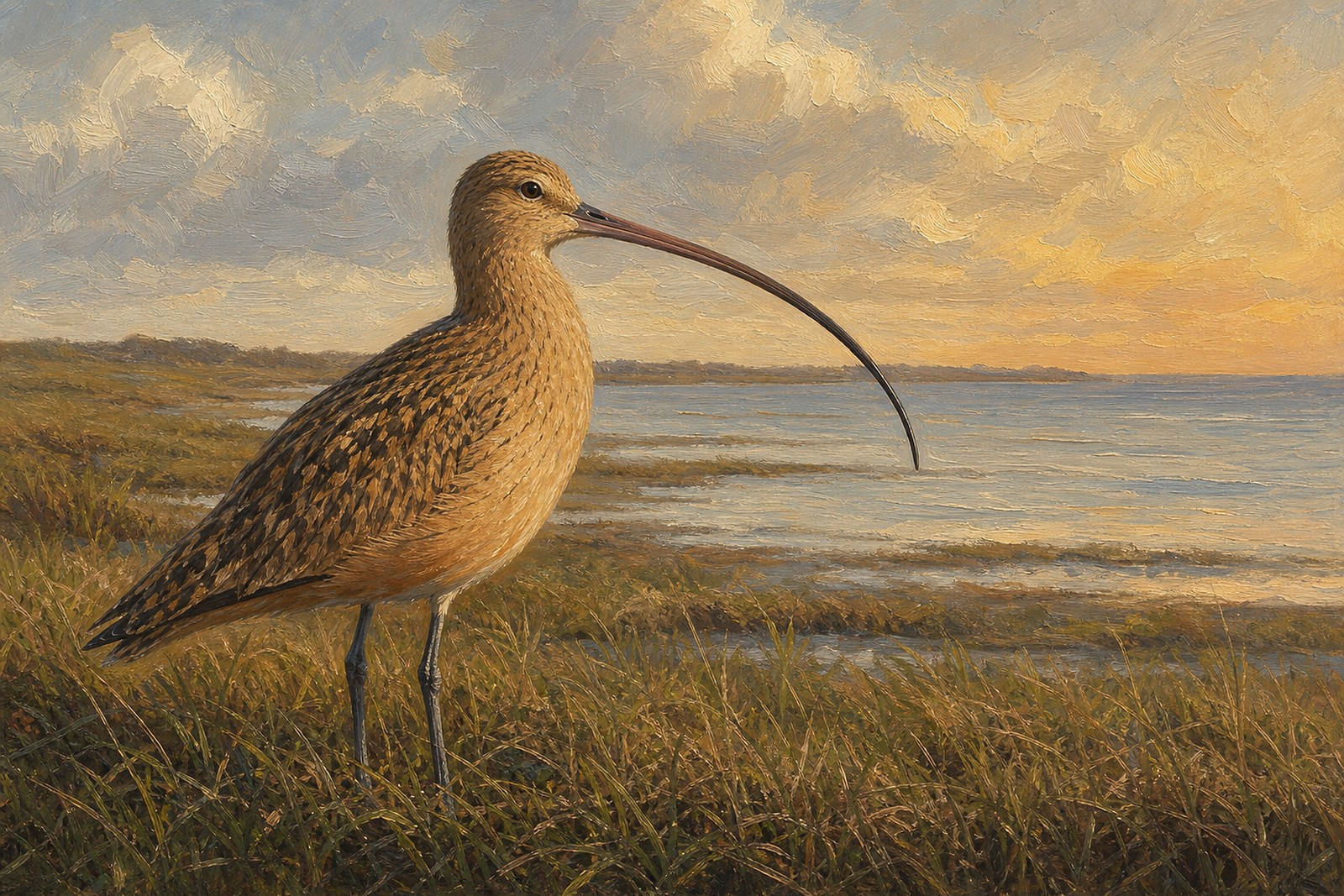
The long-billed curlew is North America’s largest shorebird, and the bill, longest in females, can pass eight inches, the most extravagant of any shorebird on the continent. The birds breed on the shortgrass prairies of the interior West and winter on coastal flats, beaches and open farmland, using that bill to pull shrimp and crabs from deep burrows that no other bird can reach.
Our Long-billed Curlew on Coastal Plain print puts a single bird on open ground under a wide pale sky, the bill carried like an instrument, the horizon set low in the classic proportion. The palette is the curlew’s own: warm cinnamon-buff, tobacco brown, dried-grass gold, sage. It is a warm print, not a blue one, and that matters for placement, because it grounds airy rooms rather than cooling them.
The marbled godwit: the upswept counterpoint
The marbled godwit is the curlew’s opposite number: nearly as large, warmer still in tone, its buff plumage patterned with the fine barring that gives the bird its name, and its long bill swept slightly upward, pink at the base with a dark tip. Where the curlew’s line drops to the ground, the godwit’s lifts toward the light.
Our Marbled Godwit in Warm Shore Light print leans into that warmth, a bird working bright shallows with the low sun turning the whole sheet gold and buff. Hang a curlew and a godwit as a facing pair, one bill sweeping down and the other up, and the two lines answer each other across a doorway or a sideboard with a symmetry no two identical prints can manage.
Open-plain compositions and the sporting art register
Because the long-billed birds live in open country, their pictures inherit a specific tradition: low horizon, big sky, a single figure or loose group, ground detail dissolving into tone. This is the register of classic American sporting art, the field-and-marsh pictures that have hung in studies and lodges for over a century, and our long-billed prints are made deliberately in the style of classic American sporting art rather than the brighter register of beach decor.
That earns them rooms other shorebird prints do not reach. The same wall logic in our hunting lodge wall art guide applies here: deeper wall colours, darker furniture, leather and timber, art that reads composed and unhurried. A curlew print holds its own in that company in a way a bright tideline scene cannot.
Where the long-billed look belongs
Studies and home offices. The open-plain composition gives a small room a horizon, and the sporting-art register suits desks, shelves and serious furniture. This is the first room to consider.
Dining rooms. Rooms for slow looking. A single curlew over a sideboard, sized to roughly two-thirds of the sideboard’s width, is a classic arrangement, and the 20x30 print at $119 spans most sideboards correctly.
Wide halls. The strong horizontal line of plain and horizon carries a long wall better than most single-subject art.
Coastal rooms that need weight. In an airy sand-and-white beach scheme, one warm open-plain piece anchors a wall the way a dark timber table anchors a pale room. Use it where the room feels like it might float away.
Sizes, frames and the details
All prints are 3:2 landscape, edge to edge with no border or mat, on archival fine-art paper. Unframed prints are $59 for 12x18, $89 for 16x24 and $119 for 20x30. Framed prints come in black, brown or gold at $189, $259 and $329. Brown is the natural first choice here, since it extends the print’s own buff and tobacco range; gold formalises it for traditional dining rooms; black sets the warmth off sharply in modern spaces.
For the facing-pair arrangement described above, the practical route is two 16x24 prints at $89 each in matching frames, hung at the same height with the bills sweeping toward the space between them. And if you want to test the look before committing wall space, the $19 digital download supplies the same 300 DPI masters, printable up to 24 inches wide at a local shop, which is a low-cost way to live with a curlew for a month before ordering the full-size framed piece.
Every print is an original AI-created artwork in the style of antique oil painting, made to order and dispatched in 2 to 5 business days, with free shipping to the US, Canada, the UK, Europe, Australia and New Zealand. The curlew and godwit stand at the connoisseur end of the complete run of shorebird prints, alongside the sandpipers, plovers and avocets, and the flats they winter on are covered in full on the Coastal & Estuary habitat page.
Frequently asked questions
How long is a long-billed curlew’s bill really?
Up to around eight and a half inches in the longest-billed females, the longest bill of any North American shorebird. It is a tool, not an ornament: curlews use it to extract shrimp and crabs from burrows on their wintering grounds and earthworms from prairie soil in summer.
Should I choose the curlew or the godwit?
Choose by line and temperature. The curlew’s bill sweeps down and its palette runs to tobacco and sage; the godwit’s bill sweeps up and its light runs warmer and more golden. If the wall allows a facing pair, the two together answer the question better than either alone.
Do these prints only suit coastal or country rooms?
No. Because they sit in the register of classic American sporting art, they belong in studies, offices, dining rooms and lodge-style interiors that have no coastal theme at all. The open-plain composition reads as landscape art first.
What size works over a sideboard?
Follow the two-thirds rule: the print, or print plus frame, should span roughly two-thirds the width of the sideboard. That makes 20x30 the standard for full-size sideboards and 16x24 the fit for shorter consoles and chests.