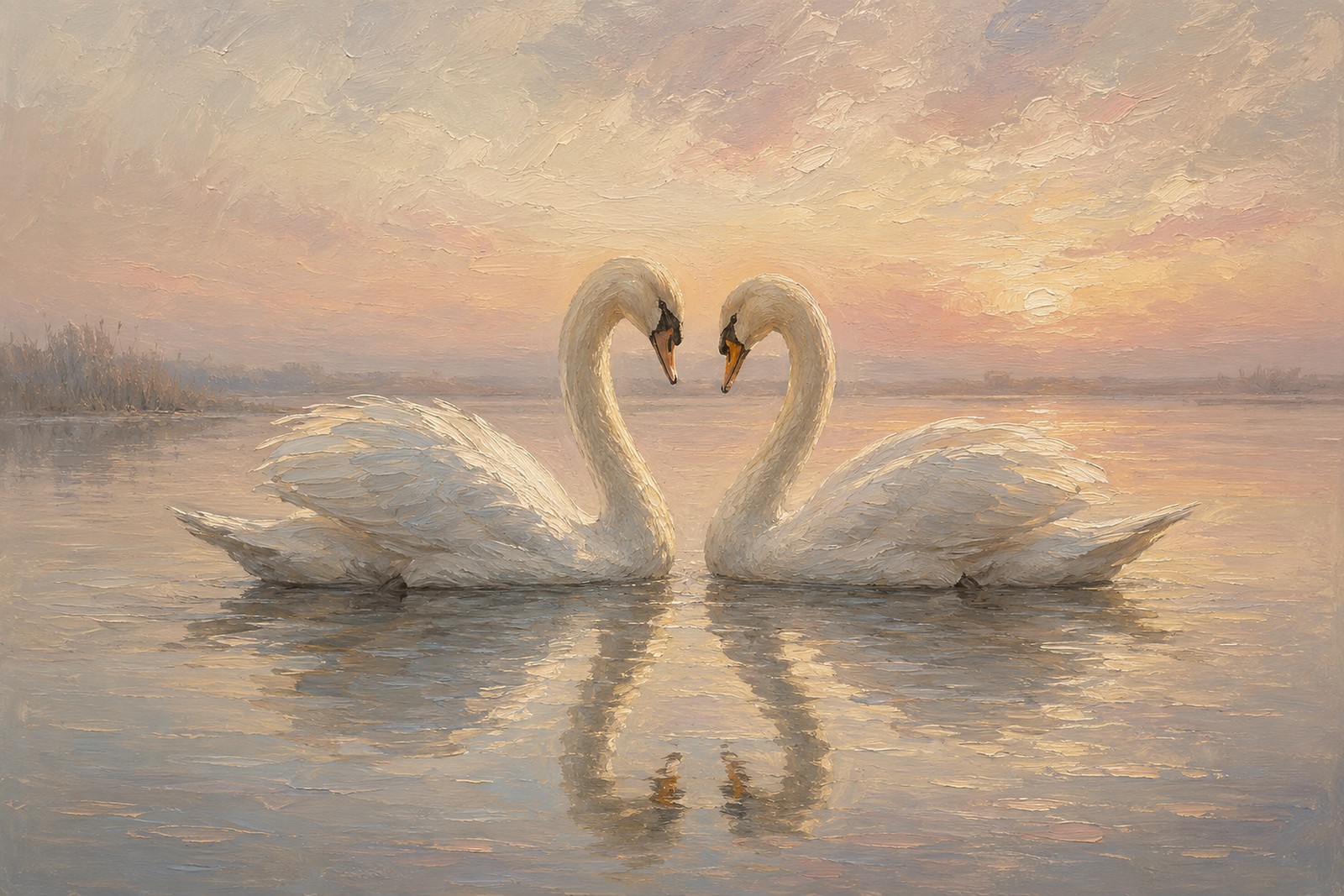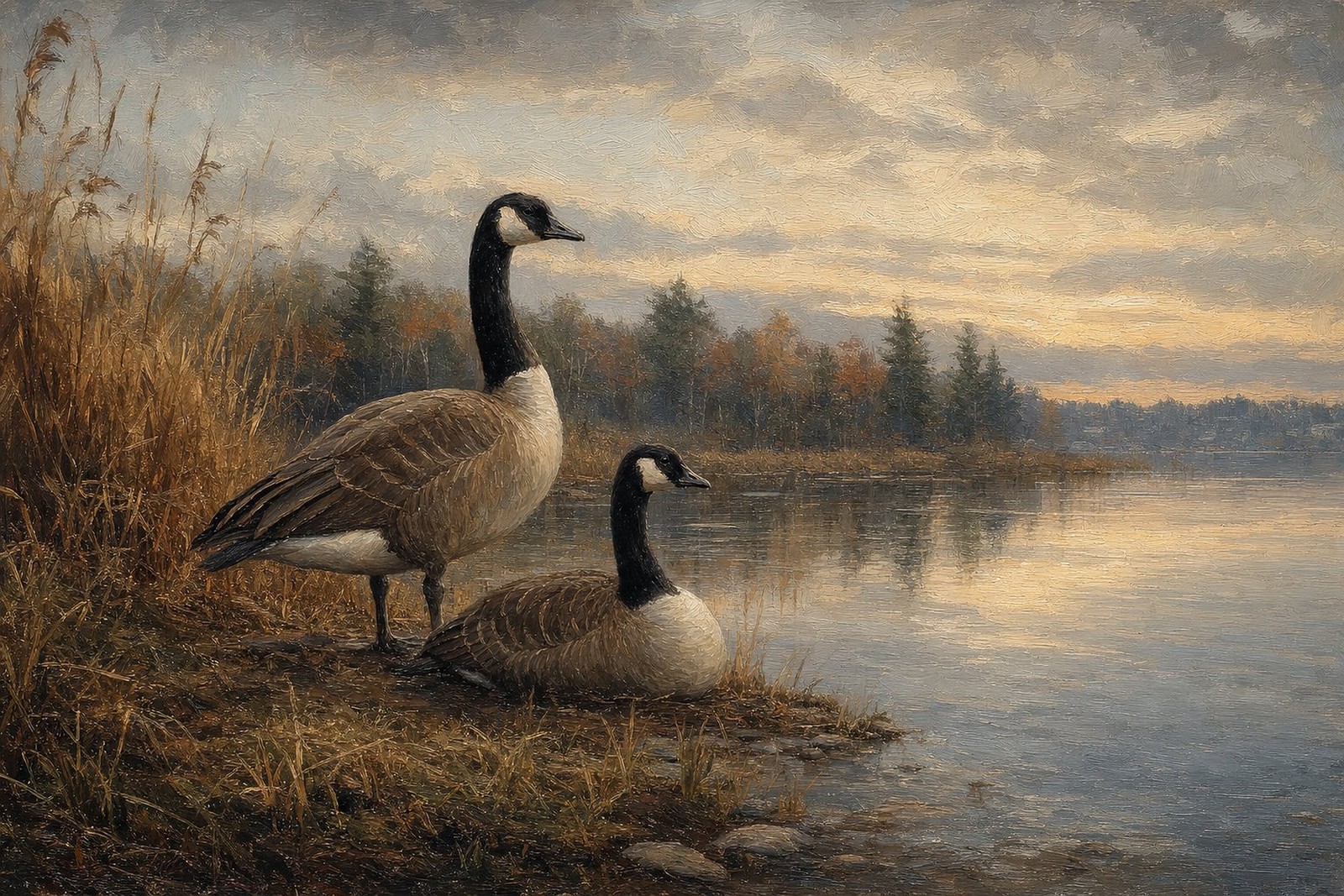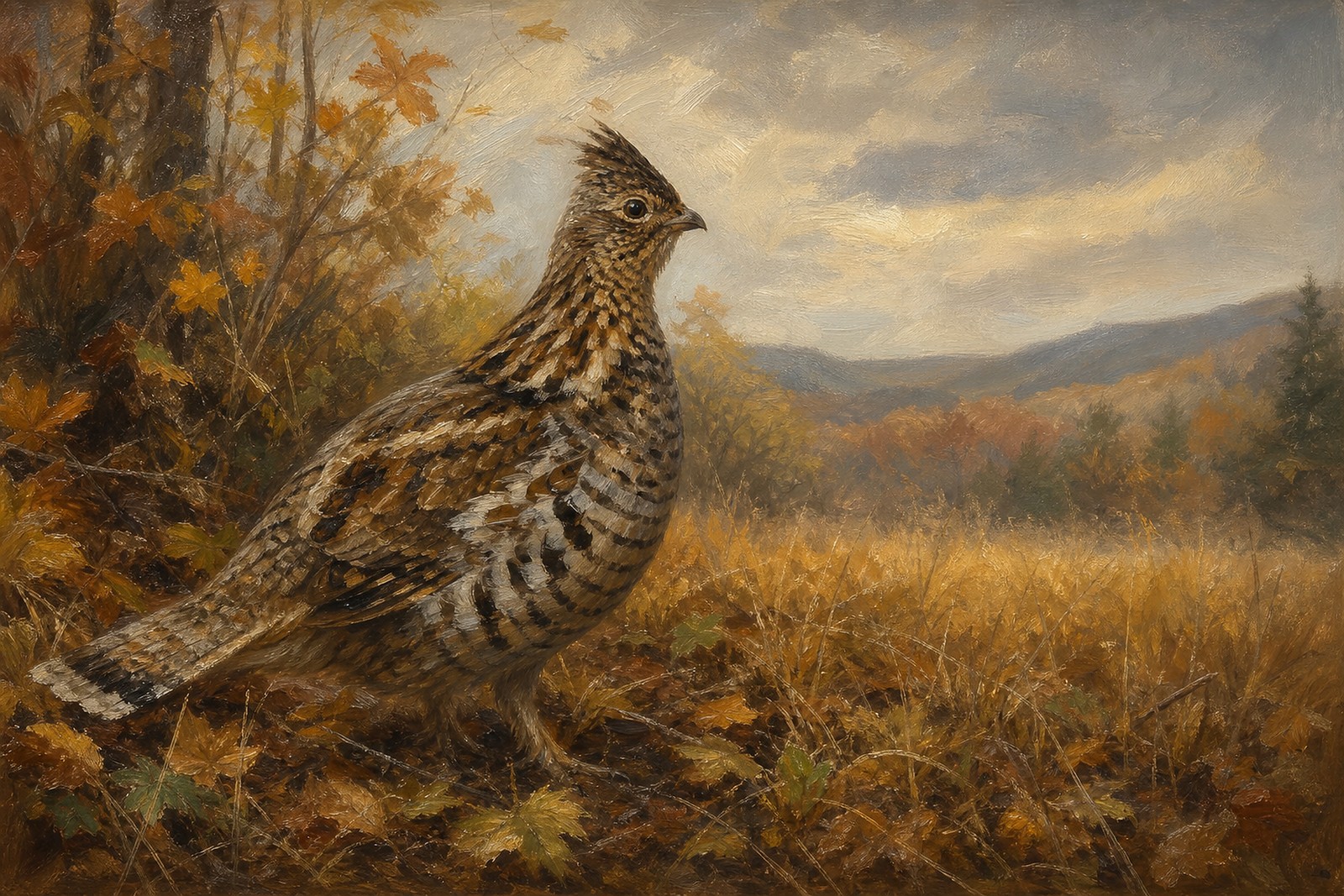
Walk one wetland at dawn and you will meet both birds inside the first hundred yards: geese grazing the margin in their upright, deliberate way, and ducks working the shallows below them, busy at the waterline. Same marsh, same morning, and yet on a wall they behave like two different genres of art. Goose art is about sky, distance, and posture. Duck art is about water, colour, and closeness. Neither is better; they do different jobs, and hanging the right one is mostly a matter of knowing which job the room needs done.
What goose art does to a room
Geese are the larger, longer-necked birds, and their art carries that bearing. Classic goose compositions favour distance: a skein crossing the sky, a pair standing at a lake edge, a flock over an autumn marsh horizon. Even at rest, the birds hold themselves upright, and an upright neck reads on a wall the way good posture reads in a portrait: composed, alert, slightly formal.
The palette is muted almost across the board: umber, slate, cream, marsh gold, winter grey. Goose art is wildlife art that behaves like landscape art, giving a wall depth of field and a horizon, and it descends directly from the sporting canvases that hung in American dining rooms and studies through the last century. Rendered in the style of classic American sporting art, a goose print brings that formality with it.
Part of the bearing is simple biology. Geese carry themselves like landowners because that is roughly what they are: grazers rather than fish hunters, birds of the field margin and the open bank rather than the reed tangle. They stand tall, in the open, in company, and art has always flattered them for it.
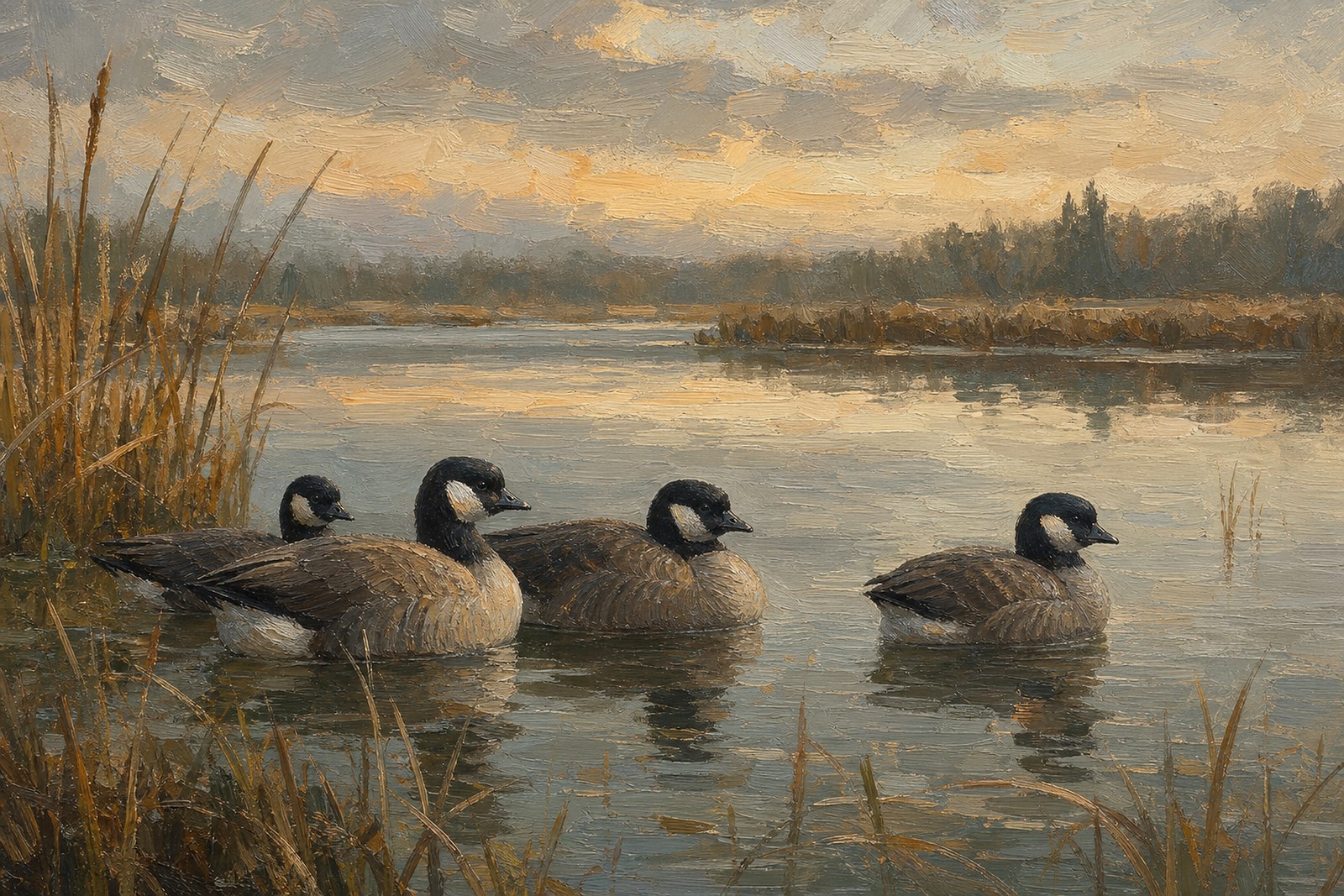
Our featured composition shows the effect at its most compact: cackling geese, the small northern cousin of the Canada goose, gathered on a still pond, and even these, the smallest of their kind, read as poised rather than busy.
What duck art does to a room
Ducks live lower and closer. Classic duck compositions happen at the waterline: a drake among morning reeds, a pair in quiet water, reflections doubled beneath them. Where goose art gives you sky, duck art gives you surface: ripples, low light, the world at arm’s length.
And ducks bring the colour. Waterfowl plumage saves its jewellery for the drakes: the mallard’s bottle-green head, a story of its own that we tell in our guide to ducks with green heads, the wood duck’s harlequin patterning, the teal’s flash of iridescence. A duck print can put emerald, chestnut, and violet on a wall inside an otherwise traditional composition, which no goose print will ever do for you.
The mood follows the viewpoint. Because the compositions sit close to the water, duck art feels intimate, occupied, and warm, less a view than a visit. It rewards being seen from three feet away, which is exactly how art gets seen in the smaller rooms of a house.
Which mood does your room actually need?
Rooms where people perform. Dining rooms, entries, offices, the formal living room: these are the rooms of posture, and they take goose art naturally. A skein over the sideboard or a composed pair above the study shelves matches the register of the room.
Rooms where people retreat. Dens, kitchen nooks, bathrooms, bedside walls, the bunk room at the cabin: intimacy suits intimacy. A drake in the reeds, hung where you see it up close, gives these rooms their reward.
The distance test. Stand where the art will actually be seen from. Twelve feet or more, across a living room or down an entry: choose geese, because distance compositions read at distance. Three feet, beside a mirror or over a towel rail: choose ducks, because detail deserves closeness.
The ceiling test. Sky compositions lift a room; waterline compositions ground it. Low-ceilinged rooms borrow height from a goose sky, while a tall awkward wall calms down under the horizontal emphasis of water.
Scale: geese want width, ducks want nearness
Every print we make is landscape format, 3:2, edge to edge with no mats, but the sizes sort themselves by subject. Goose scenes earn the large formats: 20x30 over a sofa, a mantel, or a sideboard, where the sky in the composition needs room to be sky. Duck scenes are at their best at 12x18 and 16x24, hung singly in close quarters or as a pair flanking a window or mirror, where their detail sits within arm’s reach of the viewer.
A useful pairing rule: geese anchor, ducks accompany. One large goose scene holds the main wall; two smaller duck prints answer it from the side walls without competing.
There is a budget logic hiding in that rule as well. Because the sizes price at $59, $89, and $119 unframed, a room can carry one 20x30 goose anchor and a pair of 12x18 duck companions for less than the cost of two large pieces, and the arrangement reads as more considered, not less. Hierarchy is what decorators are usually charging for; waterfowl provide it by nature.
Can geese and ducks share a wall?
Comfortably, provided everything else matches. The reason mixed waterfowl walls fail is almost never the birds; it is the styles, a photograph beside a sketch beside a cartoon. Keep one visual voice and the marsh assembles itself. Every print in our catalogue is an original AI-created artwork in the style of antique oil painting, same palette family, same 3:2 format, so a cackling goose pond scene and a mallard pair hang together like neighbours rather than strangers, which is what they are in the wild anyway.
If you are building the wall around the geese, the full geese and migration collection holds the anchors: pairs, flights, autumn marshes, and winter flocks. Choose the big scene first, then let the duck prints answer it.
The practical details
Prices are identical across subjects. Unframed prints are $59 for 12x18, $89 for 16x24, and $119 for 20x30; framed in black, brown, or gold, they are $189, $259, and $329; digital files are $19. Every order is made to order and dispatched in 2 to 5 business days, ships free to the US, Canada, the UK, Europe, Australia and New Zealand, and is covered by a 30-day replacement or refund guarantee if it arrives damaged, defective, or wrong.
Frequently asked questions
What is a cackling goose?
The Canada goose’s compact northern cousin: same black neck and white chinstrap, but smaller, with a stubbier bill and a shorter neck. It was treated as a subspecies of the Canada goose until 2004, when ornithologists split it into a species of its own. In art, it offers the classic goose look at a gentler, less formal scale.
Are goose prints too formal for a family room?
Not the grounded ones. Flight scenes and big marsh horizons lean formal; a flock resting on a pond relaxes considerably while keeping the composed goose bearing. Save the skeins for the dining room and hang the pond scenes where the family actually sits.
Which works better in a small powder room?
Ducks, almost every time. A 12x18 waterline composition is seen from close range in a small room, which is precisely the viewing distance duck art is built for, and the intimacy suits the space.
Do the goose and duck prints match in style?
Yes. Everything in the catalogue is original AI-created artwork in the style of antique oil painting, in the same landscape 3:2, edge-to-edge format, so a mixed waterfowl wall stays coherent by default.