The loon gets the postcards. The grebe gets the connoisseurs. Anyone can love a bird with a checkerboard back and a famous call, but it takes a certain kind of eye to fall for a small brown diver drifting between lily pads, doing absolutely nothing dramatic and doing it beautifully. That is the grebe’s whole proposition, on the water and on the wall. A grebe print does not announce itself when you walk into the room. It waits to be noticed, and then it keeps rewarding the notice for years.
This is a guide to the quiet-water aesthetic, the grebes that carry it, and why these are the prints we reach for when the room is small, the light is soft, and a statement piece would be shouting.
The understated alternative to the loon
Loons and grebes share the same lakes and the same trade: both are foot-propelled divers that chase fish underwater. But they occupy a room very differently. A loon print is an anchor, a bird with enough graphic force to organise a whole wall. A grebe print is closer to furniture in the old, dignified sense of the word: something that belongs to the room rather than performing for it.
That makes the grebe the better choice more often than people expect. Not every wall wants an anchor. The hallway, the guest bedroom, the bathroom with the good morning light, the wall beside a bookcase: these are places where art should lower the temperature, not raise it. A small diving bird in still water, surrounded by the green geometry of lily pads, lowers it perfectly.
The part-time submarine
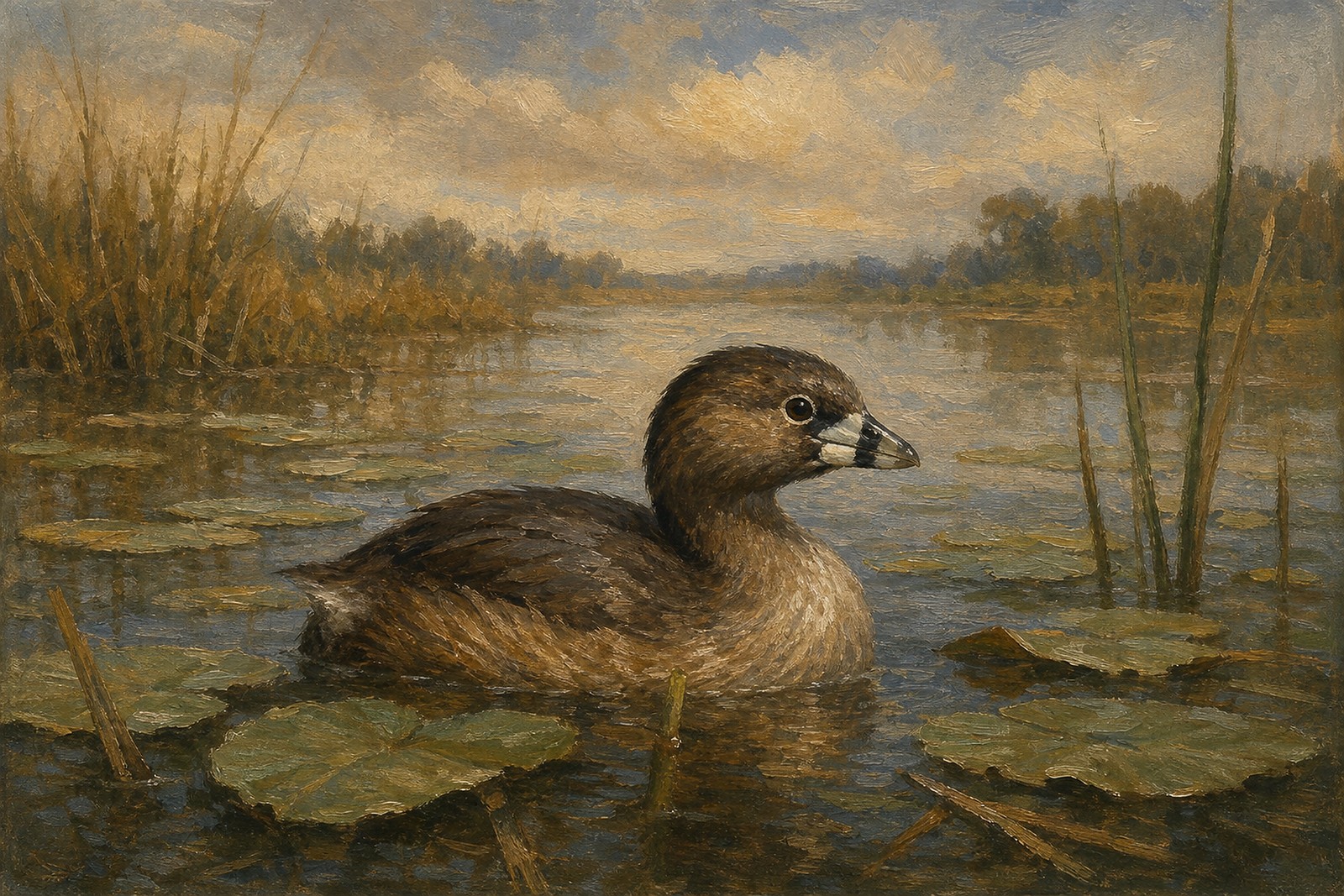
The pied-billed grebe, the bird in our lily-pad composition, deserves to be more famous than it is. It is a small, brown, thick-billed diver found on quiet ponds across most of North America, and its party trick is unlike anything the loon can do. Rather than diving with a splash, a pied-billed grebe can compress the air out of its feathers and sink, slowly and evenly, like a submarine flooding its tanks, until only its head sits above the surface. Then the head slips under too, without a ripple.
The rest of the bird is just as specialised. Grebes have lobed toes rather than webbed feet, legs set so far back on the body that they can barely walk on land, and floating nests anchored to reeds so the water can rise and fall beneath their eggs. They even swallow their own feathers, which line the stomach and protect it from fish bones. Nothing about a grebe is showy. Everything about it is exact. If that sentence describes your taste in interiors, you are the person these prints were made for.
What is the quiet-water aesthetic?
It is the opposite of the seascape. No waves, no glare, no horizon drama. Quiet-water art is built from a low viewpoint, a still surface, and the doubling effect of reflection, with a palette that stays inside soft greens, browns, and greys. The subject is small in the frame because the point is the whole held breath of the scene, not a portrait.
Lily pads are the signature of the style, and they do real compositional work. Their repeated circles give the image rhythm and structure, the way tiles give a floor structure, while the bird supplies the single point of life that keeps the pattern from going flat. In a room, that combination reads as calm with a pulse. It suits reading corners, bedrooms, baths, studies, and any small room where you want the art to slow the eye down rather than catch it. If your taste runs toward traditional smaller-space decorating, our guide to grandmillennial bird prints covers the broader look these sit inside.
Three grebes, three temperatures
The Print Room carries three grebe compositions, and they run cool to warm.
Pied-billed grebe in lily pads. The domestic one. Green, soft, midsummer, a pond you could walk to. This is the easiest of the three to place because its palette is the palette of houseplants and linen, and it makes almost any small room feel more settled.
Eared grebe on a western lake. The exotic one, though it is genuinely the most numerous grebe in the world. In breeding plumage the eared grebe wears a black head and neck, a deep red eye, and a spray of golden feathers fanning back from the eye like a struck match. These birds gather on the saline lakes of the American West in immense autumn flocks before moving on. The print carries that western strangeness: warmer, more jewelled, a little stranger than the pond at home.
Clark’s grebe in pale lake light. The formal one. Clark’s grebe is a long-necked, near-white bird of big western lakes, elegant as a table setting, and the composition around it keeps everything pale and silvery. Of the three, this is the print for rooms that lean refined: soft greys, white walls, polished wood.
Why grebe prints suit small rooms
Scale is the practical argument. Every print in the collection is a 3:2 landscape, and the 12x18 at $59 is genuinely small-room sized: right above a towel rail, over a bedside table, on the narrow wall at the turn of a stair. Small art has one rule, which is that it must reward close viewing, since everyone who sees it will be standing near it. Grebes are close-viewing birds by nature. The detail is the point.
The 16x24 at $89 is the step up for guest rooms and studies. The 20x30 at $119 exists for grebe people with a big wall and the courage of their convictions, and honestly, a quiet composition printed large is one of the more sophisticated moves in wall art. A pair of 12x18s hung one above the other also works well in tall narrow spaces, where a single larger piece would fight the proportions.
The practical part
Framed versions are $189 for the 12x18, $259 for the 16x24, and $329 for the 20x30, in black, brown, or gold. A digital download is $19 if you prefer to print locally. Every physical print is made to order, printed edge to edge with no border or mat, and dispatched within 2 to 5 business days, with free shipping to the US, Canada, the UK, Europe, Australia, and New Zealand. Anything that arrives damaged, defective, or wrong is replaced or refunded within 30 days.
These are original AI-created artworks in the style of antique oil painting, and we label them exactly that way. The grebes hang alongside the loons, rails, and bitterns in the full quiet-water collection, and the world they all share is mapped on our marsh and reedbed habitat page.
Frequently asked questions
Are grebes just small loons?
No, and the truth is stranger. Grebes and loons look alike because they evolved the same trade, foot-propelled diving, not because they are kin. Genetic work places the grebes’ closest living relatives among the flamingos, of all birds. The resemblance to loons is professional, not familial.
What rooms suit a grebe print best?
Small and quiet ones: bedrooms, baths, studies, reading corners, hallways, guest rooms. The compositions are built on stillness and soft palettes, so they thrive where the room’s job is rest. They will also happily support a larger statement piece on an adjacent wall rather than competing with it.
Which grebe print should I start with?
The pied-billed grebe in lily pads is the most versatile, because greens and soft browns fit almost every interior. Choose the eared grebe if the room wants a touch of warmth and strangeness, and Clark’s grebe if the room is pale, formal, and grey-toned.
Is this a photograph of a grebe?
No. Each piece is an original AI-created artwork in the style of antique oil painting, sold as an oil-painting-style print and described that way plainly, because we think you should know exactly what is on your wall.