Ask anyone who grew up around northern lakes what they miss most and the answer is rarely a sight. It is a sound. The long, falling wail of a common loon crossing a mile of dark water at eleven o’clock at night is the kind of thing people stop mid-sentence to remember twenty years later, usually because a film soundtrack has just borrowed it. A loon print earns its place on a wall for exactly that reason. It is not really a picture of a bird. It is a picture of a sound, and of everything that came with the sound: cold water, spruce shorelines, and the particular quiet of a lake after the last boat comes in.
Here is why the loon translates so well into wall art, what makes its plumage almost unfairly suited to interiors, and how to choose between the loon compositions in The Print Room.
The call is the point
Loons have four calls, and knowing them changes how you look at the bird. The wail is the long, mournful note that carries across open water, used by pairs to find each other after dark. The tremolo is the wavering laugh, given in alarm or in flight. The yodel belongs to males defending territory, and each male’s yodel is distinct enough that neighbouring loons recognise who is speaking. The hoot is the soft, close-range note kept for mates and chicks.
The wail is the one people mean when they say they miss the loons. No print can play it, obviously. But memory does not need the audio. People who have spent even one summer within earshot of a loon carry the sound permanently, and an image of the bird, head lifted over still water, is enough to retrieve it. That is the quiet trick of a loon print. Most wall art decorates a room. This one plays a note in the back of your head every time you pass it.
The most graphic plumage on any North American bird
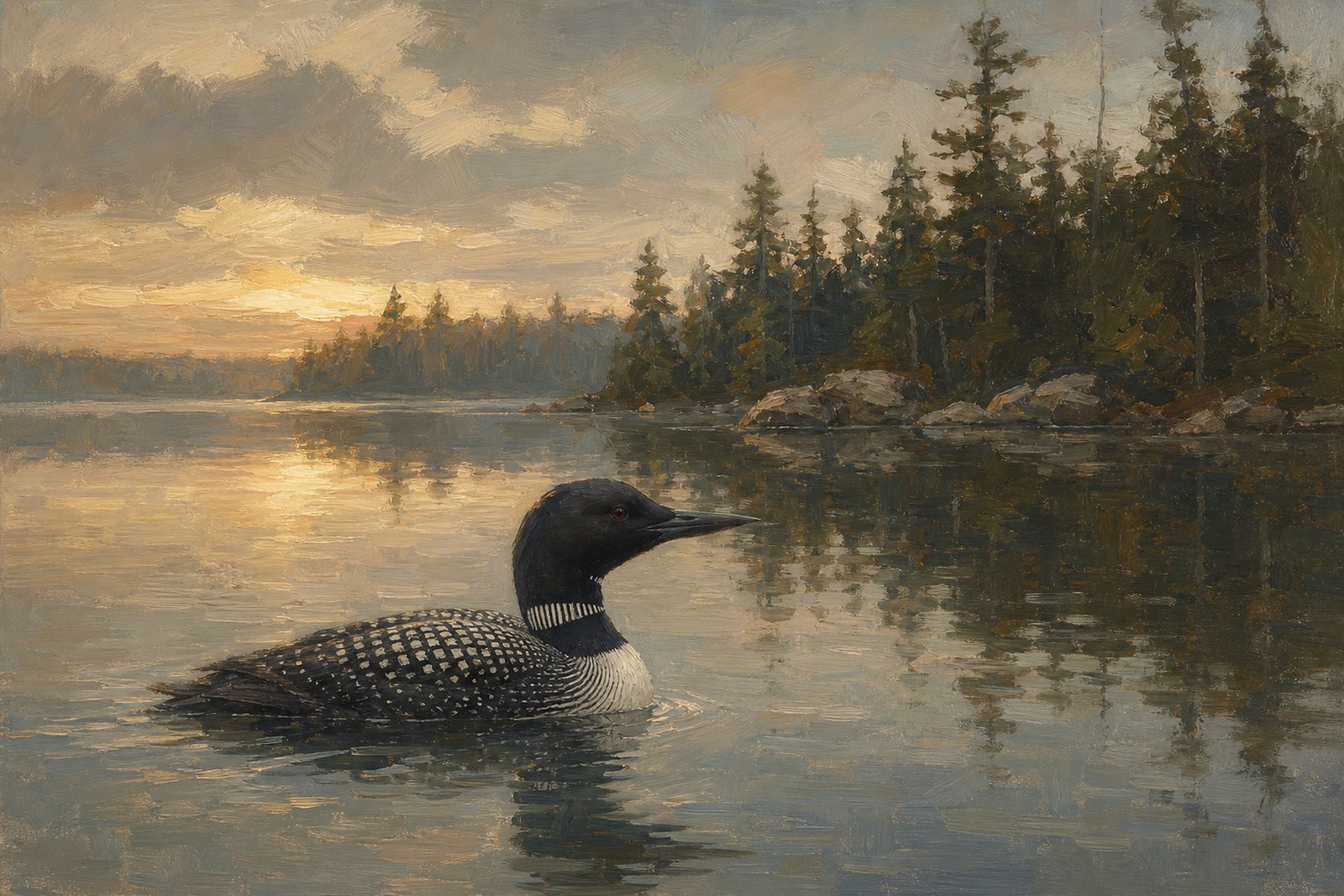
Sound aside, the common loon in breeding plumage is simply one of the best-dressed birds on the continent, and its pattern happens to be ideal for interiors. The head is black with a green sheen in strong light. The eye is deep red. Around the throat sits a striped white necklace, and across the back run rows of crisp white squares on black, a checkerboard so regular it looks engineered rather than grown.
On a wall, that pattern does two jobs at once. From across the room, the bird reads as a strong black-and-white shape anchoring a moody landscape, which gives the whole composition structure. Up close, the checkerboard rewards attention the way good tailoring does. And because the loon itself is monochrome, the print sits comfortably against almost any palette a lake house or a city apartment is likely to use: navy, forest green, warm timber, white shiplap, grey stone. Very few birds are this easy to place. The loon’s colour scheme argues with nothing.
Loon country: Minnesota, Maine, and Ontario
The loon is not just a bird in the upper Midwest and the Northeast. It is a regional identity. Minnesota made the common loon its state bird, and its ten thousand lakes hold more breeding loons than any state south of the Canadian border. Maine runs a beloved annual loon count each July, staffed by volunteers in canoes, and puts the bird on its conservation licence plate. In Ontario cottage country the loon is so completely the sound of summer that Canada put the bird on its one-dollar coin and the currency picked up the nickname. A dollar is a loonie because the loon mattered first.
That cultural weight is worth understanding when you hang the print, because in all three places the loon is shorthand for the same sentence: you are at the lake now. A loon print in a Minneapolis apartment or a Boston hallway is a small, private claim on that sentence. If you are furnishing a place in loon country itself, our guide to water birds in Minnesota covers the loon’s summer neighbours, from trumpeter swans to hooded mergansers.
Which loon composition belongs on your wall?
The Print Room carries the loon in three distinct moods, and the differences matter more than they first appear.
A single loon on a northern lake. The classic. One bird, dark water, a shoreline of conifers holding the horizon. This is the composition for rooms that want composure rather than drama: over a mantel, above a sideboard, facing a desk. It has the same quality the living bird has, which is the ability to hold an entire scene still around it.
A loon calling across misty water. The sound made visible. Head raised, bill open, mist moving over the surface. This is the most romantic of the three, and the one to choose if the call is the memory you are trying to keep. It carries a bigger emotional charge, so give it a wall where it can be the only voice.
A loon pair with a chick. Loon chicks ride on their parents’ backs for the first weeks of life, safe from pike and snapping turtles below. A composition built around that behaviour reads warm without tipping into cute, which makes it the natural pick for a family cabin, a bunk room, or anywhere the lake belongs to more than one generation.
All three hang in our loon, grebe, and marsh bird collection, alongside the quieter divers that share their water. And if your water is tidal rather than northern, the great blue heron plays the equivalent anchoring role for coastal rooms.
Sizes, frames, and the practical part
Every print is a 3:2 landscape printed edge to edge, no border and no mat, so the water runs to the frame the way it runs to the shoreline. Three sizes: 12x18 at $59, 16x24 at $89, and 20x30 at $119 unframed. Framed versions are $189, $259, and $329, in black, brown, or gold. If you would rather print locally, a digital download is $19.
Each piece is made to order and dispatched within 2 to 5 business days, with free shipping to the US, Canada, the UK, Europe, Australia, and New Zealand. If an order arrives damaged, defective, or wrong, we replace or refund it within 30 days.
On provenance, plainly: these are original AI-created artworks in the style of antique oil painting. What you are buying is an oil-painting-style print, not a photograph and not a historical piece, and we think the distinction belongs in the open rather than in fine print.
Where a loon print belongs
The best placement we know is the wall that faces the water, so the print and the lake regard each other across the room. Failing a lake, the loon suits the places where a house is quietest: above the bed, over the reading chair, at the end of a hallway where it can be seen from a distance and approached slowly.
The 20x30 is the mantel size. The 16x24 suits the space above a dresser or a desk. The 12x18 works in entries and stairwells, and it is the honest choice for the city apartment that only gets two weeks at the lake each year but thinks about it all fifty-two.
Frequently asked questions
What size loon print works best over a mantel?
Aim for roughly two-thirds the width of the mantel. For most fireplaces that means the 20x30, hung so the bottom edge sits a hand’s width above the mantel shelf. A narrow fireplace, or one with a tall vertical chimney breast, can take the 16x24 without looking underfed.
Is the loon print a photograph?
No. It is an original AI-created artwork in the style of antique oil painting, and we describe it that way everywhere it is sold. The style suits the subject: deep blacks, layered water, and the kind of low warm light that photography on a northern lake rarely cooperates with.
Do loon prints only work in lake houses?
They work anywhere classic wildlife art works, which is most places. Because the bird is black and white, the print behaves like monochrome art with a landscape behind it, so it holds up in studies, hallways, and apartments that have never smelled a campfire. The lake house association is a bonus, not a requirement.
Which frame colour suits a loon print?
Black is the safest, since it repeats the plumage and sharpens the checkerboard. Brown warms the print up against timber walls, the natural cabin choice. Gold leans formal and traditional, and works surprisingly well here because it picks up the warm light in the water.