Everyone knows the heron. It stands in the open, six feet of patience, and gets its portrait hung over half the consoles in coastal America. But the marsh keeps its best birds hidden. Stand at the edge of a cattail stand for an hour and you will hear them: a grunt from somewhere inside the reeds, a deep gulping boom, a wail in the dark that sounds almost human. The birds making those sounds are rarely seen even by people who spend their lives looking, and that is exactly what makes them extraordinary subjects for wall art. A print is the one place these birds hold still in the open.
Meet the rail, the bittern, and the limpkin: three marsh birds most guests have never heard of, and three of the best conversation pieces in The Print Room.
The rail: the bird that walks through walls
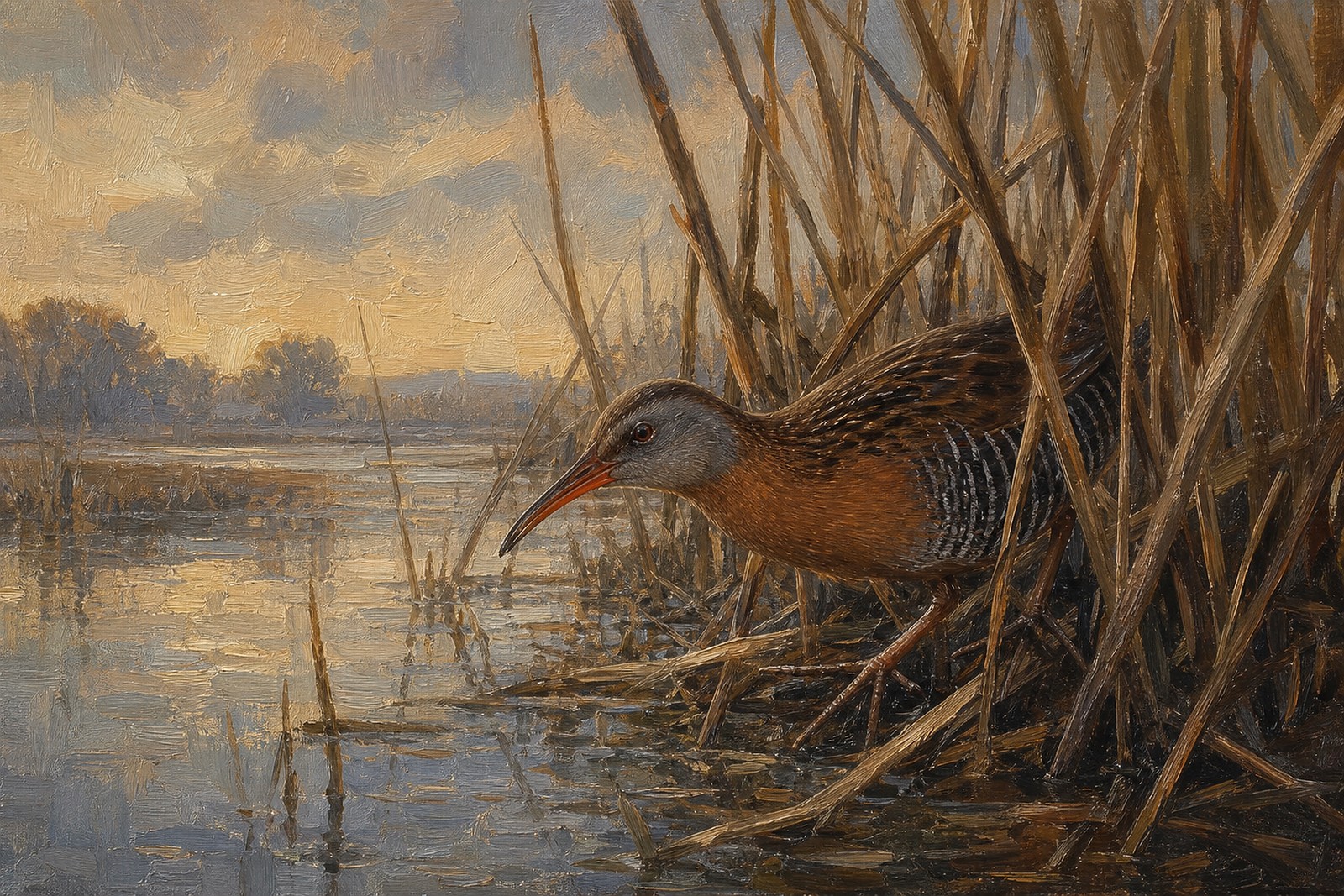
A Virginia rail is about the size of a robin gone long in the legs, rust-breasted and grey-cheeked, with a slightly curved reddish bill. What makes it remarkable is its architecture. The body is compressed side to side, so narrow through the chest that the bird can slip between standing reed stems without bending them. Even its forehead feathers are specially toughened to withstand a lifetime of pushing through vegetation. It can swim, dive, and run across floating plants, and it does nearly all of it out of sight.
Birders know rails mostly as sounds: the Virginia rail’s grunting duet, the clatter of the clapper rail across a salt marsh at dawn, the deeper call of the king rail, the largest of the family, in freshwater cattails. Actually seeing one step into the open is a small event people remember for years.
Our Virginia rail in cattails composition catches the bird in exactly that moment, out from between the stems, printed in the golds and rust-browns of the autumn marsh. Those colours are worth noting for decorating purposes: cattail gold and reed brown are warm neutrals, and they make rail prints some of the easiest wildlife art to place in a room.
The bittern: the bird that impersonates the reeds
The American bittern has one of the strangest defences in North American birdlife. Startle one and it does not flush. It points its bill straight at the sky, stretches its streaked brown neck, and becomes a reed. The vertical striping on its throat lines up with the cattails around it, and in a breeze the bird sways gently, keeping time with the vegetation. It is not hiding behind the reeds. It is performing them.
In spring the bittern gives itself away with a sound like no other bird on the continent: a deep, resonant, liquid pumping, oonk-a-lunk, that carries across the marsh and earned it the old country name of thunder-pumper. Its tiny cousin, the least bittern, is among the smallest herons in the world and spends its life straddling reed stems above the water, too light to need land at all.
Our American bittern composition plays the bird’s own game: it is hidden in the reeds, upright among the verticals, and guests genuinely do lean in before they find it. Art that makes people step closer is rare, and the bittern does it by profession.
The limpkin: Florida’s crying bird
The limpkin looks, at first glance, like a large brown ibis that lost its curve: a streaky, long-legged wader with a heavy, slightly open-tipped bill. Its fame rests on two things. The first is its voice, a piercing, carrying wail given mostly at night, so human and so unsettling that it became the sound of the southern swamp in folklore and film. Old Florida named it the crying bird.
The second is its table manners. Limpkins feed almost entirely on apple snails, and the bill’s twisted, gapped tip works like a dedicated tool for cutting the snail free of its shell in seconds, leaving neat piles of emptied shells along the waterline. Once confined mostly to Florida, limpkins have been spreading north in recent years as their snails spread, and birders in states that had never recorded one are now finding them in local wetlands.
Our limpkin in a Florida wetland composition puts the bird among cypress and still water, in the greens and umbers of the deep South. For anyone with a connection to Florida’s swamps, it is a piece of home that almost nobody else will have on their wall.
Why hang a bird nobody recognises?
Because recognisable art gets glanced at, and unrecognisable art gets asked about. A heron print is admired and filed: lovely, coastal, understood in two seconds. A bittern print stops people. What is that bird? Then you get to tell them about the sky-pointing, the swaying, the thunder-pumper call, and a piece of wall art has done something almost no decor ever does, which is start a story.
There is a quieter argument too. These three prints share the marsh palette: gold, rust, umber, deep green. Those are the colours of tweed and timber and old leather, which is why the hidden marsh birds settle into studies, dens, and hallways more easily than showier wildlife art. They are conversation pieces that also happen to be exceptionally good neutrals. All three birds work the same water, which our marsh and reedbed habitat page explores from the reeds up.
The birder-gift answer
Birders are famously hard to buy for. The optics are personal, the field guides are owned, and the clothing has opinions attached. What a birder actually treasures is evidence that someone was paying attention to their particular obsession, and this is where the hidden marsh birds are unbeatable. Nobody’s trophy bird is a mallard. The birds that take years, the heard-only entries on a life list, the one they finally saw at dawn on the fourth attempt: those are rails, bitterns, limpkins.
A print of that species says I know exactly which bird mattered to you, which is about the strongest sentence a gift can say. Ask someone close to them which bird took the longest, then find it in the marsh birds collection. For the wider gift-buying landscape, our gifts for bird lovers guide covers the rest of the field.
The practical part
Every print is a 3:2 landscape, printed edge to edge with no border or mat. Unframed prices are $59 for the 12x18, $89 for the 16x24, and $119 for the 20x30. Framed versions, in black, brown, or gold, are $189, $259, and $329, and the brown frame is particularly good with the marsh palette. A digital download is $19.
Everything is made to order and dispatched in 2 to 5 business days, with free shipping to the US, Canada, the UK, Europe, Australia, and New Zealand. If an order arrives damaged, defective, or wrong, we replace or refund it within 30 days. And plainly, as always: these are original AI-created artworks in the style of antique oil painting, sold as oil-painting-style prints and never as anything else.
Frequently asked questions
Are rails, bitterns, and limpkins rare birds?
More hidden than rare. Rails and bitterns live in dense reeds and are heard far more often than seen, which makes them feel mythical even where they are reasonably common. The limpkin was long a Florida speciality but has been expanding its range north in recent years. For most people, a print is the longest look at any of them they will ever get.
Which of the three makes the best gift for a birder?
The one on their list. If you can find out their most wanted or best remembered marsh bird, choose that species and the gift becomes personal in a way generic bird art cannot. If you cannot find out, the American bittern is the safest pick: every birder has a bittern story, usually involving not seeing one.
Do these prints work in modern interiors?
Yes, better than most wildlife art. The marsh palette of golds, browns, and deep greens behaves like a set of warm neutrals, and the compositions are quiet rather than busy. In a modern room the black frame keeps things crisp; in traditional rooms brown or gold settles in beside timber and leather.
Are these photographs?
No. Each is an original AI-created artwork in the style of antique oil painting, in the tradition of classic American sporting art. Given how rarely these species pose in the open, the style is also the only way to see them this clearly.