Twice a year, the sky organises itself. People who never look up, look up. A V of geese passing over a parking lot can stop a conversation mid-sentence, and it has been doing so for as long as people have watched autumn arrive. Migration art borrows that pull directly, and the more you know about what the V actually is, the better the art gets. Because the V is not a habit, or a shape geese happen to like. It is a machine for sharing work.
Why do geese fly in a V?
Every flying bird leaves a wake. As a goose’s wings push air down to generate lift, the air spills around each wingtip in a rotating swirl, a wingtip vortex, that trails behind the bird. Directly behind the goose that air is moving downward, which makes it the worst place in the sky to fly. But off to either side, just beyond the wingtips, the same swirl is rising. That band of climbing air is called upwash, and it is free lift, hanging in the sky, paid for by the bird in front.
A trailing goose positions itself in exactly that band: behind and to the side of the bird ahead, wingtip roughly in line with wingtip. Repeat down the line and the flock resolves into the shape everyone recognises. Aerodynamic modelling published in 1970 estimated that a formation of twenty-five birds could extend its range by roughly seventy percent compared with a bird flying the same distance alone. Real birds are messier than models, but the field evidence points the same way. A 2014 study that fitted northern bald ibises with GPS loggers found the birds held station in the upwash zone with startling precision, and even timed their wingbeats so their wings rose and fell through the moving air in phase, surfing the wave rather than flapping against it. Earlier work with heart-rate monitors on pelicans found that birds flying in formation kept lower heart rates and glided more often than birds flying alone.
So that is what a V-formation print actually depicts: not a flock, but a system. Every bird in the line except one is drafting.
The lead bird takes the headwind
The exception is the bird at the point. It flies in clean, unhelpful air and works harder than any bird behind it, which is why the point is not a throne but a shift. Geese rotate through the lead position, peeling back to recover in the cheaper air down the line while another bird moves up. The details of that rotation, and what actually determines the order of a skein, are worth a post of their own, and we have one on how geese decide who leads. The constant calling you hear from a passing V is part of the same system, the sound of a flock holding itself together at altitude and at speed.
The arrangement pays off on a scale that is hard to picture from the ground. Riding weather systems and tailwinds, migrating flocks can cover several hundred miles between one dawn and the next, a subject we take up properly in how far geese can fly in a day. The V is how a twelve-pound bird makes a continent crossable.
Why flight compositions carry motion into a room
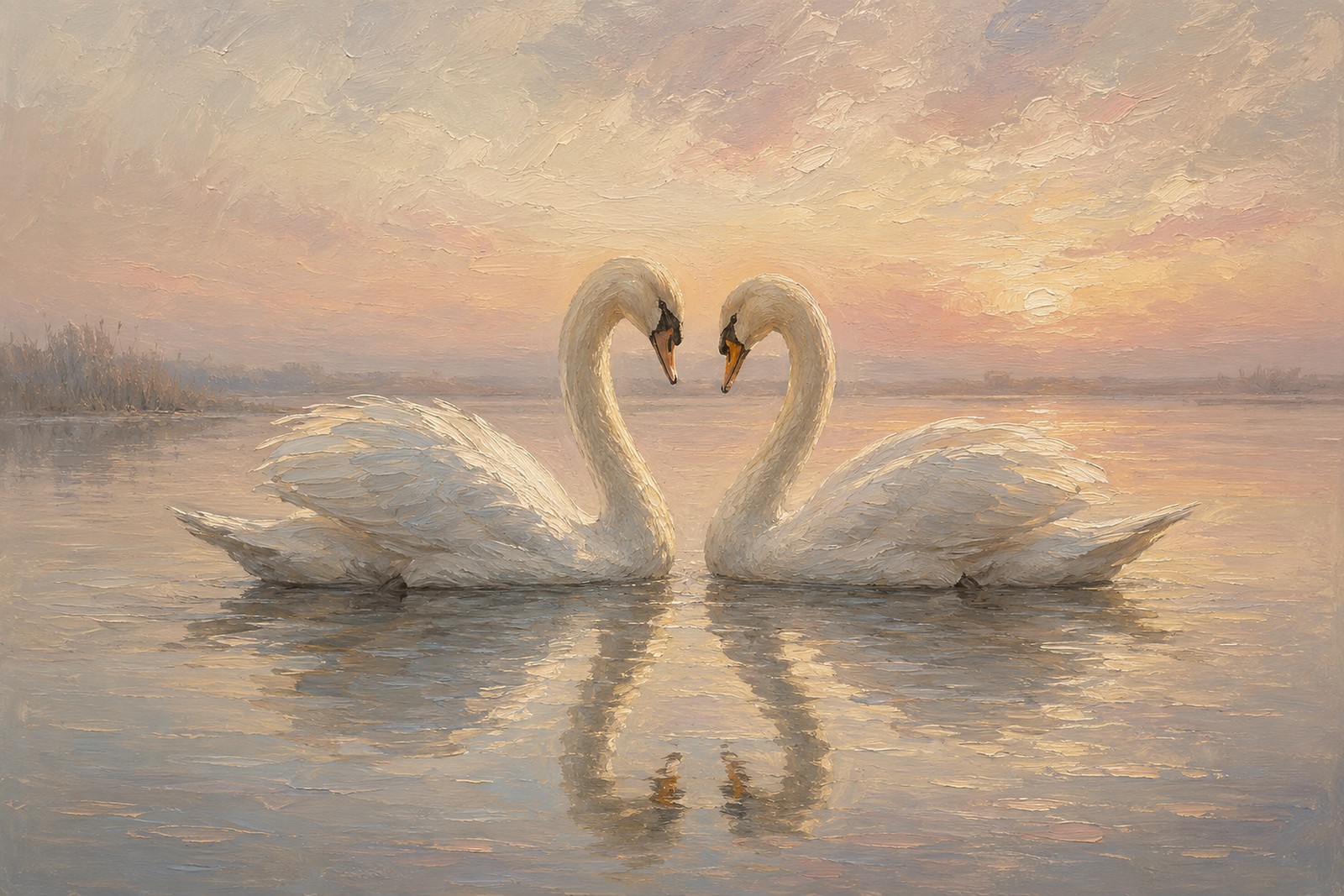
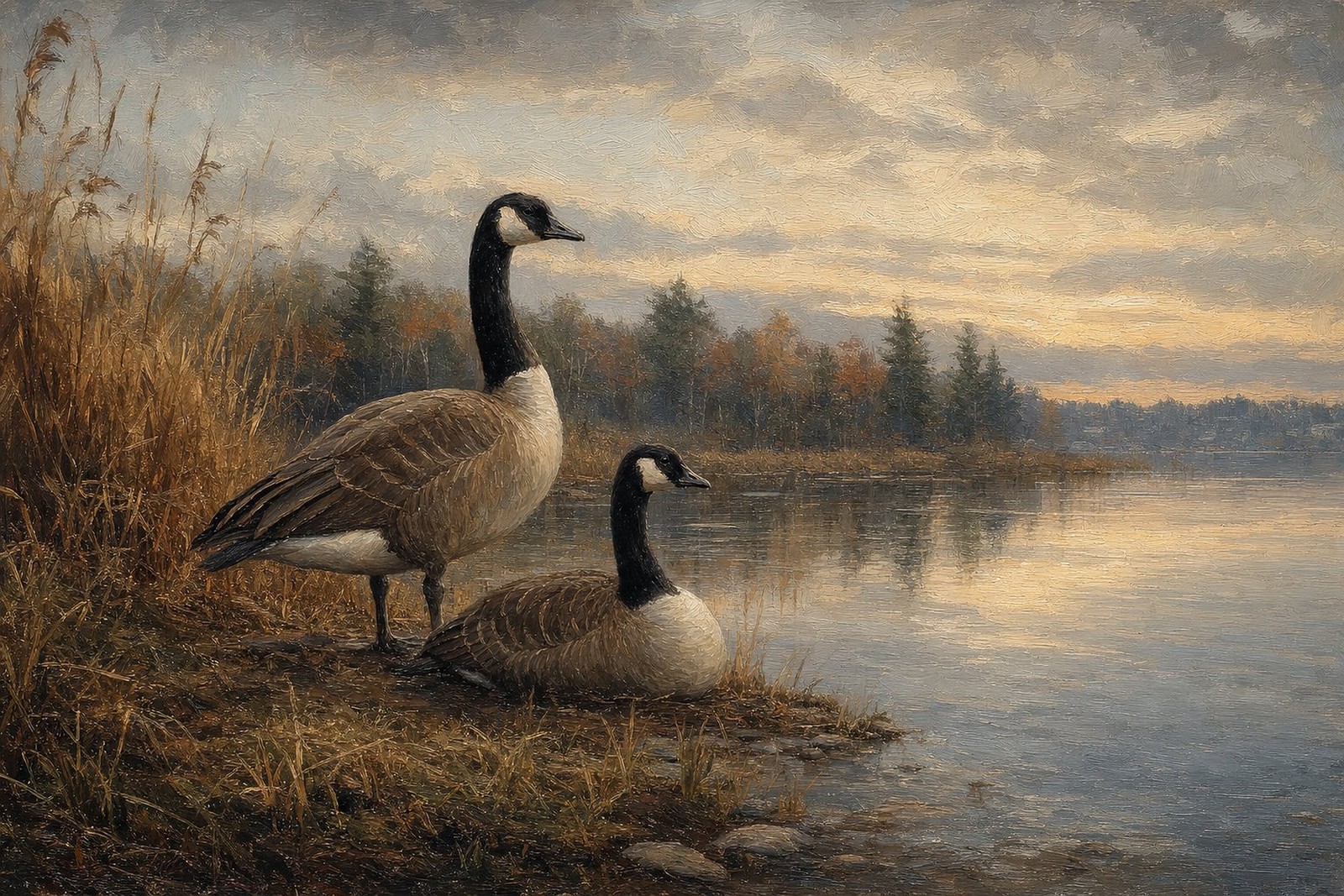
Most wall art is still, and stillness is usually the point: a pair of geese composed at the lake edge settles a room. A flight composition does the opposite job. It gives a wall a direction of travel.
The mechanics are simple to state. Diagonal lines read as movement; horizontal lines read as rest. A skein crossing a canvas is a set of diagonals organised toward a destination, and the eye runs along it involuntarily, the same way it follows an arrow. Hang that in a room and the room acquires a current. This is why flight scenes suit spaces of transit and effort: entries, hallways, stair walls, home offices. Somewhere in the house, it feels right that something is going somewhere.
There is a hanging rule that comes with this, borrowed from the oldest logic of portrait placement: the birds should fly into the room, toward the centre of the wall or the heart of the space, not off the nearest edge. A V aimed at the door reads as departure. A V aimed across the wall reads as journey. Same print, different feeling, purely by which wall you choose.
And this is where format matters. A V needs sky to cross. Our prints of geese on the wing are landscape compositions in a 3:2 ratio precisely because the subject demands width: room ahead of the lead bird, air behind the last one. A tall, narrow flight print is a contradiction; the format would stop the flock mid-journey.
What to look for in a migration flight print
A legible V. The formation should read as a silhouette from across the room, the way the real thing reads against a grey sky. If the birds dissolve into texture at distance, the print has lost its subject.
Weather in the sky. The V exists because crossing a continent is work. A sky with movement in it, layered cloud, low light, the suggestion of wind, tells that story; a flat blue sky does not.
A low horizon. The best flight compositions give most of the canvas to the air. A thin band of marsh or treeline at the bottom anchors the scene and makes all that sky feel earned.
Scale to match the viewing distance. Motion reads at range. 16x24 is the working minimum over furniture; 20x30 is the right call for entries and stair walls seen from across a room or from a flight of steps below.
The honest details
Every piece in the collection is an original AI-created artwork in the style of antique oil painting, in the tradition of the migration scenes that have hung in American studies and lodges for a century, and we describe it exactly that way on every listing. Prints are made to order and dispatched in 2 to 5 business days. Unframed, the three sizes, 12x18, 16x24, and 20x30, are $59, $89, and $119; framed in black, brown, or gold they are $189, $259, and $329; a digital file is $19. Shipping is free to the US, Canada, the UK, Europe, Australia and New Zealand, and a 30-day guarantee covers replacement or refund for anything that arrives damaged, defective, or wrong. Every print runs edge to edge with no mats, so the sky goes all the way to the frame.
Frequently asked questions
Why is one side of the V usually longer than the other?
Because the formation has no reason to be symmetrical. Each bird needs only one wingtip’s worth of upwash from the bird ahead, so a lopsided V works exactly as well as a balanced one, and crosswinds tend to skew the line further. The old joke answer, that one side simply has more geese on it, happens to be the truth.
Do geese really take turns leading?
Yes. The point position offers no upwash and costs the most effort, so it rotates through the flock rather than belonging to a single bird. Leadership in a skein is a shift system, not a hierarchy.
Which direction should the geese fly on my wall?
Into the room. Aim the formation toward the centre of the wall or the interior of the space, following the same rule decorators use for portraits and paired art. A V flying off the edge of the wall reads as an exit.
What size does a V-formation print need to be legible?
The formation itself reads at almost any size, but the sense of motion needs viewing distance. Choose 16x24 or larger for walls seen from across a room, and reserve 12x18 for close quarters like a study nook or a hallway run.