There are two kinds of cabin walls. The first is covered in things that say cabin: novelty paddles, plaid on plaid, a wooden sign listing the Lake Rules. The second kind feels like the lake came indoors on its own, and it is surprisingly hard to explain why until you stand in front of it for a while. The difference is not budget and it is not taste, exactly. It is that the first wall performs and the second wall belongs.
This is a guide to getting the second kind of wall: the northwoods palette that makes it work, the art that earns a place in it, and why one bird in particular has been carrying the whole aesthetic for as long as anyone has owned a cabin.
The northwoods palette: pine, mist, granite
Every good northwoods room is built from the same short list of colours, because the landscape itself is built from them. Pine green so dark it reads as black at dusk. Granite grey, both the boulder kind and the overcast-sky kind. The white of birch bark and the near-black of deep water. Morning mist, which is not white but a warm silver. And over all of it, in the evenings, the amber of lamplight on timber, which is the colour that makes people sigh when they walk in.
That palette is quiet, which is why the traditional accent is a single loud red: the canoe, the wool blanket stripe, the check on one chair. One red. The scheme collapses if everything competes.
Art for this room should be drawn from the same list. A print built on dark water, silver mist, and spruce shoreline slots into a northwoods room like a board into a floor. A print built on tropical brights or crisp coastal whites will sit on the wall like a guest who did not get the dress code.
Decor that performs vs art that belongs
The test is simple. Decor that performs tells visitors what kind of house they are in. Decor that belongs tells you, the owner, what you already know: which lake this is, what it sounds like at night, why you keep driving four hours to get here.
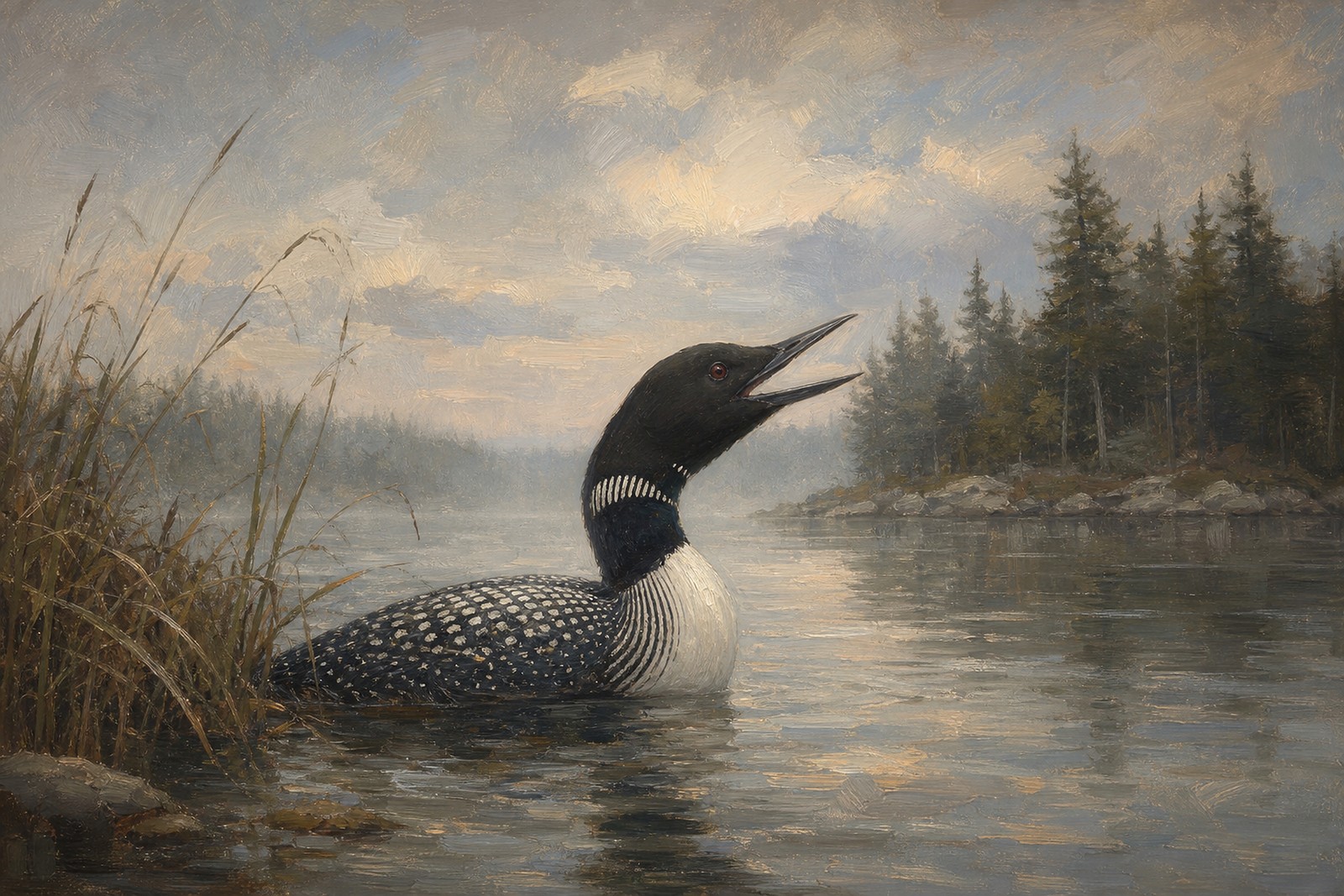
Novelty signs perform. A cartoon moose performs. They are not crimes, but they age like jokes, and by the third summer nobody sees them anymore. Art that belongs works the way a cast-iron pan works: quiet, durable, better with years. A loon lifting its head in the mist does not say lake house in general. It says this lake, tonight, and it goes on saying it for decades. That is the whole distinction, and it is worth every minute you spend applying it to a shopping decision.
Why is the loon the anchor bird of the northwoods?
Because it is the one animal that stands for the entire experience. Moose are occasional. Bears are a story you tell. But the loon is nightly, and it is audible, which makes it the bird everyone at the cabin actually shares. When people convert the northwoods into a single image, they reach for the loon the way coastal decorators reach for the heron.
Our loon calling across misty water composition was built to be that anchor. Head raised, bill open, the call almost visible over the flat water: it is the sound of the place, held still. Hang it where the evening light lands, over the mantel or facing the big window, and let the black-and-white of the bird steady all that timber. Wood-heavy rooms need a graphic element somewhere or they blur into brownness. The loon is that element, arriving politely, in period costume.
Start with the loons and grebes in The Print Room and build outward from there.
The supporting cast
One anchor, then a small supporting cast: that is the formula. The northwoods roster is deep.
Hooded merganser in a woodland pool. The dandy of the beaver pond, a small diver with a white fan of a crest it raises like a held breath. Perfect beside a bookcase or in a hallway.
Common merganser family on a river bend. Motion and multiplicity, a hen leading a flotilla downstream. Good for the room where the family actually gathers.
Common goldeneye on a cold river. The winter bird, all black and white and ice-light. This one suits cabins that get used in January, not just July.
Harlequin duck on a rocky stream. For the cabin on moving water rather than a lake, a strange and beautiful little duck riding the rapids.
Two or three of these around a single loon anchor gives a cabin a collected feel rather than a decorated one. Resist the urge to hang a zoo. If your walls lean more gun rack than paddle rack, our hunting lodge wall art guide takes the same thinking in a more sporting direction, and the duck hunter gift guide covers the waterfowler in your life.
How do you hang art on log walls?
Carefully, and mostly by choosing your spots. Full-scribe log walls curve, so large frames rock unless they land on the flattest run of a big log. The reliable surfaces in most cabins are the gable ends, the drywall or panelled partition walls, the timber above the fireplace, and stair landings. Use those for your biggest pieces and let the log walls carry smaller frames, which tolerate the curve far better.
Scale guidance is the same as anywhere, with one cabin-specific note: our prints are 3:2 landscapes, and that horizontal format agrees with log construction, echoing the long lines of the walls instead of cutting across them. The 20x30 is the fireplace and gable-wall size. The 16x24 suits partition walls and the space over a dresser. The 12x18 is the bunk room, bathroom, and entryway size, and it is small enough to sit happily on a log run.
One more cabin truth: the light is low. Deep eaves, small windows, timber that drinks whatever light gets in. Compositions with their own internal light, mist, dawn water, a pale sky behind dark trees, keep reading clearly in that gloom, and a gold frame will pick up lamplight in the evenings the way brass hardware does.
The practical part
Every print is made to order in three sizes: 12x18 at $59, 16x24 at $89, and 20x30 at $119 unframed, printed edge to edge with no border or mat. Framed versions in black, brown, or gold are $189, $259, and $329, and brown was practically invented for log walls. A digital download is $19. Orders dispatch in 2 to 5 business days with free shipping to the US, Canada, the UK, Europe, Australia, and New Zealand, and anything that arrives damaged, defective, or wrong is replaced or refunded within 30 days.
Provenance, stated plainly: these are original AI-created artworks in the style of antique oil painting, in the tradition of classic American sporting art rather than photography. We put that in the open because a cabin full of honest materials deserves honest art.
Frequently asked questions
What style of art suits a northwoods cabin best?
Oil-painting-style work in a muted palette: dark water, mist, spruce, birch. The look descends from classic American sporting art, which has hung in lake and hunting camps for over a century, so it reads as native to the setting in a way that bright modern prints and photo canvases rarely do.
What size print should go over a stone fireplace?
The 20x30. Stone chimney breasts are big, textured surfaces, and undersized art disappears against them. Hang it on the timber mantel beam or the flat masonry above, roughly at standing eye level, and keep it to one piece. A stone wall does not want a gallery.
Can bird prints share a wall with antlers, paddles, and maps?
Yes, and the mix is usually better than art alone. The rule is restraint: treat the print as the quiet centre and let two or three objects orbit it with generous spacing. When every object touches another object, the wall stops being a collection and starts being storage.
Does cabin art have to match a cabin theme?
No, and this is the heart of it. Match the palette, not the theme. A print that shares the room’s pine, granite, and amber will belong even though nothing about it says cabin, while themed decor in the wrong colours never quite settles. Palette match beats theme match every time.