Every wetland has a bird that owns it. On the marshes and river flats of the American interior, that bird is the sandhill crane: roughly four feet of grey plumage, rust-stained shoulders and unhurried posture, moving through shallow water like it has nowhere better to be. Most bird art asks you to lean in. Crane art does the opposite. It stands back, holds the room at a distance, and lets the bird’s own bearing do the work. If you want one piece of wildlife art that reads as elegant rather than decorative, this is the bird to build around.
Why the sandhill crane reads as elegant
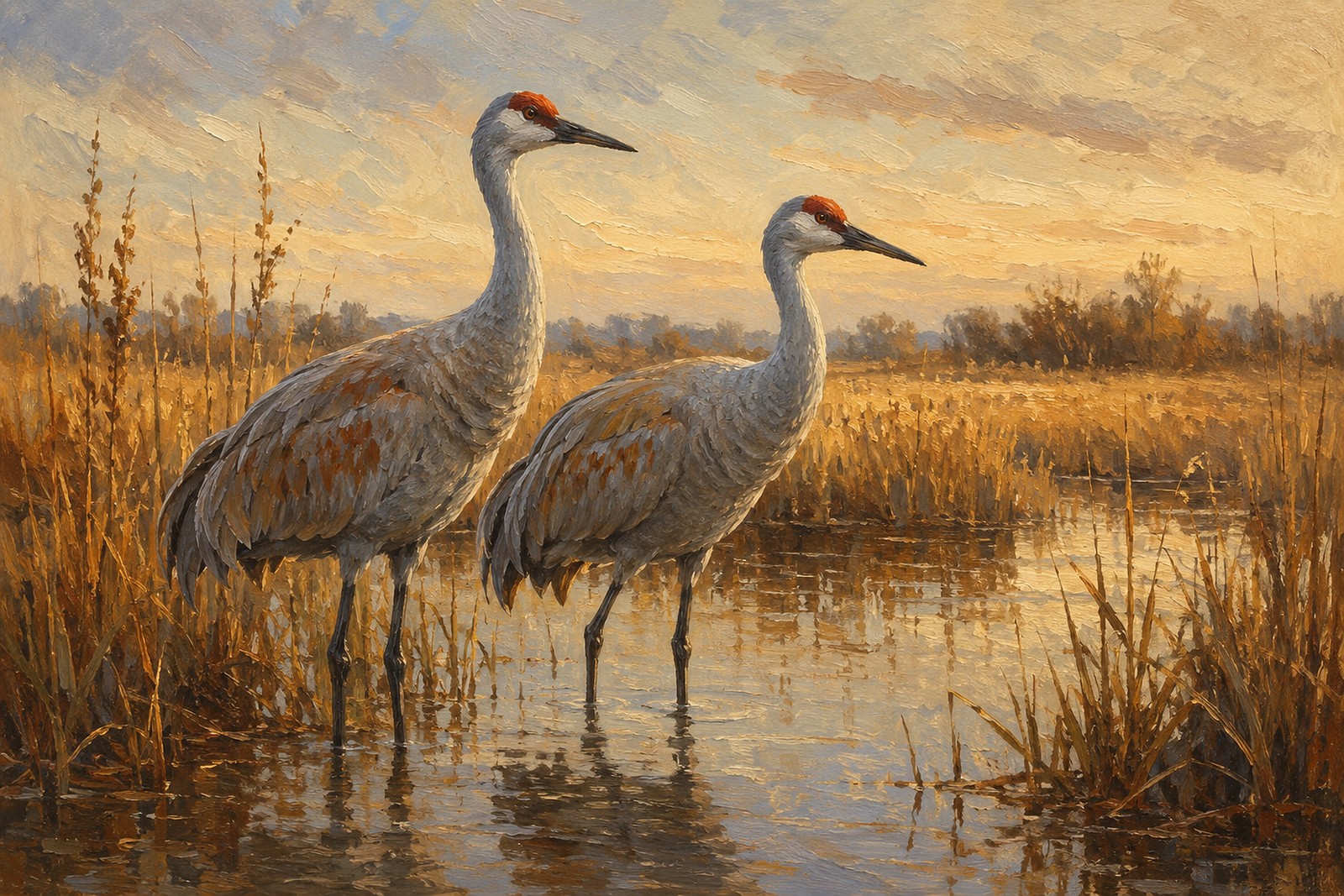
Elegance in a bird, as in a room, is mostly a matter of line and restraint, and the sandhill crane has both in unusual supply. The bird stands around four feet tall on long dark legs, with a wingspan well over six feet when it finally decides to use it. The neck is carried in a long, shallow curve rather than the heron’s coiled spring, which is why a crane reads as composed where a heron reads as watchful. The palette is restraint itself: dove grey over the body, a bare red crown at the forehead, and rusty patches across the back and shoulders that the birds acquire by preening iron-rich mud into their feathers. Grey, rust and a single note of red is a colour scheme most decorators would sign off without changes.
Then there is the bearing. Cranes walk. They walk slowly, deliberately, in pairs and family groups, across open ground where everything about them is visible. A bird that spends its life being looked at from a distance has, in effect, spent its life composing itself, and that carries straight onto a wall.
The dance, and why crane art feels alive
Sandhill cranes dance. Not as a figure of speech: they bow, leap several feet into the air with wings half spread, toss grass and sticks over their heads, and circle one another with a kind of formal, springing energy that looks choreographed because, in a sense, it is. Dancing peaks in the breeding season but happens all year round, among birds of every age, which is part of why cranes have fascinated people on every continent they inhabit.
Bonded pairs also perform what biologists call unison calling, a synchronised duet delivered with heads thrown back, the two birds answering one another in a fixed pattern. The call itself is one of the great sounds of the continent: a rolling, rattling bugle produced by a windpipe so long it coils inside the bird’s breastbone, and it carries across miles of open marsh. You hear cranes long before you see them. Our Song & Calls page covers the birds that announce themselves by voice, and no bird on it announces itself quite like this one.
For wall art, the dance and the duet matter because they are what separate a crane composition from a generic wading-bird scene. Two cranes in a marsh are never just two birds standing near each other. They are a pair, mid-conversation, and the image carries that tension even at rest.
What does a golden-hour marsh palette do for a room?
The sandhill crane pair print in this collection places the birds in golden evening light, and that choice is doing more decorating work than it first appears. A marsh at golden hour runs through ochre, honey, umber and warm grey, with the water throwing the same tones back in reflection. Hang that palette on a wall and it behaves like a warm neutral: it does not fight the room’s existing colours, it flatters them.
Warm gold light is also the natural ally of the materials traditional rooms are already made of. Walnut and mahogany furniture, brass hardware and lamps, cream walls, leather, rush and rattan: all of it sits inside the same warm band the print occupies. This is why golden-hour wildlife scenes have hung in dining rooms for generations while cooler, bluer scenes drifted toward bathrooms and studies. The print is rendered in the style of classic American sporting art, the tradition of marsh, field and waterfowl scenes that furnished exactly those rooms, and the palette is a large part of what makes that tradition feel at home indoors.
Where to hang a sandhill crane print
The dining room. The single best room for this bird. A 20x30 above a sideboard or buffet gives the wall a subject worth looking at through a long dinner, and the golden palette warms under evening light exactly the way the scene itself does. Dining rooms also reward art with a certain formality, and the crane is the most formal thing in any marsh.
The entry. An entry wants one confident piece that sets the register of the house, seen for ten seconds at a time. A crane pair does that without shouting. The birds’ height and posture read instantly, even from a doorway, and the warm palette makes a hallway feel inhabited rather than staged.
The study or office. The crane’s composure suits rooms meant for concentration. Grey and rust sit particularly well against deep green, navy or brown walls.
Above a bedroom dresser. Less obvious, but the pair-bond subject and the calm horizontal composition both earn the spot.
If you are weighing the crane against the other great statement bird of wetland decor, our heron prints guide covers the vertical, solitary alternative; the short version is that the heron suits narrow walls and single-bird drama, while the crane pair suits wide walls and warmth.
An ancient bird for a traditional interior
Part of what makes crane art feel settled is that the bird itself is old beyond intuition. Sandhill cranes are often described as one of the oldest living bird species, with crane fossils from the American interior, millions of years old, strikingly similar in structure to the bird striding across a Nebraska river flat today. Each spring, hundreds of thousands of sandhills still stage along the Platte River in one of the last great wildlife gatherings in North America, fattening on waste grain before pushing north to breed.
A print cannot carry all of that, but it carries some of it. A bird that has been doing the same dance in the same light for that long lends a room the one quality money cannot usually buy, which is the sense that the things in it were not chosen yesterday.
The print, the sizes and the practicalities
The sandhill crane pair is an original AI-created artwork in the style of antique oil painting, and we describe it that way everywhere it appears: an oil-painting-style print, not a photograph and not a historical piece. The composition is 3:2 landscape, printed edge to edge with no border or mat, so the marsh runs the full width of the sheet.
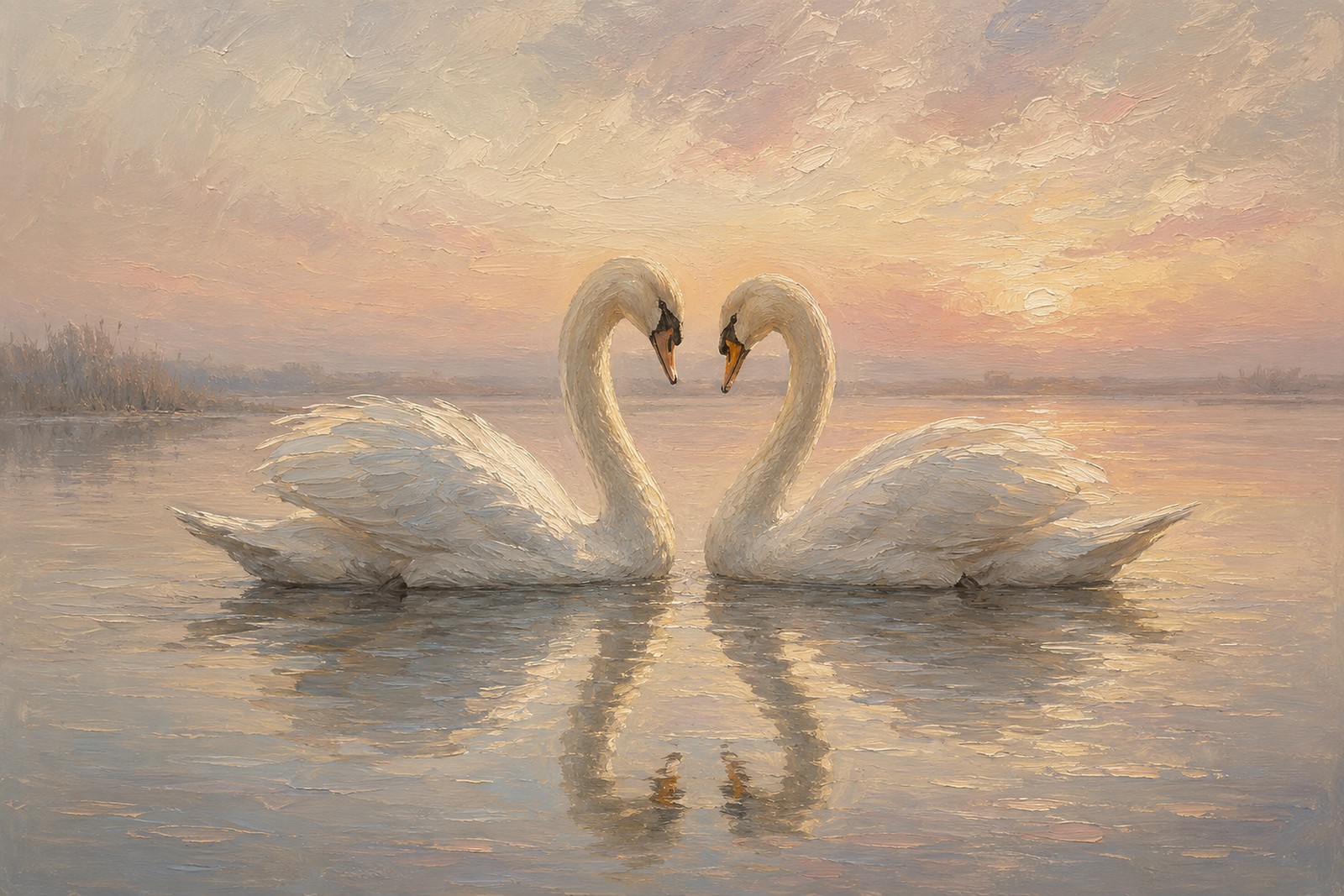
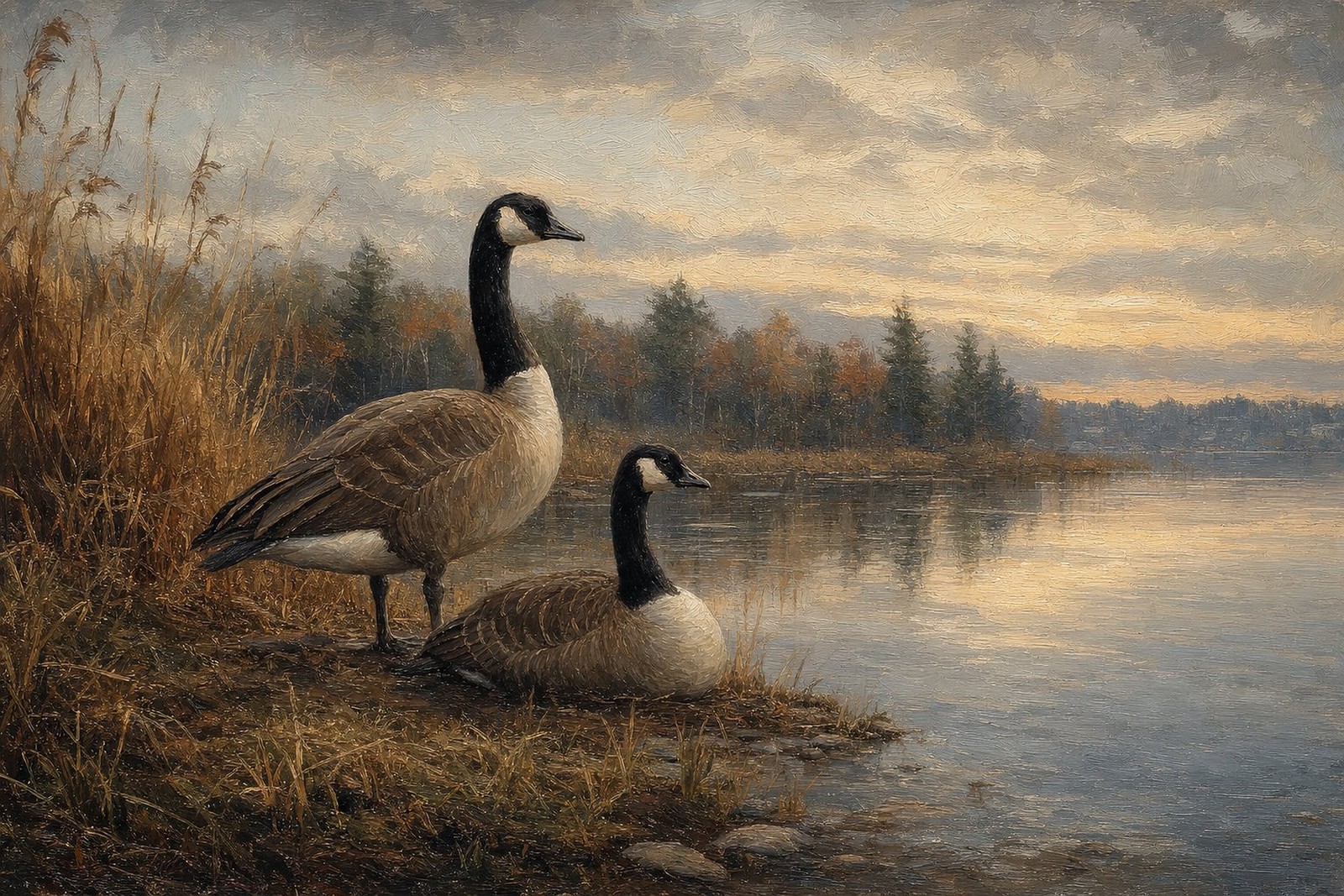
Unframed prints are $59 at 12x18, $89 at 16x24 and $119 at 20x30. Framed prints, in black, brown or gold, are $189, $259 and $329. A digital download is $19. Everything is made to order and dispatched in 2 to 5 business days, with free shipping to the US, Canada, the UK, Europe, Australia and New Zealand, and a 30-day replacement or refund if anything arrives damaged, defective or wrong. The crane pair hangs alongside its companion pieces in the swans and cranes print collection, where the same pair-bond thread runs through every image.
Frequently asked questions
What size sandhill crane print suits a dining room wall?
Above a sideboard, aim for roughly half to two-thirds the width of the furniture: the 20x30 suits a standard sideboard or buffet, while the 16x24 fits a narrower console or a smaller room. Hang it so the centre of the image sits close to eye level for a standing viewer.
Are sandhill cranes really that tall?
Yes. Adults stand around four feet tall depending on the population, with a wingspan well over six feet. Only the whooping crane stands taller among North American birds, which is why a crane in a composition reads as architecture rather than wildlife filler.
What colours pair well with sandhill crane art?
The print’s ochre, grey and rust palette behaves like a warm neutral. It flatters cream, sand and warm white walls, deepens against forest green or navy, and sits naturally beside walnut, mahogany, brass and leather. Avoid pairing it with very cool, blue-toned greys, which fight the golden light in the scene.
Is this a photograph of cranes?
No. It is an original AI-created artwork in the style of antique oil painting, in the tradition of classic American sporting art, printed edge to edge in 3:2 landscape format. We are precise about that description because accurate provenance is part of the product.