Every house has two kinds of walls. There are the walls in rooms where people sit, which get the considered art, the statement pieces, the pairs hung with a tape measure and a pencil mark. And there are the walls in the spaces people move through, the halls, the stair landings, the bathrooms, which mostly get whatever was left over, or nothing at all.
That is backwards, because transit spaces are among the most-seen walls in a house. You pass the hallway wall twenty times a day. A guest stands in the bathroom with nothing to look at but the walls. These spaces deserve art chosen for how they are actually used, and a sandpiper print is one of the few pieces genuinely built for the job.
Why halls and bathrooms need different art
A living room print is viewed from across the room, seated, at leisure. A hallway print is viewed from three feet away, at an angle, in motion. A bathroom print is viewed from closer still, in a room that is usually small, bright and hard-surfaced. Those viewing conditions change what works.
First, scale flips. The large statement piece that anchors a sitting room overwhelms a corridor where you can never step back far enough to take it in. Transit spaces favour smaller formats viewed close.
Second, single-subject drama loses its power. A portrait composition, one heron, one owl, asks the viewer to stop and consider it. Nobody stops in a hallway. What works instead is a picture that reads in a second as you pass, then repays the closer look on the hundredth pass.
Third, surface matters more. At close range, the texture of a print is part of the experience. The layered, tonal look of an oil-painting-style print holds up at twelve inches in a way a flat graphic does not.
A flock of small shorebirds happens to satisfy all three.
What makes a flock composition work?
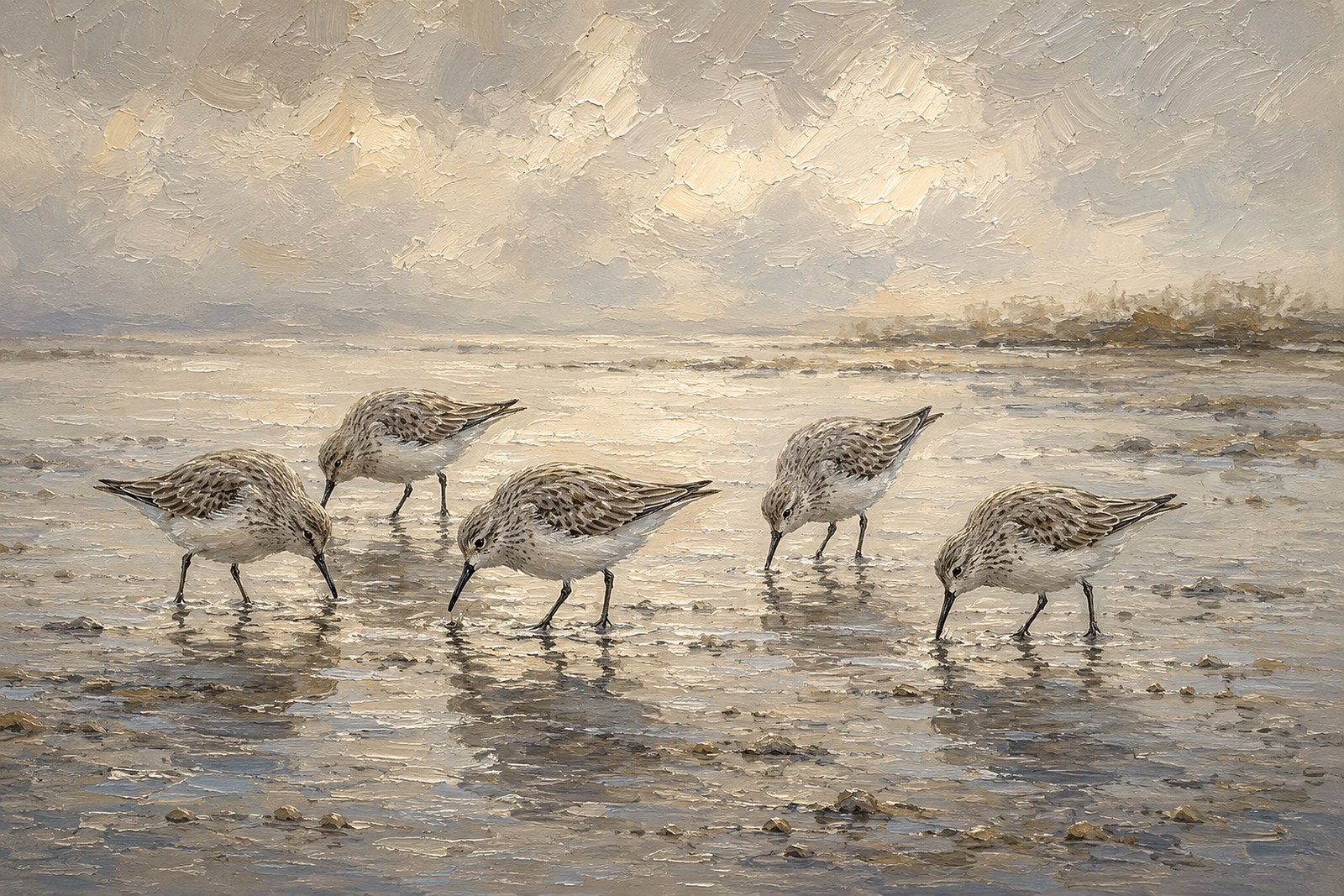
Western sandpipers are among the most abundant shorebirds in North America, and they move in flocks that can carpet a mudflat. No single bird is the subject. The subject is the rhythm: the same small form repeated across the sheet, each bird a slight variation on the last, heads up, heads down, probing, hurrying.
On a wall, that rhythm does exactly what a transit space asks of art. There is no focal point demanding a stop, so the print reads instantly, the way a patterned paper reads, as tone and texture. But unlike pattern, it rewards attention. Stand at the basin brushing your teeth and the flock resolves into individuals: one bird mid-step, one doubled in its own reflection, one turned against the grain of the rest. It is the rare kind of picture that works at both a glance and a stare, which is precisely the range a hallway or bathroom serves.
The silver light palette
Our Western Sandpipers in Silver Light print keeps to a deliberately narrow register: silver-grey, oyster, wet-sand buff, foam white. That is faithful to the birds, which in winter plumage are pale silver-grey above and white below, among the lightest-toned birds on the flats. It is also, conveniently, the native palette of the rooms this guide is about.
Bathrooms are already silver rooms: chrome, mirror, porcelain, tile. Halls tend to wear the pale, safe neutrals people choose for connective spaces. A silver-light print does not introduce a new colour that needs managing. It brings subject and atmosphere to a palette the room already owns.
The rule from our coastal wall art guide applies doubly here: contrast in value, not colour. Tone-on-tone is the risk when both print and wall are pale, so let the frame draw the line. A black or deep brown frame separates the print cleanly from white tile or off-white walls without adding a new colour to the scheme.
Where a sandpiper print earns its keep
Hallways. Hang at eye level and centre each print on its stretch of wall, not on the corridor as a whole. A 12x18 print suits the close viewing distance; for a longer hall, a run of two or three spaced evenly turns the walk into a sequence rather than a single event.
Stair landings. The landing is the one pause point in a stairwell, and it usually offers more height than width to spare. A 16x24 sits comfortably where the turn of the stairs gives you a step or two of viewing distance.
Bathrooms. Art works in bathrooms under three conditions: frame it behind glazing, make sure the room ventilates, and keep it out of the direct steam path above a shower or bath. A framed print in an ordinarily ventilated bathroom is a reasonable, durable choice.
Powder rooms. A half bath has no shower, so no steam cycle, which makes it the friendliest bathroom in the house for art. Unframed prints are fine here, and the small walls suit the 12x18 format exactly.
Sizing and framing for close viewing
All of our prints are 3:2 landscape, edge to edge with no border or mat line, on archival fine-art paper. The 12x18 at $59 unframed is the transit-space workhorse: large enough to carry a wall segment, small enough to read fully from three feet. The 16x24 at $89 suits landings and wider halls. The 20x30 at $119 belongs only where the space lets you step back, a broad upstairs landing rather than a corridor.
Framed prints come in black, brown or gold at $189, $259 and $329 across the three sizes. For a silver palette, black reads crisp and current, brown warms a hall with timber underfoot, and gold suits halls where the furniture already leans traditional. In a bathroom the frame is not just an aesthetic decision, since the glazing is what stands between the paper and the steam.
There is also a $19 digital download, supplied from 300 DPI master files that print up to 24 inches wide. It is the practical route if you want to print a small pair or trio locally and build a run down a long hallway.
Every print is an original AI-created artwork in the style of antique oil painting, made to order and dispatched in 2 to 5 business days, with free shipping to the US, Canada, the UK, Europe, Australia and New Zealand. The sandpipers hang alongside sanderlings, plovers, avocets and godwits in the full shorebird collection, and for the world these birds actually come from, the Coastal & Estuary habitat page covers the tideline from mudflat to surf.
Frequently asked questions
What size sandpiper print works best in a narrow hallway?
12x18 in most cases. In a corridor you view art from a few feet at most, and a 12x18 print reads fully at that distance. If the hall is long, two or three 12x18 prints spaced evenly work better than one large piece you can never step back from.
Can I hang a paper print in a bathroom?
Yes, with conditions. Choose the framed version so the paper sits behind glazing, make sure the bathroom has working ventilation, and keep the print out of the direct steam path over a shower or bathtub. In a powder room without a shower, even an unframed print is fine.
Are these photographs of sandpipers?
No. Every print is an original AI-created artwork in the style of antique oil painting, not a photograph. We state that plainly because it matters to buyers, and because the layered tonal style is a large part of why the print reads so well at close range.
Which frame colour suits a silver palette?
Black is the crisp choice for tiled and modern rooms, brown warms halls with wood floors, and gold belongs where the furnishings already lean traditional. All three frame colours are available at every size.