Winter light is its own colour. Not the gold of autumn or the blue of summer shade, but something paler and more silver, the light that comes off snowfields and frozen marshes and a low January sun. Most art fights that light. A snow goose print is made of it.
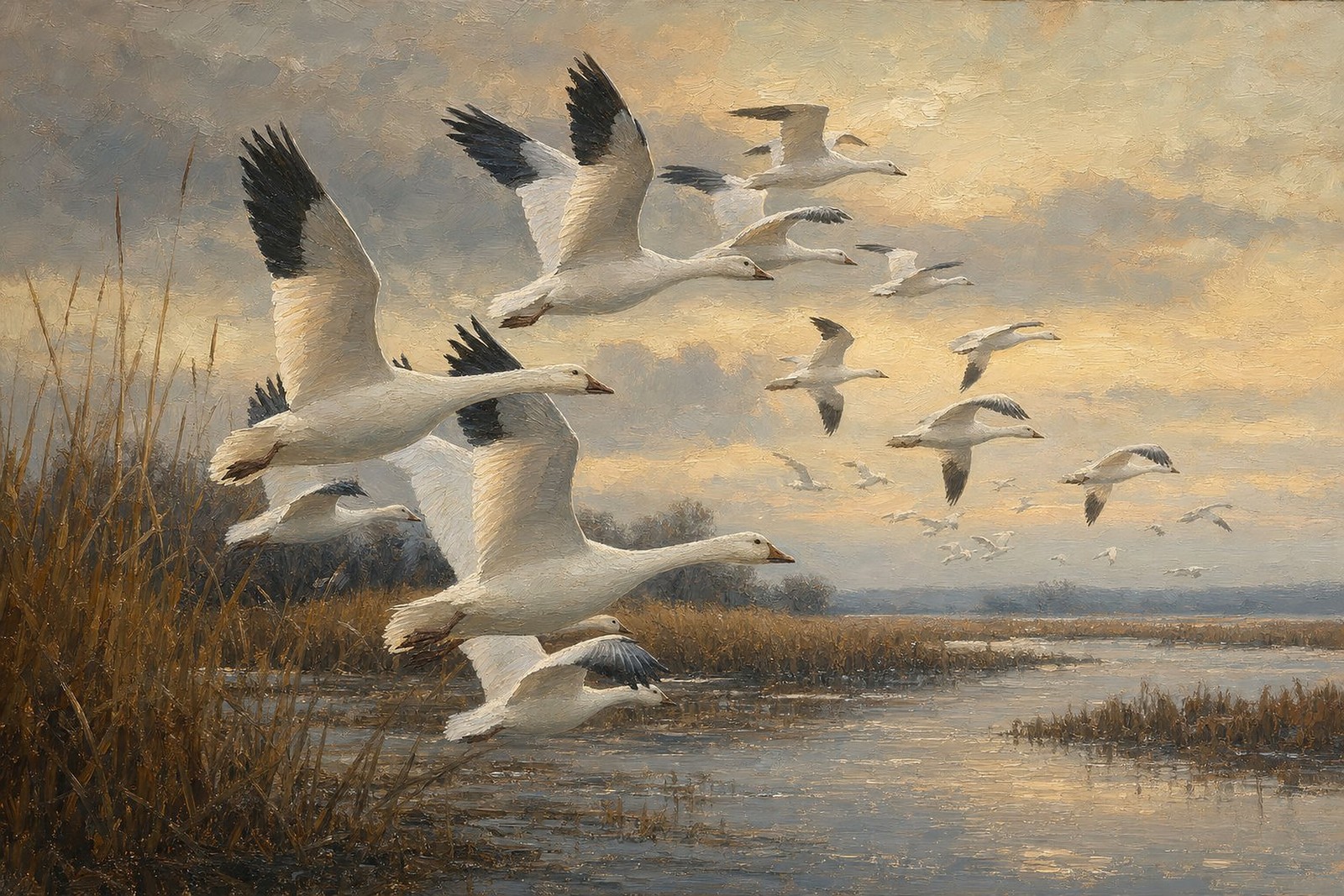
The snow goose is the rare subject where the bird and the palette are the same thing: a white goose with black wingtips, moving in flocks large enough to change the look of the sky. A print of snow geese rising off a wetland is less a picture of birds than a picture of light with birds in it, and that is exactly what makes it useful on a wall.
The bird made of winter light
Snow geese breed on the Arctic tundra and pour south in autumn to winter across American marshes, bays, and grain fields, travelling and roosting in flocks that can number in the tens of thousands. Among North American geese they are the great spectacle species: when a wintering flock lifts off at once, the effect is routinely compared to a blizzard running in reverse. They are heard before they are seen, a high, carrying chorus we cover separately in our post on snow goose calls.
For decorating purposes, three things matter. The plumage is white with black wingtips, which means built-in graphic structure. The setting is winter wetland, which means a palette of silvers, pale golds, and greys. And the classic composition is the mass rising, dozens of birds at different angles, which gives a print energy without a single strong colour anywhere in it.
Does white art disappear on a white wall?
This is the first question people ask, and the answer is no, for a reason decorators have understood for a long time: white-on-white is not an absence of colour but a scheme of its own. A room layered in whites works through tone and texture, warm ivory against cool paper-white, matte against sheen, and a snow goose print is a working demonstration of exactly that. The birds read as warm whites and creams, the sky behind them as cooler silver-grey, and the black wingtips punctuate the whole thing like commas in a long sentence.
Practical guidance. On a warm white wall, the print’s cooler sky tones separate cleanly and the piece reads as luminous. On a pale grey wall, the warm birds come forward instead. The one pairing to avoid is a stark builder’s white with no other texture in the room; give the print a timber console or a wool throw somewhere nearby, and the whites start speaking to each other.
Light direction matters too. North-facing rooms run cool all day, and a pale print with warm bird whites is one of the few pieces of art that softens that coolness instead of amplifying it. South-facing rooms flood warm in the afternoon, and there the print’s silver sky tones keep the scheme from turning yellow. A snow goose scene is, in effect, a colour-correcting device that happens to be beautiful, which is more than can be said for most things hung on walls.
The blue morph: the connoisseur pick
Here is the detail that separates people who know this bird. Snow geese come in two colour forms. The familiar one is white. The other, called the blue morph, wears a dark slate-brown body with a white head and neck, so distinct that into the 1970s it was classified as a separate species entirely, the blue goose. Same bird, two costumes, and wintering flocks carry both at once.
In art, the blue morph is the moody, knowing choice. A composition that includes dark birds scattered through the white mass gains depth and rhythm, and a scene built around the slate-and-white pattern suits rooms that run darker: charcoal walls, deep green studies, panelled dens. If the all-white flock is winter at noon, the blue morph is winter at dusk. Choosing it says you did not just buy a white bird print; you bought the whole story of the species.
Where winter light earns its keep
The bedroom. Low contrast is restful, and a pale flock scene above a headboard settles a room the way strong-coloured art never will. White or oat bedding continues the scheme without effort.
The living room with pale walls. Rooms decorated in creams and light woods often struggle to find art that neither vanishes nor shouts. A snow goose print is the third option: presence through composition rather than colour.
The dining room. Winter whites turn formal after dark. In candlelight or under a dimmed fixture, a gold-framed snow goose print reads like silver on a set table.
The windowless hallway or landing. A large pale print acts as borrowed light in spaces that have none of their own. This is one of the oldest tricks in decorating, and a rising flock does it with more life than an abstract ever could.
Which frame finishes a snow goose print?
Black is the crisp answer, echoing the wingtips and giving the pale composition a defined edge; choose it in modern rooms. Gold warms the whites and suits traditional and formal spaces, especially dining rooms. Brown eases the print into rooms with a lot of timber, where black can feel abrupt. And unframed is the right call if you already own a frame with some history to it, because a white flock scene looks remarkably good inside an old frame.
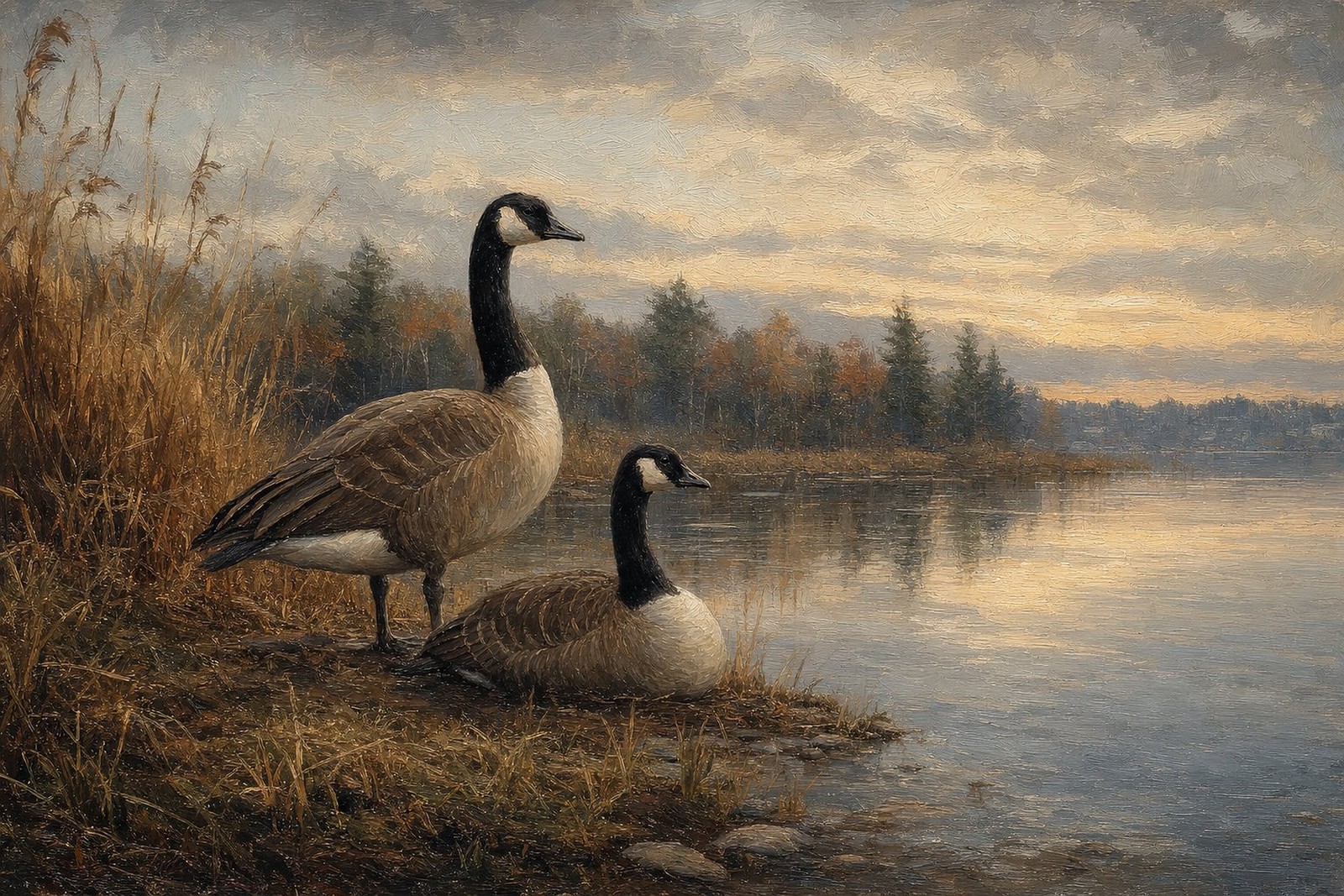
The snow geese hang alongside Canada geese, Ross’s geese, and autumn marsh scenes in our collection of goose migration prints, all in the same style, so a winter scene and an autumn scene can share a wall without argument.
The practical details
Every piece is an original AI-created artwork in the style of antique oil painting, and we state that plainly rather than let anyone assume otherwise. The format is landscape, 3:2, printed edge to edge with no mats, in three sizes: 12x18, 16x24, and 20x30. Unframed prints are $59, $89, and $119. Framed prints in black, brown, or gold are $189, $259, and $329. A digital download is $19. Everything is made to order and dispatched in 2 to 5 business days, shipping is free to the US, Canada, the UK, Europe, Australia and New Zealand, and if an order arrives damaged, defective, or wrong, our 30-day guarantee replaces or refunds it.
Frequently asked questions
Is the blue goose a different species from the snow goose?
No. The blue goose is a dark colour morph of the snow goose, slate-bodied with a white head. It was treated as a separate species until the 1970s, when ornithologists formally folded the two together. Mixed flocks contain both forms, often side by side on the same pond.
Will a white print get lost on a white wall?
Not if the whites differ. The print carries warm bird whites, cool sky silvers, and black wingtips, so against any single wall white it reads as layered rather than invisible. The riskier backdrop for a pale print is actually a busy mid-tone colour, which flattens it.
What size suits the wall above a bed?
20x30 spans well above a queen or king headboard, following the rule that art should cover roughly two-thirds the width of the furniture below it. For a full or twin, or a wall broken up by sconces, 16x24 is the better fit.
Do you ship framed snow goose prints outside the US?
Yes. Shipping is free to the US, Canada, the UK, Europe, Australia and New Zealand, framed or unframed, with dispatch in 2 to 5 business days because every print is made to order.