Pink is the most argued-over colour in decorating. Done well it is the warmest thing in the house; done badly it is a bubble-gum accident that the whole room has to apologise for. Most people settle the argument by avoiding pink altogether, which is safe and a little sad.
Nature settled it differently. On the Gulf and south Atlantic coasts there is a large wading bird that wears pink the way old rooms wear rose damask: layered, warm, and completely unembarrassed. A roseate spoonbill print is the rare way to bring a true pink statement into a room without the room becoming about the pink. Here is why the spoonbill’s pink behaves, and where to use it.
Why is spoonbill pink different from flamingo pink?
Ask anyone to name a pink bird and you will get the flamingo, which is precisely the spoonbill’s advantage. The flamingo has spent seventy years as a plastic lawn ornament, a pool float and a cocktail logo, and it cannot walk into a room without dragging all of that behind it. Flamingo art, whatever its quality, reads as novelty first.
The spoonbill carries no baggage because most people cannot name it. Guests see a tall rose-coloured wader in a soft marsh and read it as art, not as a reference. Half of them will assume it is some grand exotic species; Floridians will recognise a neighbour. Either way, the bird is unfamiliar enough to be looked at rather than merely recognised, which is the difference between an artwork and a logo.
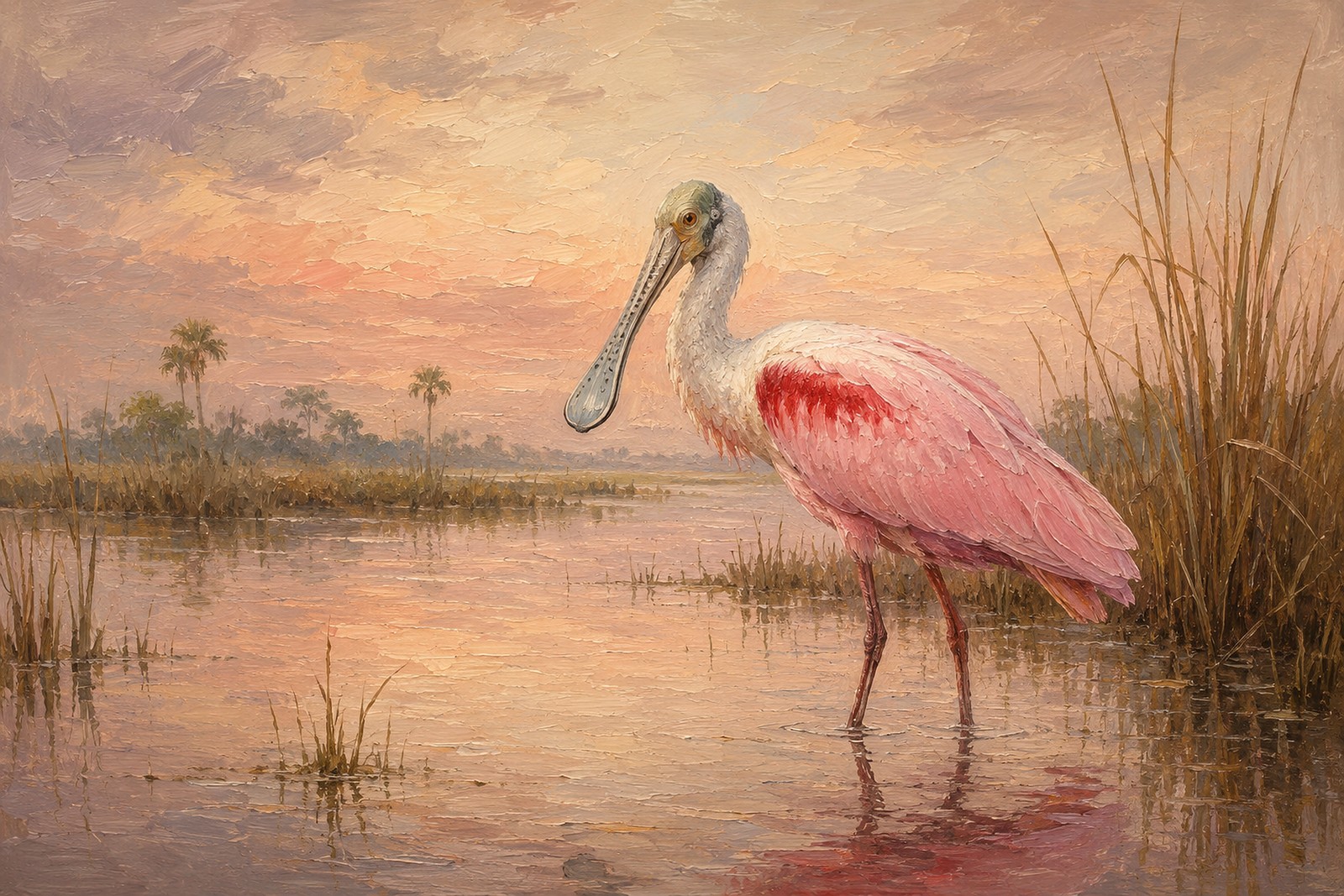
The colour itself is different too. A flamingo is saturated coral more or less throughout. A spoonbill is a gradient: white at the neck warming through shell pink across the body to genuine deep rose at the shoulder of the wing. That range is what painters would call a controlled pink, and it is why the bird can be the boldest thing in a composition without being loud.
There is also a good answer to the inevitable dinner-table question of why the bird is pink at all: the colour is earned. Spoonbills take their rose tones from carotenoid pigments in the small crustaceans they sieve out of the shallows, sweeping that unmistakable spoon-shaped bill side to side as they wade. The pink is the diet made visible, which is a better story than any paint chip has.
The one pink that stays elegant
Our roseate spoonbill print sets the bird in a soft pink marsh, early light, the water and sky holding pale warm greys so the strongest colour in the scene belongs to the bird alone. Rendered in the style of antique oil painting, the pinks behave the way they do in old textiles: muted, layered, closer to rose and blush than to candy. It is an original AI-created artwork, and we say so plainly on the product page; the style is the point, because this exact subject rendered as a glossy photograph tips instantly toward tropical-postcard, and rendered in soft oils it tips toward heirloom.
The composition is a 3:2 landscape printed edge to edge on archival fine-art paper. No white border, which matters with pink more than with any other colour: a hard white margin makes pink look like a swatch, while a full-bleed marsh lets it read as atmosphere.
Grandmillennial meets coastal
The spoonbill sits at the exact intersection of two aesthetics that were always going to find each other. Grandmillennial decorating, the young revival of traditional rooms, runs on rose tones, floral chintz, scalloped edges and things that look inherited. Coastal decorating runs on wading birds and watery light. The spoonbill is both at once: a rose-toned bird that looks like it stepped out of a nineteenth-century folio, standing in the Gulf.
In practice that makes it the easiest statement piece in either style. Over a skirted console, beside rattan and toile, above a bed with a quilted coverlet, the spoonbill’s pink agrees with everything the grandmillennial room already owns, while quietly anchoring the coastal story. If that traditional-revival direction is your room’s centre of gravity, our grandmillennial bird prints guide covers the wider look; the spoonbill is its most confident coastal recruit.
Frame choice seals it. Gold is the natural pick here, warm against rose, and finishes the piece like the folio plates it stylistically descends from. Brown quietens it for wood-heavy rooms; black modernises it for crisp interiors where the pink should be the only soft thing.
Where does a pink statement piece belong?
Bedrooms. The obvious and best answer. Rose tones in low light are flattering to everything, and a 16x24 or 20x30 above the headboard gives the room a focal point that is warm without being sweet.
Living rooms in need of one bold move. A neutral room, cream and oak and linen, takes exactly one statement. The spoonbill supplies colour, subject and conversation in a single frame, which is more efficient than repainting.
Powder rooms and dressing rooms. Small rooms tolerate strong statements, and a framed spoonbill turns a windowless powder room into a set piece.
Nurseries with a long view. Unlike cartoon animals, a spoonbill print survives the transition from nursery to grown room; it was never childish to begin with.
The bird’s own address is worth knowing too. Spoonbills feed and nest along the mangrove edges of Florida and the Gulf, and the mangrove swamp habitat page introduces the tangled, extraordinary world the pink actually comes from. Like the egrets, spoonbills were nearly lost to the plume trade a century ago, and their slow return to Florida Bay is one of the region’s quiet conservation successes. A statement piece with a recovery story beats one with a hashtag.
Sizes, prices and the practical part
The spoonbill print comes in three 3:2 landscape sizes: 12x18 at $59, 16x24 at $89 and 20x30 at $119 unframed. Framed in black, brown or gold, $189, $259 and $329. A digital download is $19. Sizing follows the usual furniture logic: 20x30 over sofas and beds, 16x24 over consoles and dressers, 12x18 for halls and small walls.
Every print is made to order and dispatched in 2 to 5 business days, with free shipping to the US, Canada, the UK, Europe, Australia and New Zealand, and a 30-day replacement or refund for anything that arrives damaged, defective or wrong. If pink is not the statement your room wants, the rest of our coastal wading birds cover the whites, blues and golds of the same marshes.
Frequently asked questions
Is a pink bird print too bold for a neutral room?
The opposite: a neutral room is where it works best. Cream, oatmeal and oak give the rose tones nothing to argue with, so the print reads as the room’s one deliberate statement. Pink fails in rooms already full of competing colour, not in quiet ones.
Which frame colour suits the spoonbill print?
Gold first, for warmth and the traditional folio feel that suits the subject. Brown if the room is heavy on wood and you want the print quieter. Black if the interior is modern and the pink should stand as the only soft element. All three framed options are $189, $259 or $329 by size.
Why are roseate spoonbills pink?
Diet. The crustaceans and other small invertebrates they filter from shallow water carry carotenoid pigments, and those pigments end up in the feathers, white at the neck deepening to rich rose on the wings. The colour is strongest in mature, well-fed birds.
Is the spoonbill print based on an old painting?
No. It is an original AI-created artwork in the style of antique oil painting, printed edge to edge on archival fine-art paper. We describe it exactly that way on the product page; the traditional rendering is a style choice, stated plainly, not a claim of age.