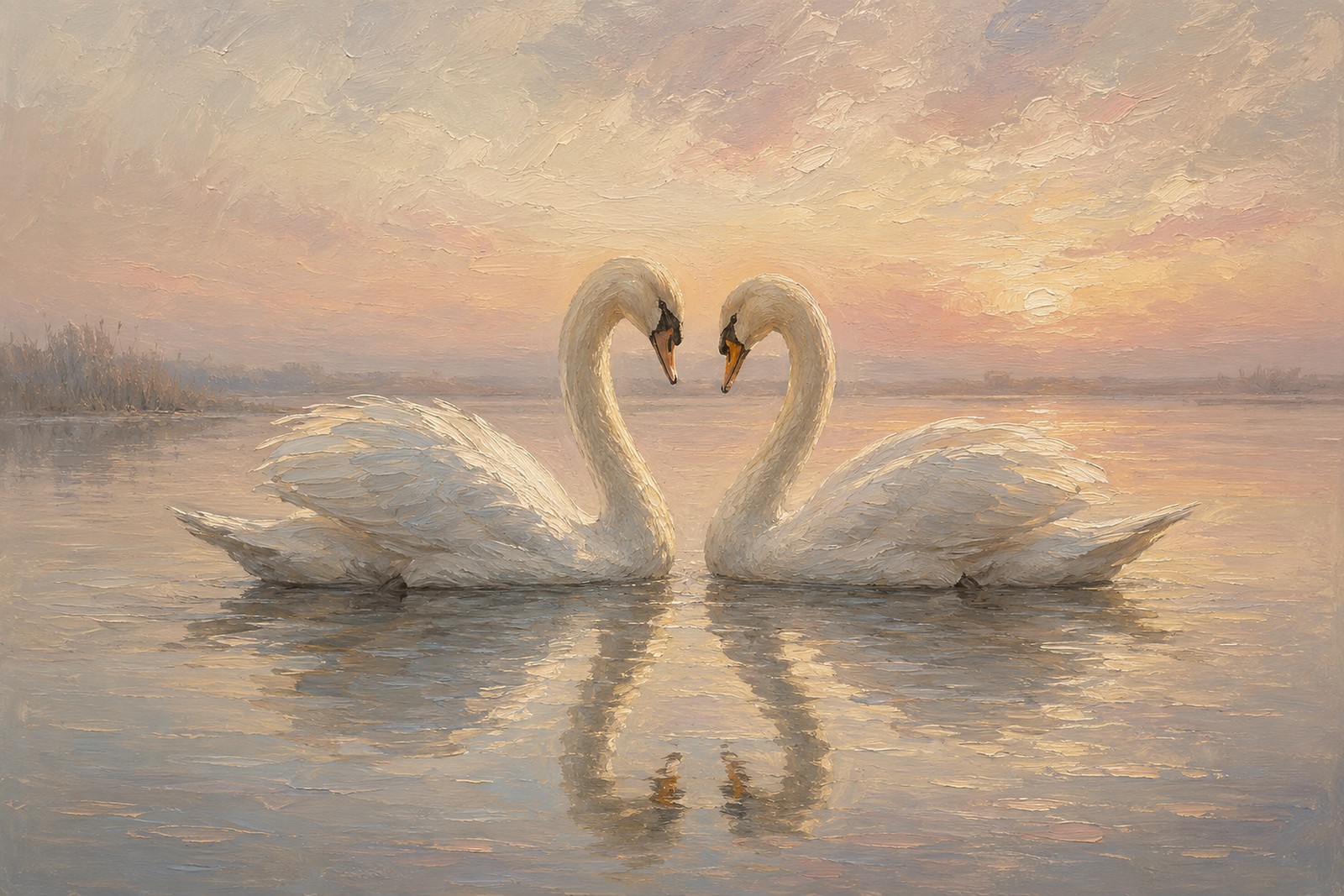
Nursery art splits into two schools. The first buys for the baby: primary colours, cartoon animals with oversized eyes, alphabet posters. The second buys for the child that baby will become, and for the room the family will still be living with in ten years. The first school gets replaced around the time the child starts school. The second school gets kept, moved, reframed and eventually argued over. A gentle swan print belongs firmly to the second school, and this guide is about doing that properly: the palette, the placement, and why the traditional route holds up so much better than the cartoon one.
Why swans belong in a nursery
No bird has deeper roots in childhood than the swan. Andersen’s ugly duckling grows up to be one. Swan Lake has been the first ballet of generations of children. E.B. White, who gave children Charlotte and Stuart Little, gave them a trumpeter swan named Louis too. A swan on a nursery wall is not a random pretty bird; it connects to stories the child is going to meet anyway, and it will still make sense when they do.
The bird itself is doing quieter work as well. A swan is white, slow and smooth-edged, gliding rather than flapping, and a nursery benefits from every one of those qualities. Wading birds mid-strike or ducks mid-splash bring energy to a wall. A swan pair on a calm garden lake brings the opposite, and the opposite is what a room built around sleep actually wants.
There is one more point in the swan’s favour, and it is the honest version of a famous claim. Swans usually pair for the long term. Most pairs hold together season after season, though a small number do separate and a widowed bird will generally pair again. A print of two swans in a nursery quietly stands for the pair who made the room, which is a nicer piece of symbolism than any alphabet poster manages.
What makes a palette calm enough for a nursery?
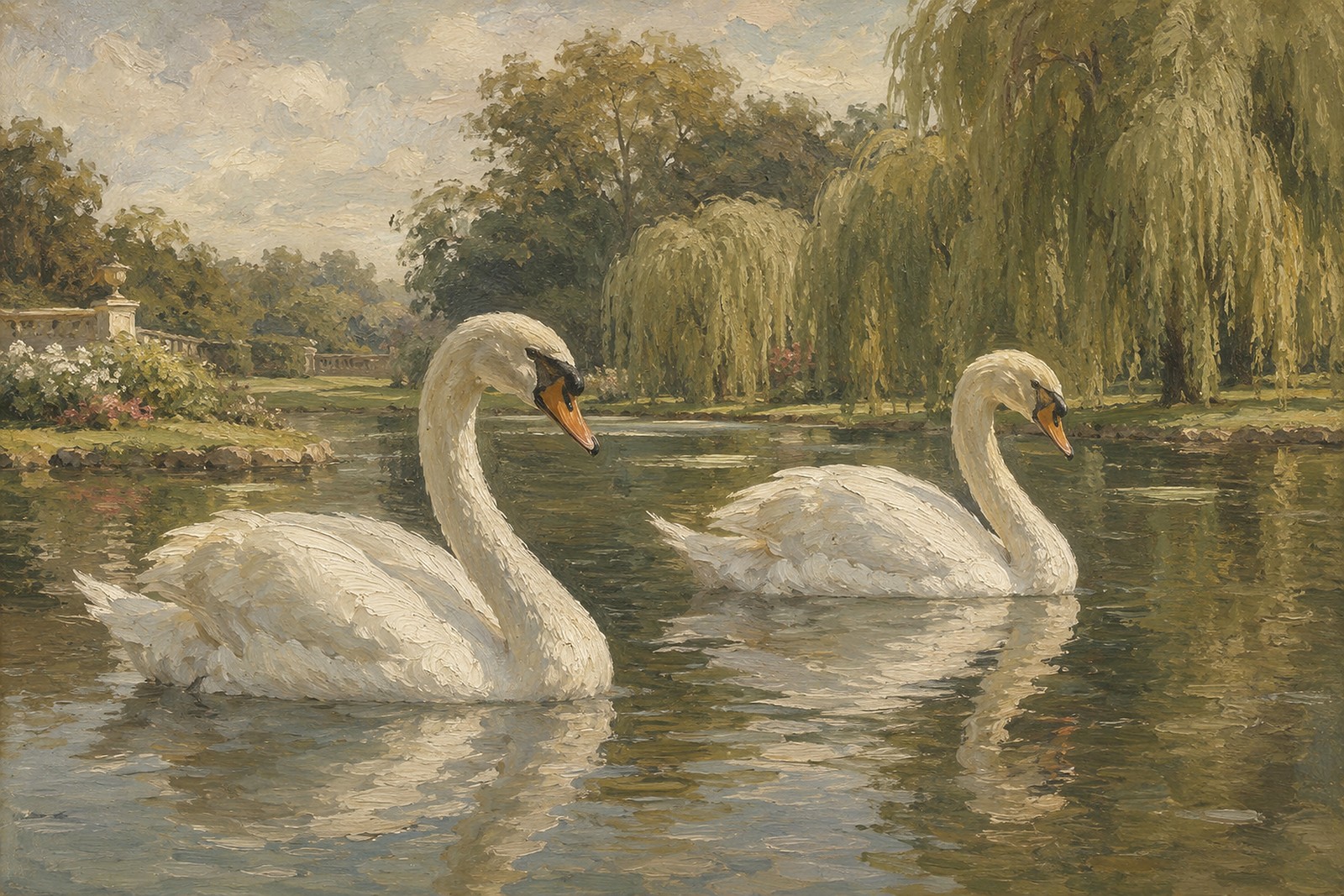
Calm, in decorating terms, is mostly three measurable things: low contrast, muted saturation and few colours. The mute swan pair print runs on exactly that formula. Soft whites in the plumage, still green-grey water, gentle banks behind, nothing saturated, nothing sharp-edged. It is the visual register of early morning, and it holds a nursery’s colour story together instead of competing with it.
Build outward from those tones and the room assembles itself: warm white or cream walls, sage or soft blue textiles, natural wood furniture, brass or ceramic lamp bases. Because the print behaves like a soft neutral, it survives the redecorations to come. The sage nursery that becomes a blue big-kid room, then a teenager’s grey one, keeps the same swans through all three.
The format helps too. The print is a 3:2 landscape, printed edge to edge with no border, so the water spreads the full width of the sheet and the image reads as a window onto a quiet lake rather than a busy framed object. Landscape orientation also fits the furniture nurseries actually contain, which is long and low: dressers, changing tables, toddler beds in waiting.
Heirloom over cartoon: art that grows with the child
The strongest argument for the traditional route is arithmetic. Character decals and cartoon canvases have a working life of four or five years before the child themselves rejects them. An oil-painting-style print has no expiry, because it was never pegged to an age. It reads as gentle over a cot, as classic over a child’s bookcase, and as simply good art in the hallway of the house they come home from college to.
Honesty about what the piece is matters here, and we are precise about it: our swan prints are original AI-created artworks in the style of antique oil painting. Not photographs, not historical pieces, and we never describe them otherwise. What the style gives a nursery is the visual language of traditional art, the soft layered look that has hung in family homes for two centuries, in a print made this year for this room. The grandmillennial revival has pulled exactly this look back into young families’ homes, and our grandmillennial decor guide covers that wider return to traditional walls if you are furnishing more than the nursery.
Where to hang art in a nursery
Above the dresser or changing table. The best wall in the room for a statement piece. The 16x24 suits a standard dresser; the 20x30 suits a long one. You will spend a great deal of time standing at this spot, and it is worth having something better than a blank wall to look at.
The wall the rocking chair faces. Hang a print here slightly lower than standard gallery height, because the person looking at it is seated, usually at 3am. This is where a calm image earns its keep most directly.
Not directly over the cot. This is the one hard rule, and it is about physics rather than style. Keep framed art off the wall space immediately above where the baby sleeps, and hang everything in the room on proper fixings rated for the frame’s weight, into a stud or a rated anchor. A framed 20x30 is a substantial object, and nursery walls should be the best-secured walls in the house.
A pair of smaller prints. Two 12x18s hung side by side give a longer wall rhythm without one large piece, and the swans-and-cranes theme holds them together naturally.
Choosing the frame, or not framing yet
Framed prints come in black, brown or gold. For a traditional nursery, brown wood is the quiet default alongside natural-wood cots and dressers, and gold suits rooms leaning properly grandmillennial with wallpaper and skirted furniture. Black reads crisper and suits a nursery that will grow into a more tailored child’s room.
The unframed print, at $59, $89 or $119 depending on size, is the right choice for parents who want the frame to match existing furniture exactly, and the $19 digital download suits a family mid-move or gifting long-distance. Everything is made to order and dispatched in 2 to 5 business days, with free shipping to the US, Canada, the UK, Europe, Australia and New Zealand; framed pieces run $189 to $329. If anything arrives damaged, defective or wrong, the 30-day replacement policy covers it.
The swan pair sits alongside its companion pieces in our swans and cranes collection, and if you are weighing this composition against the single-bird portraits, our swan prints guide covers those alternatives room by room.
Frequently asked questions
Is a framed print safe in a nursery?
Yes, with two conditions. Do not hang it directly above the cot, and fix it to the wall properly: a stud fixing or a wall anchor rated well above the frame’s weight, checked once it is up. Those are the same rules that apply to shelves and mirrors in a child’s room.
Will a swan print still work when my child is older?
That is the core of the case for it. Because the image is a classic oil-painting-style scene rather than an age-pegged cartoon, it moves from nursery to child’s room to hallway without ever looking like a leftover. It is the difference between decorating for a stage and buying something the family keeps.
Which size suits a nursery best?
The 16x24 is the most flexible: substantial above a dresser without dominating a small room. Choose the 20x30 for a long wall or a larger room, and a pair of 12x18s where you want rhythm along a wall rather than a single anchor.
Do the prints come with a white border for framing?
No, the image is printed edge to edge across the full 3:2 sheet. If you prefer a border or a mat as part of the final look, a local framer can add matting when you frame an unframed print, which is one reason some parents choose the unframed option.