No bird in North America has had a better second act. By the early twentieth century the wild turkey had been hunted and logged out of most of its range, gone entirely from many states where it had once been the commonest large bird in the woods. Today it walks through suburban yards in forty-nine states. That recovery, funded largely by hunters and carried out one trapped-and-relocated flock at a time, is one of the great conservation stories on the continent, and it is the reason a wild turkey print carries more meaning on a camp wall than almost any other species you could hang there.
This is a guide to the turkey as wall art: why the comeback matters to the picture, why the bird reads so well in the style of antique oil painting, and where it earns its place at camp, at home, and in the office.
The comeback bird
The turkey’s crash was ordinary for its era: unregulated market hunting on one side, the clearing of the eastern forests on the other. What was not ordinary was the return. Early attempts to release farm-raised birds failed almost everywhere, and the recovery only took hold when wildlife agencies switched to trapping wild birds and moving them, flock by flock, into empty habitat. License fees and excise taxes on sporting equipment paid for most of it. Over a few decades the turkey went from a remnant population to an estimated several million birds, occupying more range than it held before European settlement.
Hunters know this story the way other people know sports history, which changes what the print means. A mallard print on a camp wall is decor. A turkey print is a flag: proof that the system of seasons, licenses, and habitat money the camp participates in actually works. It is the rare piece of wall art that makes an argument.
Why does a turkey read noble in oils?
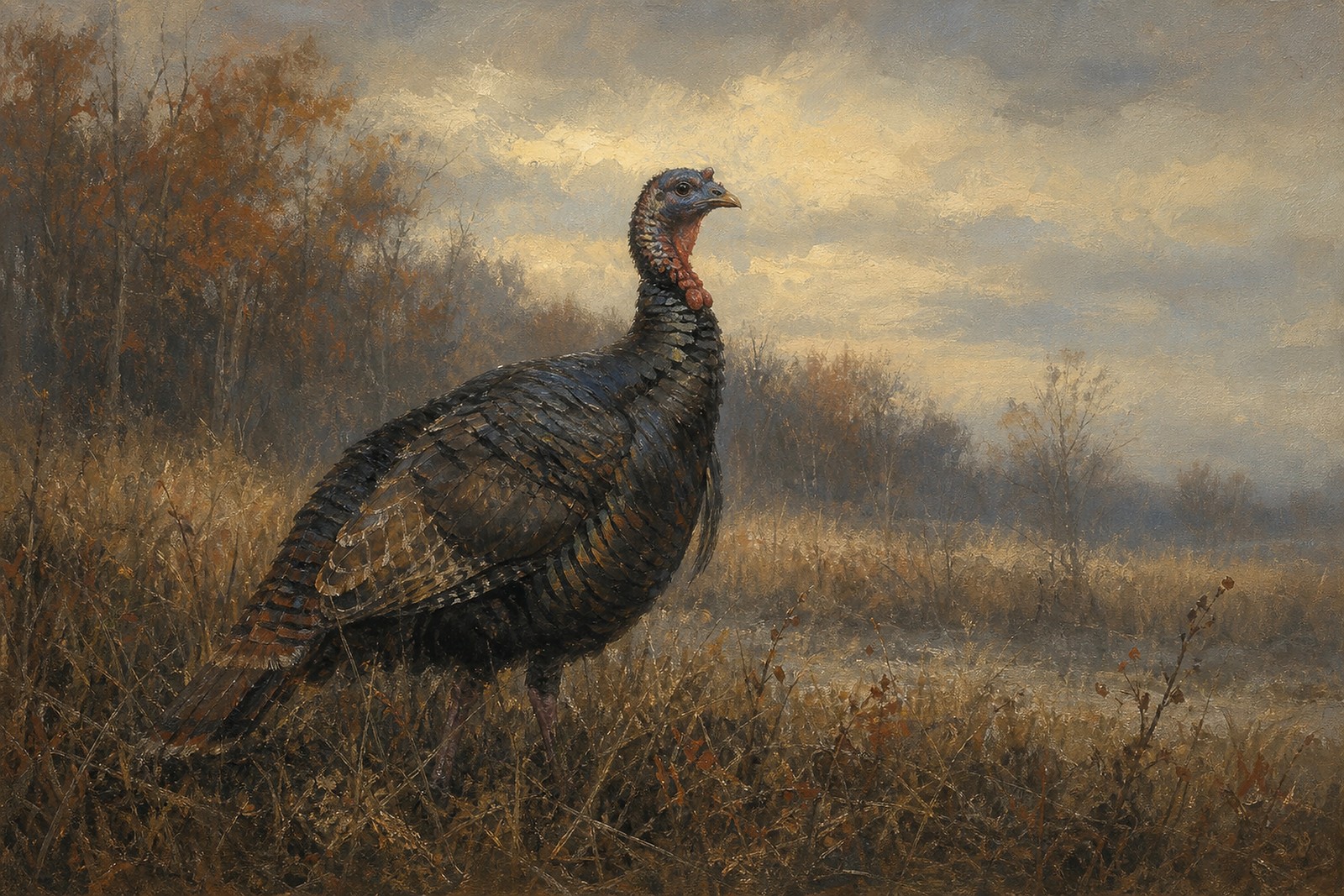
Photographed badly, a turkey is a farmyard joke. Rendered in the style of classic American sporting art, it is something else entirely, and the difference is the plumage. A gobbler’s body feathers are iridescent bronze, copper, green, and near-black, colours that shift with every step the bird takes. Flat photography tends to kill that shimmer. The layered, warm-ground approach of traditional oil technique is built for exactly this problem, the same way it flatters brass, leather, and old wood, which is why turkeys in this style read as burnished rather than comic.
Composition does the rest. Our Wild Turkey in Misty Autumn Field places the bird low in a 3:2 landscape frame, mist holding in the treeline behind, printed edge to edge. The format gives the bird what it has in life: ground, distance, and a certain wariness. Benjamin Franklin, in the letter every turkey hunter eventually quotes, called it “a bird of courage,” and the oil treatment is the only style of art that consistently agrees with him.
The camp wall
Hunting camps decorate themselves over time, licence plates, old photographs, the occasional fan and beard from a memorable spring. A turkey print gives that accumulation a centrepiece without gentrifying the room.
At camp, go bigger than instinct suggests. Camp walls are busy, and a 12x18 print disappears into the clutter; a 16x24 at $89 unframed, or $259 framed, is the minimum that holds the wall, and a 20x30 over the main table or the stone fireplace anchors the whole room for $119 unframed. The brown frame is the camp default, sitting quietly against pine and plywood alike. And because every print is a 3:2 landscape in the same style, the turkey hangs naturally beside the waterfowl pieces most camps already lean toward. A turkey and a Mallards Coming Into Timber print side by side covers both seasons the camp actually hunts. Our hunting lodge wall art guide covers the wider wall, dark-wood pairings and all.
The office and the den
Outside camp, the turkey print does a quieter job. In a home office it reads as American landscape art with a story attached, less expected than a duck, less solemn than an eagle. It suits the person whose working life and hunting life share a wall: the print is entirely presentable on a video call background, and it still means what it means.
For dens, the autumn palette is the selling point. Mist, oat-gold field grass, the dark mass of the bird against a soft treeline, these are low-light colours that warm up under lamps in the evening, the hours the room actually gets used. Black frames sharpen the piece for a modern den; gold pushes it toward the traditional study look.
A gift with a story built in
The turkey print has one more natural role: the gift for the hunter who is impossible to buy for. Gear is personal and usually already owned. A print of the comeback bird is neither, and it comes with its own explanation attached, the story above is the gift card. If you are shopping for a waterfowler rather than a turkey hunter, our duck hunter gift guide runs the same logic across a dozen other ideas.
Practical details, since gifts have logistics: every print is made to order and dispatched in 2 to 5 business days, shipping is free to the US, Canada, the UK, Europe, Australia, and New Zealand, and a $19 digital download is available if distance or timing argue for printing locally. If a print arrives damaged, defective, or wrong, there is a 30-day replacement or refund.
Where the turkey fits in the bigger collection
The turkey heads the upland side of the Lake House & Lodge series, alongside the ruffed grouse, the pheasant, the bobwhite coveys, and the old working decoy. Every piece in the range is an original AI-created artwork in the style of antique oil painting, the same tradition the Federal Duck Stamp programme built its century of conservation art on, and we describe the provenance plainly because buyers should know exactly what they are hanging: new artworks, classic style, honest label.
Frequently asked questions
What size wild turkey print suits a hunting camp wall?
A 16x24 is the working minimum, because camp walls are cluttered and small art vanishes into them. Over a fireplace or the main table, a 20x30 is the anchor size. Framed in brown, either sits naturally against pine, log, or plank walls.
Why are wild turkey prints in an oil style rather than photographic?
Because a turkey’s iridescent bronze plumage is exactly what traditional oil technique renders best and what flat photography tends to flatten. The style also matches the bird’s history: the sporting-art tradition and the conservation funding system that restored the turkey grew up together.
Is a turkey print only for turkey hunters?
No. The comeback story makes it a strong piece for anyone who cares about conservation, and in an office or den it reads as American wildlife art first. But for a turkey hunter specifically it is close to the perfect species: personal, story-rich, and almost never already owned.
Are these prints of antique paintings?
No, and we label them carefully. They are original AI-created artworks in the style of antique oil painting, printed to order, edge to edge, in 3:2 landscape format. The look is traditional; the artwork itself is new, and priced like a print rather than an heirloom: $59 to $119 unframed, $189 to $329 framed.